Analysis of Classification and Application Characteristics of Different Rock Drill Bits
In routine operations and industrial production, drill bits are indispensable tools for hole-making. However, because there are many types of bits with clearly different working principles and application ranges, users often find it difficult to distinguish and apply them accurately. This article provides a systematic overview from three perspectives—classification criteria, typical applications, and structural composition—to support efficient bit selection and use.
Two Core Classification Systems for Drill Bits
Drill bits are mainly classified by cutting principle and practical function. These two systems complement each other and clearly define the core characteristics of each bit type.
Classification by cutting principle
Cutting bits:
These remove material through rotational cutting by sharp cutting edges with optimized angles. They are suitable for softer, easier-to-cut materials or formations.Impact–crushing–shearing bits:
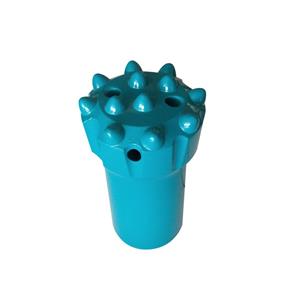
These combine impact, crushing, and shearing. During rotation, high-frequency impact creates cracks in the target material, and shearing force then completes fragmentation. They are well suited to medium-hard and heterogeneous formations.Grinding bits:
These have no prominent cutting edge. Instead, they rely on high-hardness abrasive materials (such as diamond) embedded on the bit surface, which break material through high-speed friction. They are designed for ultra-hard, highly abrasive formations or materials.
Classification by function
Full-face drilling bits:
Used for full-section drilling, these break and remove all material at the hole bottom. They are the most common basic type in industrial work and geological exploration.Annular drilling bits:
These machine only the annular area of the hole while preserving the central core column, providing core samples for subsequent analysis.Special-purpose bits:
Designed for specific operating conditions—such as curved-surface drilling or deep-hole operations—with dedicated structures and functions to meet customized drilling requirements.
Application Scenarios and Characteristics of Common Drill Bit Types
Because of differences in structure and operating principle, different bits show clear differences in performance and applicable conditions.
Drag bits
Best suited for soft, plastic formations such as mudstone and shale. They have a simple structure with no moving parts. However, they generally require higher torque, place greater strength demands on the drill string, and may increase long-term tool wear.Roller cone bits
Widely used across formations from soft to hard, including sandstone and granite. Their rotating cones reduce required torque during rock breaking, improve drilling efficiency, and effectively reduce drill string load.Diamond bits
Designed for hard, highly abrasive formations such as quartzite and basalt. Diamond particles are embedded on the bit surface, providing very high hardness, no moving parts, high drilling precision, and strong durability.PDC bits
Polycrystalline Diamond Compact bits are suitable for soft to medium-hard homogeneous formations, such as interbedded sandstone and mudstone. With no moving parts and PDC cutters as cutting elements, they require lower weight on bit and generally outperform traditional cutting bits in both penetration efficiency and service life.Core bits
A key type of annular drilling bit. Their primary purpose is to retrieve rock cores from boreholes. These cores are used for geological structure analysis, lithology identification, and other scientific or engineering evaluations.Basic Structural Composition of Drill Bits
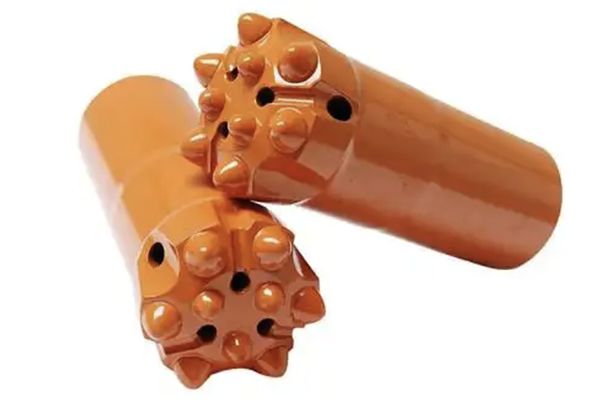
Most conventional drill bits share a broadly similar core structure, mainly consisting of two parts:
Cutting section
Located at the front of the bit, this is the key rock- or material-breaking component. Its material, geometry, and layout directly determine drilling efficiency and application range. For example, the cutting section of a roller cone bit is the rotating cone assembly, while that of a diamond bit is a diamond-impregnated layer.Bit body
Typically axial in shape and connected at the base side of the cutting section, the body transmits torque and weight on bit, providing stable support for the cutting section. A standardized shank or connection end is configured at the base to connect with drill rods and drilling equipment, ensuring reliable power transmission during operation.