Why Button Bits Break: Causes and Prevention of Carbide Button Failure
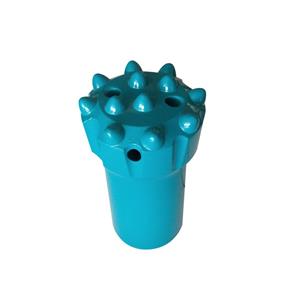
Carbide button bits are widely used in top-hammer and down-the-hole drilling because they combine high penetration capability with strong wear resistance. Yet even a well-designed button bit can fail prematurely when the carbide buttons chip, crack, break, loosen or wear out of shape.
Understanding the failure pattern is the first step toward improving bit life. Button failures are rarely caused by one factor alone. They usually result from the interaction of rock conditions, carbide grade, button geometry, bit-body support, manufacturing quality and drilling practice.
The Four Main Button Bit Failure Modes
Most button-bit failures fall into four categories:
Wear
Carbide buttons gradually flatten, lose gauge or become uneven through normal drilling. Excessively rapid wear may indicate an unsuitable carbide grade, highly abrasive rock, inadequate flushing or an incorrect bit selection.Button breakage
Carbide buttons may chip, crack or fracture under repeated impact and bending loads. Edge buttons are particularly vulnerable because they often experience more complex loading than face buttons.Button loss
A button can loosen or fall out when the button-retention process, hole geometry, interference fit or bit-body support is inadequate. Overheating, corrosion and severe impact can also contribute.Bit-body damage
The steel body may crack, deform or wear excessively. This can reduce button support and eventually cause carbide failure even when the carbide itself is of good quality.
Each failure mode requires a different corrective action. Replacing the carbide grade may help with early wear but will not solve a retention problem. Improving the interference fit may prevent button loss but will not correct excessive bending caused by poor drilling alignment.
Why Edge Buttons Break More Often
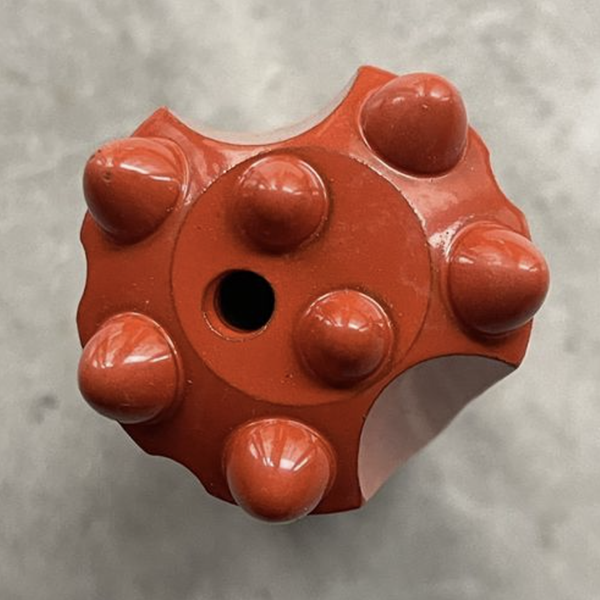
Gauge buttons and other edge buttons are frequently the first to break. They help maintain hole diameter and contact the rock at an angle, so they may experience a combination of compression, bending and side loading.
Face buttons are usually loaded more directly along the drilling axis. Edge buttons, however, are more likely to encounter uneven rock surfaces, fractured ground, hole-wall contact and off-axis loading. If the bit is worn out of gauge or the hole is poorly aligned, the load on these buttons can increase significantly.
A fractured edge button often reveals useful evidence. Smooth or radiating features may indicate a tensile fracture origin, while transverse cracking can reflect compressive loading and bending. Careful examination can help determine whether the button broke because of material defects, poor support, excessive interference, operational loading or a gap around the button seat.
The Importance of Button Support
Carbide is extremely hard but relatively brittle compared with steel. It performs best when it is uniformly supported by the bit body. If the button seat does not hold the carbide securely around its circumference, local bending stress can increase dramatically.
Gaps near the button seat are especially harmful. They allow the button to move or bend under impact instead of transferring load evenly into the steel body. This can create a crack at the embedded portion of the button and eventually cause fracture.
High-quality bit manufacturing therefore requires accurate button-hole geometry, correct interference fit, controlled insertion methods and sufficient steel support around each button. The goal is to keep the carbide firmly seated without introducing excessive installation stress.
Material Quality and Carbide Selection
Carbide grade should match the rock formation and drilling method. Harder grades typically offer strong wear resistance, while tougher grades are better able to survive impact and shock. A carbide grade that performs well in abrasive, competent rock may not be the best choice in highly fractured or variable ground.
Early button breakage can be associated with poor carbide quality, incorrect grade selection, internal defects or unsuitable microstructure. However, not every broken button is a carbide-material problem. The complete drilling system must be reviewed before drawing conclusions.
Relevant factors include:
Rock hardness and abrasiveness.
Degree of fracturing and geological variation.
Drill impact power and rotation speed.
Feed pressure and drill alignment.
Bit face design and button layout.
Button grade, size and exposure.
Retention-hole accuracy and bit-body quality.
Flushing efficiency.
Preventing Premature Button Breakage
The most effective approach is preventive control from manufacturing through field operation.
Manufacturers should maintain consistent carbide quality, control button dimensions and inspect button-hole geometry. The bit body must provide sufficient support, especially around gauge buttons. Retention processes should be validated through dimensional checks and production testing.
Drilling crews should select bits for the actual rock conditions rather than relying only on diameter and thread type. Proper feed force, rotation and flushing reduce harmful stress in the bit. Operators should avoid excessive force when the bit encounters fractured ground, uneven formations or changing rock conditions.
Routine inspection is also essential. A bit should be removed for maintenance when buttons become heavily flattened, show cracks, lose gauge or develop visible damage. Continuing to drill with a damaged button can transfer load to neighboring buttons and cause a chain of failures.
Use Failure Patterns to Improve the System
Every failed button bit contains information. Where did the first break occur? Was it an edge button or a face button? Did the carbide chip, split, pull out or wear away? Was the bit operating in abrasive rock, fractured rock or a mixed formation?
Answering these questions helps identify the correct improvement. A persistent edge-button fracture may point to insufficient steel support, improper bit design, an unsuitable button grade or off-axis drilling. Repeated button loss may indicate a retention-process issue. Rapid flat wear may require earlier grinding or a different carbide grade.
A reliable button bit is the product of balanced design, quality manufacturing and correct operation. By treating carbide, bit body, drilling parameters and rock conditions as one system, drilling teams can reduce button breakage, extend bit life and lower total drilling cost.