Button Bit Manufacturing Processes and Connection Types
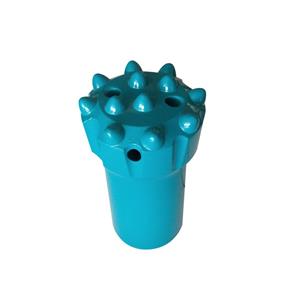
As a core rock drilling component, the button bit plays a direct role in drilling efficiency, durability, and service life. Its manufacturing process largely determines product quality and wear resistance, while its connection type affects equipment compatibility and operational stability. When selecting button bits, buyers and operators often pay close attention to these two factors. Below is a practical guide to the two mainstream manufacturing methods and the most common connection types used in the industry.
Two Main Manufacturing Processes for Button Bits
At present, the two most common manufacturing processes for button bits are brazing and cold pressing. The main differences lie in the production method and the final product performance. In general, cold-pressed button bits offer a higher quality level than brazed button bits.
1. Brazed Button Bits
The brazing process is the traditional manufacturing method. In this process, the tungsten carbide buttons are joined to the bit body through brazing technology.
This method offers several practical advantages:
relatively simple production steps,
lower requirements for hole accuracy and button size,
easier manufacturing for standard applications.
Because of these features, brazed button bits are commonly used in basic rock drilling applications such as:
secondary rock breaking in mines,
small tunnel or drift excavation,
general low- to medium-duty drilling work.
However, brazing also has some limitations. The heating process may generate thermal stress, which can cause slight deformation of the bit body. If the process is not well controlled, issues such as incomplete brazing or weld defects may occur. Under long-term high-impact working conditions, the buttons are more likely to loosen or fall out, which shortens the service life of the bit.
2. Cold-Pressed Button Bits
The cold-press process is the mainstream choice for high-quality button bits.
This method requires precise calculation of the interference fit between the button and the button hole. External force is then used to press the carbide button into the hole, and the elastic-plastic deformation of the surrounding steel creates a very strong mechanical bond.
The cold-press process is much stricter than brazing. Each step requires high precision, often at the micron level. Because no high-temperature heating is involved, the original properties of both the bit body and the carbide buttons can be preserved to the greatest extent, avoiding thermal deformation and material damage.
Compared with brazed bits, cold-pressed button bits offer:
higher connection strength,
better structural stability,
lower risk of button loss or breakage,
much longer service life.
For this reason, cold-pressed button bits are generally the preferred choice for high-end and heavy-duty rock drilling operations.
Common Connection Types of Button Bits
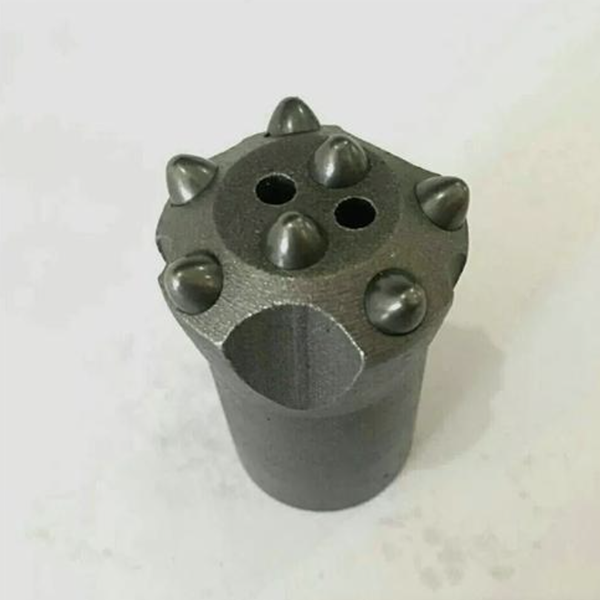
The main connection types for button bits are:
tapered connection
R-thread connection
T-thread connection
The purpose of each connection type is to ensure accurate matching with the drill rod and rock drill, while efficiently transmitting impact energy and rotational torque.
1. Tapered Connection
The tapered connection features a simple structure and easy installation and removal. It relies on the friction force between tapered surfaces to secure the bit in place.
Its main advantages are:
simple design,
fast bit replacement,
convenient handling in the field.
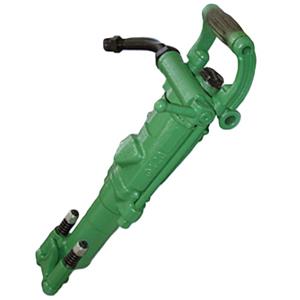
Tapered button bits are commonly used with pneumatic rock drills and are suitable for light to medium-duty drilling operations. However, because the connection strength is limited, tapered connections are generally not recommended for heavy-duty applications.
2. R-Thread Connection
The R-thread connection is one of the most widely used connection types in the industry.
Its advantages include:
strong versatility,
compatibility with various rock drilling machines,
moderate connection strength,
convenient regrinding and bit replacement.
Because of its balanced performance, R-thread button bits are widely used in:
underground mining,
open-pit quarries,
medium- to high-intensity rock drilling operations.
3. T-Thread Connection
The T-thread connection is designed for high-strength drilling applications. Its thread structure is specially engineered to provide stronger resistance to:
impact,
deformation,
heavy-duty working loads.
T-thread button bits are typically used with heavy rock drilling equipment and are suitable for demanding conditions such as:
large open-pit mines,
tunnel construction,
other severe rock drilling environments.
The main drawbacks are that T-thread connections require higher machining accuracy and involve higher production cost, but they deliver superior performance in harsh applications.
How to Choose the Right Button Bit
The manufacturing process and connection type of a button bit directly determine its service performance and suitable application range.
As a general guideline:
For basic, low- to medium-intensity drilling, brazed button bits with tapered or R-thread connections are usually a practical choice.
For heavy-duty and demanding drilling operations, cold-pressed button bits with T-thread or R-thread connections are generally the better option.
Understanding these differences can help users choose the right bit according to their equipment type and working conditions. Proper selection improves drilling efficiency, reduces operating cost, and helps avoid unnecessary tool damage or project delays caused by mismatched products.
Conclusion
Button bit performance depends not only on the carbide buttons themselves, but also on the manufacturing process and connection design behind the product. Whether choosing a brazed or cold-pressed bit, or selecting between tapered, R-thread, and T-thread connections, the key is to match the bit to the actual drilling task.
A well-chosen button bit can improve rock drilling efficiency, extend service life, and ensure more stable operation across different mining and construction environments.