Button Bits Are Tough. That's Exactly Why People Destroy Them.
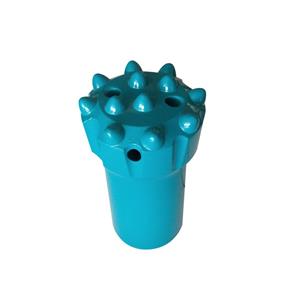
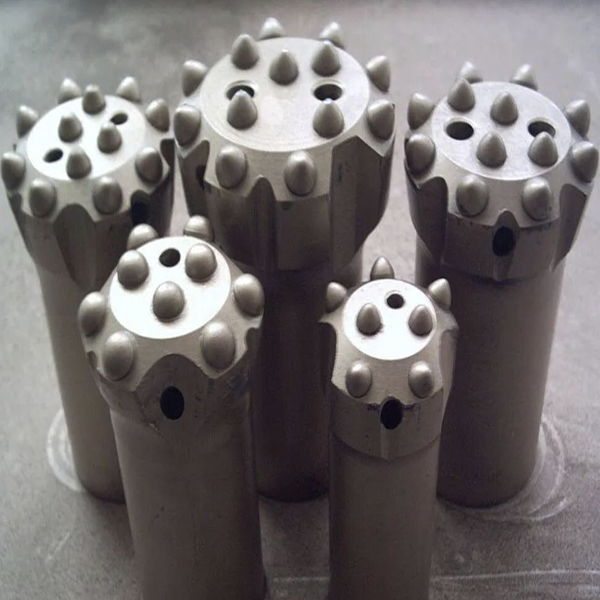
A button bit is the most abuse-tolerant drill bit design ever made. Multiple carbide inserts distributed across a steel face. No single cutting edge to chip. No braze joints vulnerable to overheating the way a chisel bit's single blade is. The design inherently spreads impact load and resists catastrophic failure.
And that toughness is the problem. Because operators who'd never dream of running a chisel bit dull or dry will push a button bit well past its limits, assuming it can take it. It can't — not forever. When a button bit fails, it fails harder and more expensively than a chisel bit, because the damage cascades through multiple inserts and into the bit body.
Here's what "tough but not invincible" actually means in practice.
The Monitoring Trap
A chisel bit screams when it's dull. Penetration drops off a cliff. The drill vibrates. The operator feels it in the controls and changes the bit because continuing is obviously pointless.
A button bit whispers. The inserts wear gradually. Penetration declines slowly enough that the operator adjusts to it without noticing — "the rock must be harder in this section." The bit keeps drilling, just slower and slower, generating more heat, putting more stress on the remaining insert edges, wearing the bit body thinner.
Two signs break through the whisper:
Snakeskin or micro-cracking on the inserts. Also called "tortoise shell" cracking — a network of fine lines visible on the polished carbide surface. This is thermal fatigue. The insert surface has been heated and cooled repeatedly, usually from intermittent or insufficient flushing. The cracks are shallow at first, but each impact cycle drives them deeper. An insert showing snakeskin isn't worn out — it's damaged. Regrind it before the cracks propagate through the full insert and it spalls.
Penetration rate drops noticeably. Not "I think it might be slower." Actually noticeably slower. When the bit is drilling at two-thirds of its normal rate on the same rock with the same rig settings, the inserts are dull. Don't wait. Pull it. Regrinding a dull button restores penetration immediately and prevents the accelerated body wear that comes from a dull bit grinding instead of cutting.
The Thermal Shock That Nobody Sees Happening
This is the single most common cause of premature button bit failure, and it happens in the first thirty seconds of drilling.
Here's the sequence: operator collars the hole. No water yet — maybe the valve is off, maybe they're waiting for the bit to seat. The bit face heats up. Carbide conducts heat fast, so the inserts are getting hot. Then the operator opens the water valve. Cold water — groundwater temperature, maybe 10-15°C — hits inserts that are 200-300°C at the surface. Thermal shock.
Carbide is strong in compression, weak in tension. The rapid cooling puts the insert surface into tension. Micro-cracks form. The operator sees nothing — the cracks are invisible to the naked eye. But they're there, and they grow with every impact, and three shifts later an insert breaks and everyone blames the bit quality.
The fix is embarrassingly simple: turn the water on before you pull the trigger. Collar wet. The water keeps the bit cool from the first impact. No thermal cycle, no shock, no micro-cracks. It adds zero time to the drilling cycle and prevents the failure mode that no amount of bit quality can fix.
The Feed Force Misconception
There's a persistent belief that button bits need heavy feed pressure to perform. They don't. They need enough feed to keep the inserts in contact with the rock — no bouncing, no blank firing — and that's it.
Excess feed pressure does three things, all bad. It increases rotation torque without increasing penetration. It accelerates insert wear by pressing the carbide harder into abrasive rock during the rotation phase. And it loads the bit body in bending, particularly in uneven or fractured ground where the bit face isn't in full contact.
A button bit that's fed correctly drills fast, wears evenly, and retires with all its inserts intact. A button bit that's been forced drills roughly the same speed, wears its gauge row unevenly, and retires with chipped or missing inserts. The difference in technique costs nothing and buys everything.
The Lifecycle That Works
A button bit run properly goes through multiple regrind cycles. Each cycle: the inserts are ground back to their original dome profile, the bit body is dressed to remove any reverse taper, and the flushing holes are cleared. A quality bit might see four, five, even six regrind cycles before the inserts are too short or the body is too worn.
The key to getting those cycles is catching the bit before it goes past the regrind window. Once an insert wear flat is too wide, regrinding removes too much carbide to restore the dome. Once the bit body has reverse-tapered severely, dressing it back removes too much steel. The regrind window closes fast once wear accelerates, and wear accelerates fast once the bit is running dull.
Inspect on a schedule, not when the bit stops drilling. Regrind on a threshold — 1/3 to 1/2 of insert diameter for the wear flat, any visible cracking, any measurable reverse taper — not on a feeling. The difference between a bit that gets five regrinds and one that gets two is mostly about when the operator decided to walk it to the grinder.
The Bottom Line
Button bits are the most forgiving bits in the industry. But "forgiving" doesn't mean "immune." A button bit run dry at the collar, forced with excess feed, and ignored until the inserts are flat will fail. Not because the bit was bad. Because the operator assumed toughness meant invincibility.
Tough means you get more warning before failure. It doesn't mean you can ignore the warning.