Common Steering Tools Used in Conventional-Rig Directional Conversion and Horizontal Directional Drilling (HDD)
1. Spade Bit
Also known as a duckbill bit, guide-plate bit, or paddle bit.
Depending on formation conditions, it is typically available in:
single-bend standard type, and
double-bend enhanced type.
It is mainly suitable for soft to medium-hard, relatively uniform clay formations, as well as loose to moderately dense sandy soils.
Steering method:
For straight drilling: rotate the drill string while applying thrust.
For steering: stop rotation, orient the bit face toward the target direction, then push without rotation.
Monitor angular change in real time to avoid over-correction.
2. Rocking Bit
The rocking bit is used in harder formations and soft rock where thrust alone is insufficient for penetration.
Steering method:
During build/turn operations: rock the bit alternately clockwise and counterclockwise.
For straight drilling: same as the spade bit—rotation plus thrust.
3. Bent Sub Bottom-Hole Assembly (Bent Sub BHA)
This BHA is commonly used for large directional crossings in soft formations.
The bent sub angle is generally 1.5°–2°, often paired with a milled-tooth tricone bit.
In harder formations with sufficient thrust, deflection performance is better.
In soft formations, build tendency is relatively weak.
Steering principles are the same as for the spade bit.
4. Mud Motor Bottom-Hole Assembly (Mud Motor BHA)
A mud motor provides both deflection capability and downhole drilling power. It is usually matched with a tricone bit and is a primary tool for hard formations and rock drilling.
In shallow, very soft ground, the motor may sag under its own weight, making hole lift and trajectory control more difficult.
Direction control is achieved by a bent housing/elbow, typically not exceeding 3° (commonly 1.75°), located about 1.5 m behind the bit.
Shorter bit-to-bend distance + larger bend angle = higher steering sensitivity.
Steering operation is the same as with a spade bit.
5. Dual-Wall Drill Pipe Rock Drilling Guidance System
This system uses dual top drives specifically designed for dual-wall drill pipe.
Its bottom-hole layout is similar to a mud motor system but without a downhole drive unit; tricone bits are commonly used.
Steering method:
The inner pipe continuously rotates the bit.
The outer pipe controls direction by orienting the bent housing.
When both inner and outer pipes rotate together, the tool drills straight.
The bent housing both supports the bit and accommodates the probe. Because the probe is positioned close to the bit tail, steering response is faster than that of many mud motor systems. However, due to drill pipe structural constraints, wired guidance systems cannot be used.
Best suited for:
short crossings,
soft to medium-hard rock,
confined sites where large rigs and mud pumps cannot be deployed.
For large-diameter, long-distance hard-rock crossings, it is generally less efficient than mud motor drilling.
6. HDD Down-the-Hole Hammer BHA
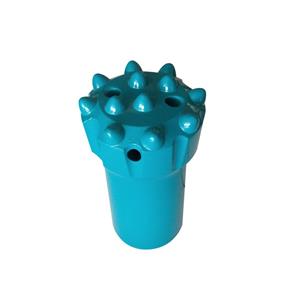
Powered by compressed air, this system is suitable for small rigs performing short crossings in medium- to high-hardness rock, with relatively high penetration efficiency.
Steering is achieved with an eccentric flat-face bit fitted with carbide inserts. By using the high-side toolface, corrective steering can be performed by pushing without rotation. For straight drilling, apply moderate weight on bit and rotate slowly.