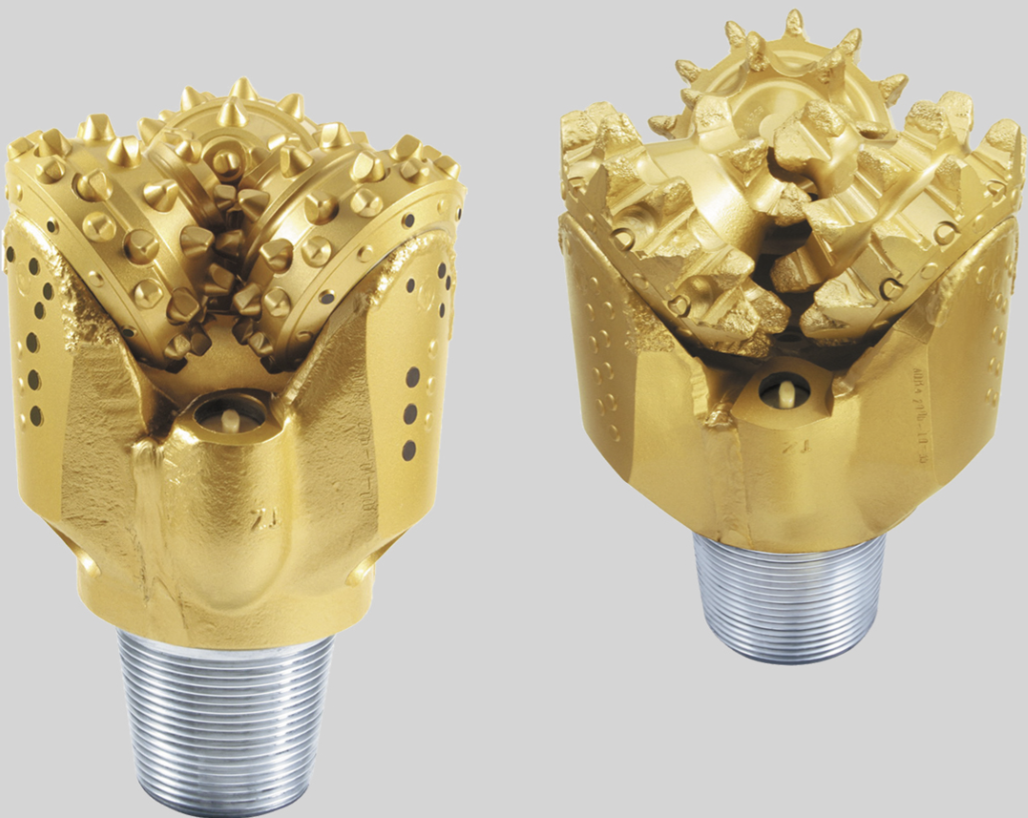
Correct Use of Tricone Drill Bits
How formation lithology affects bit failure Formation lithology influences drilling performance in multiple ways: it affects penetration rate and footage, can produce complex drilling problems such as lost circulation, kicks, well collapse, and stuck pipe, alters drilling-fluid behavior, and affects borehole quality (borehole deviation and irregular diameters), which in turn impacts cementing quality. Analyzing the lithology and its drilling behavior is essential for selecting the appropriate bit and judging whether its use is reasonable.
Clays, mudstones and shales: These formations readily absorb free water from drilling fluid and swell, reducing borehole diameter and creating resistance to penetration that can lead to stuck pipe. Prolonged soaking can also cause sloughing and borehole enlargement that results in collapse. Use freshwater or low-density, low-viscosity mud where possible. Carbonaceous shales have weak cohesion and are prone to collapse. Soft, clay-rich formations drill quickly but are vulnerable to bit balling.
Sandstones: Sandstone properties vary greatly with grain size, mineral composition and cement type. Finer grains, higher quartz content, and siliceous or iron-rich cement make the rock harder and more abrasive, increasing bit wear (e.g., quartz arenite). More clay cement, mica or feldspar makes the rock softer and easier to drill. Coarser grains and poor cementation increase permeability and raise the risk of fluid loss; a thick filter cake can form on the wall and cause sticky adhesion and sticking problems, leading to abnormal bit operation.
Conglomerates: Drilling in conglomerate often causes bit bounce, chatter and borehole wall failure. If pump rate is low or mud viscosity is insufficient, gravel-sized particles do not return to the surface easily; large cuttings can damage bit cones and teeth.
Limestones: Typically hard with slow penetration and limited footage. Many limestones develop fractures, vugs and cavities; encountering these can cause bit stalling, washouts, lost circulation and occasionally kicks or blowouts. Limestone strongly affects penetration, mechanical rate and bit wear. Alternating hard and soft beds (for example mudstone interbedded with hard sandstone) and highly dipping formations increase the likelihood of borehole deviation; bit damage is more likely when drilling highly deviated holes. Soluble salt layers (gypsum, halite, etc.) can degrade mud properties and impair normal bit performance.
Drilling parameters and their effects Key controllable drilling parameters in the drilling process are weight on bit (WOB), rotary speed (RPM), and mud circulation rate. These parameters should be selected based on formation conditions, bit type, drilling rig capabilities and operator skill. Drilling parameters are commonly classified as:
Optimized drilling parameters: those that achieve the best economic outcome under given conditions.
Aggressive (or enhanced) drilling parameters: values higher than normal to achieve greater penetration rates.
Special drilling techniques: specific methods or constrained parameter sets used for particular objectives.
Different parameter choices require different bit types; bits fail by different mechanisms under different drilling conditions and must be treated accordingly.
2.1 Effect of weight on bit (WOB) WOB is the essential condition for breaking rock at the bit face. The magnitude of WOB determines the rock-breaking mode and characteristics and directly affects penetration rate and bit wear. Under axial load and rotational torque, the cutting teeth wear, dull or fail as they press into and shear the rock, which obviously affects penetration. As WOB increases, penetration generally rises, but bearings and cutting teeth wear faster, which in turn affects penetration. The relationship between WOB and penetration changes through three distinct stages:
Surface-fracture stage: When WOB is less than the rock’s indentation hardness, the cutting teeth cannot penetrate but only abrade the rock surface. Wear is high and penetration is low, though penetration increases proportionally with increasing WOB.
Fatigue-fracture stage: When WOB approaches the rock’s indentation hardness, repeated action of the teeth generates many surface cracks and progressive fragmentation occurs even without full penetration.
Bulk-fracture stage: When WOB exceeds the rock’s indentation hardness, the teeth penetrate and produce bulk fracturing; drilling becomes efficient and this is the normal drilling regime. Therefore, applied WOB must be sufficient to allow the teeth to penetrate and produce bulk fragmentation.
Doubling WOB in tests on tricone bits showed that different rocks respond differently: medium-hard rocks (rock classes 6–7) exhibit the largest rate increase in penetration; softer (classes 4–5) and harder (classes 8–9) rocks show smaller increases. Drilling adhesive soft formations can cause mud bridging and bit sticking, so WOB should be relatively low. In highly abrasive formations, insufficient WOB causes premature bit wear, so WOB should be increased appropriately. When encountering fractured formations, bit bounce is common and WOB should be reduced to avoid tooth breakage or spalling. WOB is therefore a critical parameter that must balance sufficient tooth penetration with minimization of tooth wear.
2.2 Effect of rotary speed (RPM) Rotary speed measures how fast a bit of a given diameter rotates. Because rock-breaking behavior and the influence of WOB vary with rock hardness, the effect of RPM on rock breaking and mechanical penetration must account for lithology and rock-breakage time factors.
RPM in soft formations: In soft, highly plastic, low-abrasion formations (e.g., clay-like beds) the chip thickness equals the tooth penetration depth and tooth wear is minimal. With WOB held constant, RPM and mechanical penetration rate increase roughly proportionally.
RPM in medium-hard and hard formations: In these formations the indentation hardness and abrasiveness are higher; teeth dull more quickly, contact area increases, and crack propagation and deformation times lengthen. Penetration slows and higher WOB is required. Increasing RPM in hard formations can extend the rock-breaking time per revolution, so excessive RPM can prevent complete fracture before the teeth disengage, reducing effective penetration and accelerating wear. Therefore, RPM should not be increased excessively in medium-hard or hard formations.
RPM differences between rock types: Each rock type has a characteristic response curve and a limiting RPM. In clays, penetration rate increases proportionally with RPM; in hard, highly abrasive rocks, penetration increases more slowly with RPM because of extended rock-breakage time and a lower limiting RPM—exceeding that limit can actually reduce penetration.
Test results from doubling RPM on tricone bits show that for a rock of grade 4 (e.g., marble) penetration rate increased by about 93%, while for a grade 9 porphyritic granite the increase was only about 28%. From grade 4 to grade 9, the penetration increase with RPM decreases along a curve. Thus, increasing RPM benefits soft, low‑abrasion formations but offers limited advantage in hard, highly abrasive formations.