What's Inside a Quality Drill Bit: The Metallurgy Behind the Meterage
A drill bit looks simple from the outside. A steel body. A few carbide buttons pressed in. A threaded or tapered connection. But the difference between a bit that drills 300 meters and one that dies at 80 is almost entirely invisible — it's in the steel composition, the heat treatment, and how the inserts were fixed into the body.
Here's what's actually inside a quality drill bit, and how to use that knowledge when you're buying.
The Harshest Working Conditions in Engineering
Let's put the drill bit's job in perspective. It takes 2,000 to 3,000 impact blows per minute. Each blow carries between 25 and 500 joules of energy — the high end being roughly the muzzle energy of a hunting rifle, delivered thousands of times per minute. Meanwhile, it's bathed in high-pressure water or air carrying abrasive rock particles. It's under tension, compression, bending, and torsion all at once.
The failure mode that results — stress-corrosion fatigue — is why a drill bit's service life is measured in minutes to hours of actual contact time with rock. No other mass-produced steel component operates under this combination of cyclic loading, abrasion, and corrosion. A drill bit is, arguably, the most abused tool in industry.
This is why quality matters more than price. A bit made from the wrong steel, or with inserts fixed incorrectly, won't just drill less — it'll fail in a way that costs more than the bit itself.
Blade Bits vs. Button Bits: Why Buttons Won
For decades, the dominant drill bit in China was the blade bit — a chisel bit, a cross bit, or an X bit, with carbide blades brazed across the face. Chisel bits alone accounted for over 80% of production. They're simple, cheap, and fine for small, shallow holes.
But blade bits have hard limits. The carbide blade is loaded in tension — the impact force pulls the blade apart along its cross-section. Tension is the worst loading mode for carbide. The blade geometry also limits diameter: chisel bits top out around 45 mm, cross bits around 64 mm, X bits around 89 mm. Beyond those diameters, the blade can't survive the stress and fractures early.
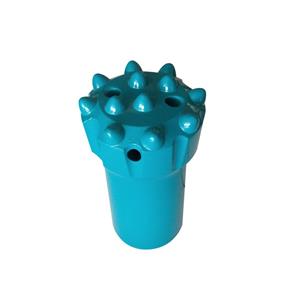
Button bits changed the game. Instead of one or two blades, the face carries multiple individual carbide buttons. Each button is loaded primarily in compression — the impact presses the button into the rock and against the bit body. Compression is what carbide does best. The buttons can be placed freely across the face, so there's no diameter limit and no "blind spots" where rock doesn't get broken. Multi-point crushing is more efficient than blade scraping.
The practical result: button bits drill faster, last longer between regrinds, and work in larger hole diameters. They've largely replaced blade bits in modern drilling, especially in mechanized and deep-hole applications where bit changes are expensive.
The Connection: Tapered vs. Threaded
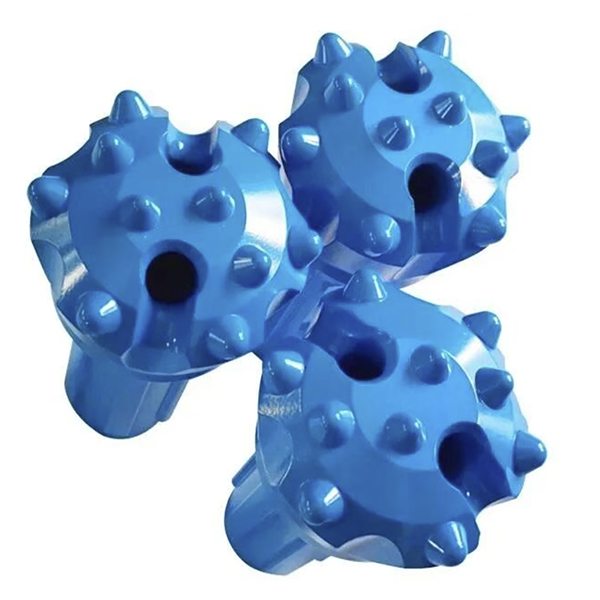
Button bits come in two connection styles. Tapered bits fit onto tapered rods with a friction fit — simple, cheap, fine for hand-held drilling and shallow holes. Threaded bits screw onto threaded rods — more complex to make, but necessary for hydraulic drilling rigs where the higher impact energy and rotation torque demand a positive connection.
Threaded button bits for hydraulic jumbos are the high end of the market. The manufacturing tolerance requirements are tight, and the failure consequences are serious — a bit that fails mid-hole on a production jumbo costs the bit plus the downtime plus potentially a stuck string. This is the segment where imported bits from Sandvik and Atlas Copco have historically dominated, and where the gap between good and average manufacturing is widest.
The Three Ways to Fix an Insert
How the carbide buttons are held in the bit body determines how the bit fails — and how long it takes to get there. Three methods exist:
Brazing (welding). The oldest method. Drill a hole, put the button in, braze it with copper or silver solder. Simple, cheap, forgiving of dimensional tolerance. But the braze joint is a weak point. It can fail under repeated impact. The solder can flow unevenly, leaving voids. Brazed bits have shorter lives and more insert loss. This method survives mostly in small, cheap tapered bits and is fading out.
Cold press (interference fit). The button is slightly larger than the hole it goes into. A hydraulic press forces it in, and the elastic deformation of the steel body grips the button. This is the most common method because it's fast and repeatable. But the press-in process itself can damage either the button or the hole wall — micro-cracks that become failure sites later. Cold-pressed bits are fine for moderate service but tend to lose inserts late in life, especially under high impact.
Hot press (thermal shrink fit). The best method, and the one top manufacturers use for premium bits. The steel body is heated, expanding the insert holes. The buttons drop in with minimal force. As the body cools and shrinks, it grips the buttons uniformly. Because the buttons and the body experience almost no mechanical stress during insertion, there's no press-in damage. The grip is more uniform and more reliable than cold pressing. This is why hot-pressed bits hold their inserts longer, especially in the late-life stage where cold-pressed bits start losing buttons.
If you're buying premium threaded button bits, ask about the insert fixing method. "Hot-pressed" is a real manufacturing claim with real performance implications, not marketing language.
The Steel That Holds It All Together
The bit body steel has to do three contradictory things: be hard enough to resist abrasive wear, be tough enough to not crack under impact, and hold the inserts tightly for the bit's entire life. That's a demanding specification.
For hot-pressed bits, the body steel needs: 40-50 HRC hardness after heat treatment, high fatigue strength, high wear resistance, good thermal stability (so it doesn't soften in the heat of drilling), and a controlled coefficient of thermal expansion (so the hot-press grip works reliably).
The alloy recipe that delivers this is a carefully balanced medium-carbon steel:
Carbon (0.42-0.48%): provides strength and hardness. Too little and the body is soft. Too much and it loses the toughness it needs to survive impact.
Silicon (0.15-0.30%): strengthens the steel through solid solution and improves toughness.
Manganese (0.60-0.90%): improves hardenability and refines the grain structure.
Molybdenum (0.90-1.10%): prevents temper embrittlement and improves high-temperature strength — critical because the bit body gets hot in service.
Chromium (0.90-1.20%): improves hardenability and corrosion resistance, which matters because the bit runs in water and abrasive slurry.
Nickel (0.40-0.70%): improves toughness, but is expensive so it's kept to the minimum effective level.
A bit body made from this composition, properly heat-treated, will hold its inserts, resist wear, and survive impact. A bit body made from whatever alloy was cheapest will do none of those things reliably.
What This Means When You're Buying
The next time you're comparing two drill bits that look identical on the spec sheet, remember what you can't see. The steel composition. The heat treatment. The insert fixing method. These are where the cost difference lives, and where the meterage difference comes from.
A cheap bit isn't cheap if it loses inserts at 60 meters. A premium bit isn't expensive if it drills 400 meters and retires from normal wear. The metallurgy is the meterage. Understand what's inside, and you'll understand what you're actually paying for.