When to Retire a Drill Bit: Four Signs It's Done — and Two Numbers That Prove It
Knowing when to pull a drill bit isn't as obvious as it sounds. Bits don't usually fail catastrophically — they degrade gradually, and the degradation is easy to rationalize away. "It's still cutting." "Just a few more meters." "The rock is harder here." And every meter you push a worn bit past its retirement point, you're spending more on fuel, more on wear to the drill rod and shank adapter, and more on the eventual downtime when the bit finally gives up mid-hole.
Here's how to know when a bit is done — not by gut feel, but by measurable signals and hard numbers.
Signal One: Penetration Rate Falls Off a Cliff
The most obvious sign of a worn bit is also the easiest to dismiss. The bit that was making a meter a minute is suddenly taking ninety seconds. Then two minutes. Then the operator is leaning on the feed pressure, the penetration rate is still dropping, and everyone is blaming the rock instead of the bit.
A simple rule: in the same formation, on the same drill, with the same parameters, if the time to complete a hole increases by more than 30%, the bit is worn. Not "the rock changed." Not "the drill is tired." The bit. Pull it and look at it.
Here's what's happening at the cutting face: as carbide inserts wear, their contact area with the rock increases — a sharp button has a small contact patch, a worn button has a broad, flat contact face. More contact area means lower contact pressure for the same feed force, which means each blow does less work fracturing rock. The bit isn't cutting anymore. It's rubbing. And rubbing generates heat, which accelerates wear, which increases the contact area, which reduces penetration further. It's a death spiral that shows up on the clock.
Signal Two: The Holes Aren't Round Anymore
A worn gauge row on a drill bit doesn't just reduce the hole diameter — it makes the hole irregular. The bit starts to wander because the gauge inserts that should be holding it centered in the hole are worn flat, and the bit is essentially drifting inside an oversized, out-of-round cavity of its own making.
You'll see it in the cuttings: more coarse fragments, fewer fine chips, because the bit is spalling rock off the wall rather than cutting cleanly at the face. You'll hear it in the drill: a rougher, more irregular impact rhythm as the bit catches and releases against the uneven hole wall. And you'll feel it in the rod: increased vibration and occasional binding as the rod flexes inside an irregular borehole.
For production drilling, an irregular hole is more than a quality problem. It means the next bit going into that hole will have to ream its way down, wearing its own gauge row prematurely. One worn bit run past its retirement point can damage the next bit before it even reaches the face.
Signal Three: The Drill Sounds Wrong
Experienced drillers diagnose bits by sound. A sharp bit produces a crisp, high-frequency crack with every blow — the sound of energy being efficiently transferred into rock fracture. A worn bit produces a duller, lower-frequency thud — the sound of metal hammering against metal because the carbide inserts can no longer penetrate.
As carbide inserts wear unevenly — which they almost always do, because the gauge row wears faster than the face row — the bit starts to rock slightly with each blow. That rocking produces a distinctive metallic screech, a vibration pattern that changes from blow to blow, and an impact rhythm that becomes irregular. The bit is no longer seating squarely against the hole bottom, and every off-center blow is sending shock waves sideways into the drill rod and back up into the shank adapter.
Signal Four: The Machine Is Working Harder for Less Result
A worn bit makes the entire drill string work harder. The feed pressure required to maintain any penetration at all creeps up. The rotation torque increases as the bit struggles to maintain RPM against increased friction. Hydraulic oil temperature climbs because the system is dissipating energy as heat rather than as rock breakage. Fuel consumption rises.
These are all measurable. If your rig has data logging, compare the feed pressure, rotation torque, and penetration rate for the current bit against a new bit in the same formation. The trends will tell you when the bit crossed over from "worn but functional" to "costing you money."
If your rig doesn't have data logging, you can feel it. The drill runs hotter. The controls feel heavier. The shift feels longer. Trust that. The machine knows the bit is done even when the operator doesn't want to believe it.
The Two Numbers That Settle the Argument
For when subjective signals aren't enough — or when someone is arguing that the bit still has life in it — here are the hard numbers:
For cross bits and chisel bits: measure the carbide insert wear land. If the wear flat on any insert exceeds 3 millimeters, the bit is done. Three millimeters is the threshold where cutting efficiency drops sharply and the heat generation starts to accelerate insert degradation. Not 3.5. Not "close to 3." Three.
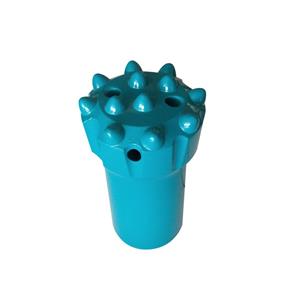
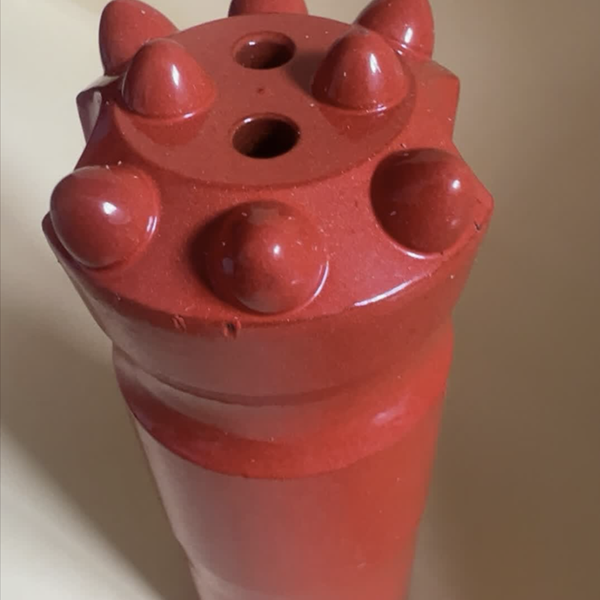
For button bits: measure the remaining carbide protrusion. If any button has worn down to less than two-thirds of its original height — meaning more than one-third of the insert is gone — the bit is done. Also: if any button is cracked, chipped, or missing, the bit is done regardless of wear measurements. A cracked button will spall and fail catastrophically, and the resulting steel-on-rock contact can destroy the bit body.
These are field measurements. A set of calipers or a wear gauge takes thirty seconds to check. Write the numbers on the bit body with a paint marker when it's new so you have a baseline to compare against.
When You Replace the Bit, Check What's Above It
A worn bit doesn't just wear itself out — it wears out everything connected to it. When you pull a worn bit, inspect the drill rod's threaded connection. A bit that's been rocking in the hole will have been transmitting irregular loads into the rod threads, accelerating fatigue. Check the shank adapter for signs of off-center impact — a polished ring around the striking face that's wider on one side than the other means the bit was running crooked and the piston was hitting off-axis. Replace the rod or shank if they show damage, because putting a new bit on worn tooling is just killing the new bit slowly.