Why Your Drill Jumbo Keeps Getting Stuck: Geology vs. Tooling — Which One's the Real Culprit?
Getting a drill string stuck in the hole is one of those moments every operator dreads. Rotation stops, the rig strains, and the clock starts ticking on how long it'll take to free the steel — or whether you're about to lose the rod, the bit, and the hole entirely.
When it happens repeatedly, the frustration compounds. Is the ground just bad? Or is the tooling worn out and nobody noticed? Usually, it's a bit of both — but knowing which one to blame in the moment is what separates a five-minute recovery from a lost shift.
The Ground Doesn't Care About Your Schedule
Fractured rock is the most common geological cause of stuck drill steel. The bit breaks through into a natural fissure or joint plane, the hole wall shifts slightly, and the bit body gets wedged. Rotation torque spikes instantly. If the operator doesn't back off immediately, the rod binds, and what started as a momentary catch becomes a full-on jam.
Hard, competent rock causes a different kind of problem. In granite or dense basalt, there's nothing to wedge the bit — but the drilling is slow, the bit generates heat, and any deviation from straight-line drilling creates friction against the hole wall. The rod rubs, the hole tightens, and eventually the torque required to keep turning exceeds what the rig can deliver. The string stops. It didn't catch on a crack — it just ran out of room.
Neither of these is preventable in the sense of "fix the geology." What you can control is how you respond: in fractured ground, ease the feed and keep the rotation steady so the bit doesn't snatch when it hits a void. In hard ground, don't force the penetration rate — let the bit do the work at the speed the rock allows.
The Tooling Is Telling You Something
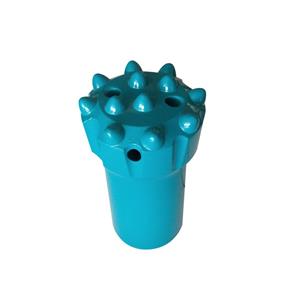
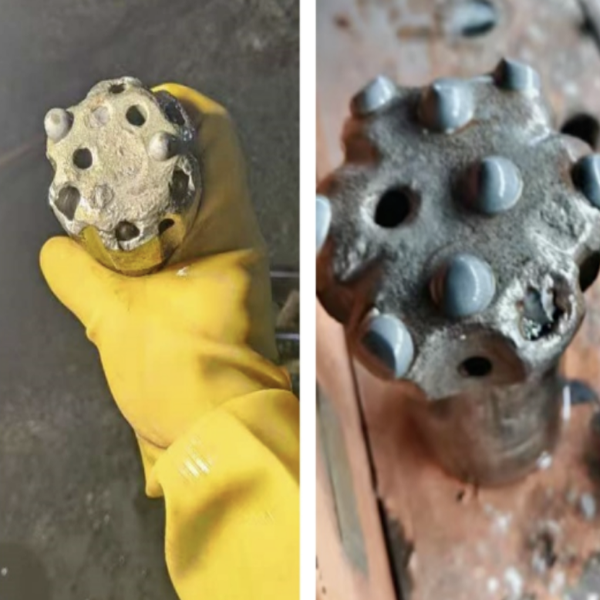
A button bit with worn, flattened carbide inserts doesn't cut — it rubs. The penetration rate drops, the operator compensates by adding feed pressure, and now you've got a blunt tool being forced through rock instead of fracturing it. The hole diameter shrinks as the bit wears, and the rod behind it starts dragging against the hole wall. That drag is what eventually locks the string.
If the bit face is visibly flattened or individual buttons are missing, the bit is done. Don't try to squeeze one more hole out of it — the cost of a stuck string dwarfs the cost of a new bit.
Then there's the drill rod connection. A coupling sleeve that's worked loose, a thread that's partially backed off under reverse rotation — these create a hinge point in the string. Instead of running straight, the rod above the loose connection wobbles inside the hole with every rotation. The hole gets oversized and uneven, the rod rubs against the wall, and the resulting friction builds until the rotation motor can't overcome it.
Tighten every connection properly before the string goes in the hole. Check the coupling sleeves for worn threads that won't hold torque. A loose connection two rods back will ruin a hole you haven't even reached yet.
So Which One Is It?
When a string jams, the first question is: did it happen suddenly? A sudden lock-up at depth usually means the bit hit a fracture or a void and wedged. Back the feed off, try gentle reverse rotation, and don't yank — pulling too hard on a wedged bit can snap the rod at the coupling.
A gradual increase in rotation resistance over several rods' worth of drilling, culminating in a stall, usually means worn tooling or an undersized hole from a worn bit. Pull the string, check the bit face, check the rod diameters along the length, and check the connections. The evidence is on the steel — you just have to look.