Drill Rod Breaking at the Bit End? Two Causes That Account for Almost Every Failure
There's a particular kind of frustration that comes with pulling a drill string and finding the rod snapped clean at the bit-end thread — not worn out, not gradually failing, just broken. The break surface is fresh. The rod body above the break looks fine. And your first thought is always the same: defective steel.
It's almost never defective steel. In nearly every case, the rod broke because the ground changed and the operator didn't, or because the hole got too deep for the conditions and nobody adjusted the plan. Here's what's actually happening at that threaded connection when it fails, and how to stop it from happening on your next shift.
The Sudden Break: When the Ground Ambushes Your Rod
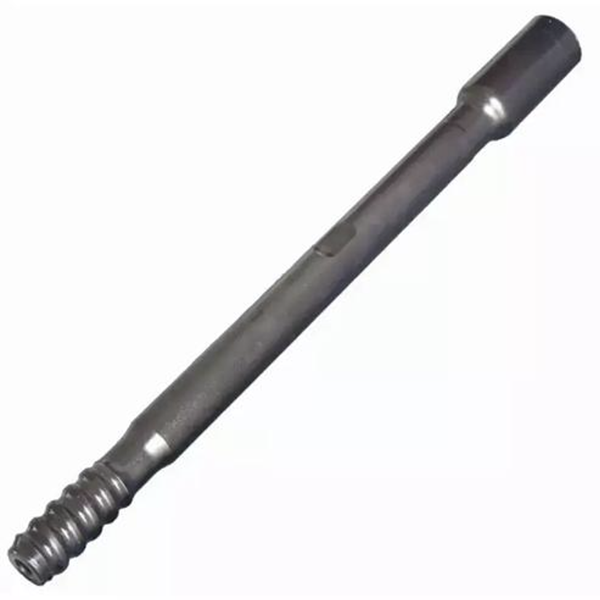
The most unnerving kind of rod failure is the one with no warning. The drill is running smoothly, penetration is steady, and then — crack. The rod snaps at the bit-end thread, and the bit is left at the bottom of the hole with a stub of thread still inside it.
This happens almost exclusively in mixed or unpredictable ground. A rod drilling through uniform rock experiences steady, predictable loading. The impact energy travels down the rod, into the bit, and into the rock in a consistent pattern. The threads at the bit end carry their design load, cycle after cycle, within the fatigue limits they were engineered for.
Then the bit hits something different. A hard lens of quartzite in otherwise soft sandstone. A void where the bit suddenly has no resistance and then slams into the far wall. A fractured zone where the bit catches an edge and the rotation momentarily binds. In that instant, the load at the threaded connection spikes far beyond its steady-state value. The threads — which are already the highest-stress location in any rod because of the geometric stress concentration at the thread root — see a load that can exceed the material's ultimate tensile strength.
If the operator is running high impact power and fast feed when this happens — which is exactly what you'd be doing if the ground had been soft and cooperative up to that point — the rod has no margin. The spike hits, the stress at the thread root exceeds what the steel can take, and the rod snaps. Not gradually. Not after a hundred cycles. On that single blow.
The fix is situational awareness, not stronger rods. When you're drilling in ground you know has variability — and in most mining and construction drilling, you always know, or you should — you need to listen to the drill. When the impact sound changes pitch, when the rotation torque fluctuates suddenly, when the penetration rate drops for no apparent reason, those are the ground telling you it's changed. Back off the impact power and slow the feed rate before the rod takes a hit it can't survive. You lose a few seconds of penetration speed. You gain a rod that finishes the hole.
The Slow Death: Fatigue That Looks Fine Until It Isn't
The other common failure mode is harder to diagnose because there's no obvious trigger event. The rod just snaps one day, and when you look at the break surface, part of it is dark and oxidized — old crack — and part is bright and fresh — the final fracture. That two-tone break surface is the calling card of fatigue.
Fatigue failures in drill rods happen when the rod is run under conditions that exceed its endurance limit, cycle after cycle, until the accumulated micro-damage reaches a critical point. The most common driver of this is a hole that's too deep for the ground conditions.
Here's the chain: as hole depth increases, cuttings evacuation becomes less efficient. The annular space between the rod and the borehole wall gets longer, the flush air or water loses velocity over distance, and heavier chips start settling instead of flowing out. The rod now has to rotate against the resistance of packed cuttings in addition to the normal drilling load. That extra rotational resistance isn't uniform — it fluctuates as cuttings accumulate and clear, accumulate and clear — and the rod experiences cyclic torsional loading on top of the percussive impact loading it was designed for.
At the same time, deep holes in broken ground rarely have perfectly straight walls. The rod flexes slightly as it rotates, and that flexing puts bending stress into every rotation. Bending plus torsion plus impact is a fatigue triple-threat.
The threaded connection at the bit end takes the worst of it. The thread root — already the geometric stress concentrator that makes threads inherently weaker than the rod body — accumulates fatigue damage with every cycle. A micro-crack initiates at the root. Over the next few hundred meters of drilling, that crack grows, micron by micron, until the remaining cross-section can't carry the load and the rod snaps.
The operator sees a rod that "looked fine" break without warning. What actually happened was a fatigue crack that had been growing for the last fifty holes, invisible from the outside, until it reached critical size.
How to Catch Fatigue Before It Catches You
You can't see a subsurface fatigue crack without specialized inspection — magnetic particle or ultrasonic testing — but you can manage the conditions that cause them.
First: control your hole depth. In broken, fractured, or highly abrasive ground, a shallower hole with better cuttings clearance puts less fatigue load on the rod than a deeper hole with marginal flushing. If the flush return at the collar is slowing down or running dirty, the hole is telling you it's getting too deep for the conditions. Stop before the rod pays the price.
Second: inspect the threads every time the rod comes off the string. You're looking for three things: galling (torn, rough metal on the flank surfaces), deformation (threads that are no longer sharp and clean at the crest), and pitting (small cavities from corrosion or cavitation). Any of these are stress concentrators that accelerate fatigue. A rod with visible thread damage should be pulled from service — not "one more hole," not "we'll keep an eye on it." Pulled.
Third: match the rod to the ground. A rod spec'd for medium-hard homogeneous rock won't have the fatigue margin for fractured, variable ground where loading is unpredictable. In difficult conditions, you need a rod with a larger cross-section at the bit-end connection, a more generous thread root radius, and a material spec that prioritizes fatigue resistance over raw tensile strength. The rod that costs 20% more and lasts three times longer in bad ground isn't expensive — the rod that snaps mid-hole is expensive.