Drill Rod Handling and Storage: Most Rods Don't Die in the Hole — They Die on the Rack
A drill rod that survives hundreds of meters of hard rock percussion, abrasive cuttings flow, and cyclic fatigue loading can be destroyed in five seconds by a forklift operator who's in a hurry. I've seen it. A bundle of rods lifted with a single sling, the ends clattering together like wind chimes, thread protectors cracked and falling off, and nobody thinking twice about it because "they're just rods, they're tough."
They are tough. But they're also precision components with threaded connections machined to tolerances measured in hundredths of a millimeter, and those connections don't distinguish between damage from downhole impact and damage from being dropped on concrete. A rod with dinged threads is a rod that will cross-thread, gall, or fail at the connection — and it doesn't matter whether the ding happened at 200 meters depth or two meters from the delivery truck.
Here's what actually matters when you're handling, storing, and moving drill rods — and why most of the damage that shortens rod life happens before the rod ever touches a drill rig.
Thread Protectors: The Cheapest Insurance You'll Ever Buy
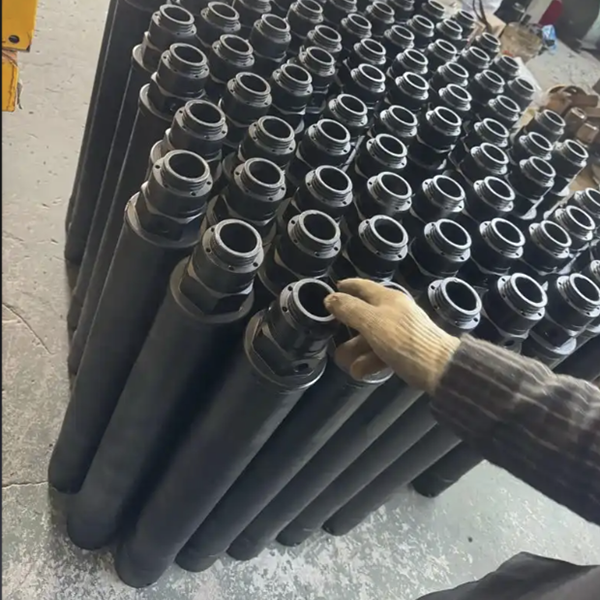
Every drill rod ships with thread protectors on both ends — a plastic or steel cap threaded onto the pin and box connections. These aren't packaging. They're not meant to be thrown away after unboxing. They're supposed to stay on the rod every moment the rod isn't connected to another rod or to a drill bit.
The pin thread — the external male thread — is especially vulnerable. The thread crests are sharp. The profile is precise. A single impact against another metal object can raise a burr or flatten a crest, and that imperfection will prevent the thread from fully engaging on the next connection. Partial engagement puts all the torque and tensile load on fewer thread flanks, overloading them, leading to galling or fatigue cracking at the overloaded section.
The box thread — the internal female thread — is harder to damage from external impact but easier to damage from contamination. Dirt, sand, or dried mud packed into the box will act as grinding compound the moment the pin thread is made up. Every make-and-break cycle with contaminated threads is a lapping operation, wearing the thread flanks away a micron at a time.
The rule is simple and should be enforced without exception: thread protectors on whenever the rod is not in the string. Not "usually." Not "when we remember." Always.
Loading and Unloading: Slow Down
The most common handling damage to drill rods happens during loading and unloading — from truck to rack, from rack to rig, from rig back to rack. Two mistakes dominate:
Single-point lifting. A bundle of rods lifted from the middle with a single sling or forklift fork bends under its own weight. The rods at the bottom of the bundle sag, the rods at the top curve, and every rod in the bundle takes a set — a slight permanent bend. That bend will put the rod into cyclic flexural loading the instant it starts rotating in a borehole, and cyclic flexural loading is the fastest path to fatigue failure.
Lift bundles with at least two support points, spaced to keep the rods straight. For individual rods, support them at the quarter points from each end — roughly the same points where they'd be supported on a drill rig's rod rack.
Impact between rods. Rods handled in bundles without individual separation will knock against each other during movement. The sound of steel on steel during transport isn't just noise — it's thread damage accumulating. Each impact might be small, but over the course of a truck journey or a rig move, the cumulative damage to unprotected threads is real.
Keep rods separated during transport. If they're in a bundle, use spacers. If they're being moved individually, move them one at a time. The extra minutes cost nothing compared to the cost of replacing rods with damaged threads.
Connection and Break-Out: Where Most Field Damage Happens
Thread compound isn't optional. It's not a nicety. It's the difference between a thread that unscrews cleanly after a thousand meter run and one that galls on the third make-up.
Thread compound — sometimes called "dope" in the field, though the proper term is anti-seize compound — does three things: it lubricates the thread flanks during make-up so the torque goes into stretching the connection rather than fighting friction, it fills the microscopic gaps between the thread surfaces to prevent metal-to-metal contact, and it provides a barrier against corrosion during service.
Apply it before every connection. Not a thick glob — that just gets forced out of the joint and wasted — but a thin, even coating on both the pin and box threads, covering every flank from root to crest.
When breaking out, don't use the rig's full power to spin off a tight connection. If the joint won't break loose at low torque, work it — tighten slightly, then loosen, tighten, then loosen — to break the bond without galling the threads. High-speed reverse rotation on a stuck joint is a fast way to destroy both the pin and box threads.
The Shoulder: The Face Nobody Thinks About
Threaded drill rod connections don't just transmit load through the threads. The flat shoulder faces — the annular ring at the base of the pin and the matching face at the mouth of the box — carry a significant portion of the compressive and impact loads. When the connection is properly made up, the pin shoulder and box face are in full contact, forming a metal-to-metal seal and load path.
Damage to the shoulder face — a nick from a dropped shackle, a dent from a hammer blow, a score from dragging across concrete — prevents full contact. The load that should be distributed evenly across the shoulder face concentrates at the high spots around the damage. The connection loses its seal, flush fluid leaks, and the uneven loading accelerates fatigue at the thread roots.
Inspect the shoulder faces every time you handle a rod. A damaged shoulder is just as disqualifying as damaged threads. The rod needs repair or retirement.
Storage: Horizontal, Supported, Clean, and Dry
The ideal drill rod storage setup is simple and often ignored:
Horizontal, never vertical. A rod stored vertically leaning against a wall or rack will sag over time, taking a permanent bend.
Supported at multiple points. A rod supported only at its ends will sag in the middle. Support at the quarter points, or use a full-length cradle rack.
Clean and dry. Rods stored wet will corrode, and corrosion pitting on the thread flanks or on the internal bore wall creates fatigue initiation sites. After cleaning, a light coat of rust preventive oil on all exposed surfaces — especially the threads — is cheap protection.
Thread protectors on, always. See above.
Separated, not piled. Rods stacked directly on top of each other will dent and scratch. Use rack separators or store individually.
The One Rod You Should Never Run
A damaged rod — any damaged rod, whether the damage is on the threads, the shoulder, or the body — should never go back into a string. Running a damaged rod doesn't just risk that rod failing. It risks the damaged rod destroying the undamaged rod it connects to.
A damaged pin thread will gall the box thread it's made up to. A damaged shoulder face will brinell the matching shoulder face. One bad rod taken out of service saves the rod next to it from becoming two bad rods.