How to Pick the Right Drill Rod: A Selection Framework That Goes Beyond "Whatever's on the Rack"
Walk into a typical site tool crib and you'll see a rack of rods. Some are the ones the crew actually uses. Some have been there for six months because someone ordered the wrong thread type and nobody wants to deal with returning them. And somewhere in the back, there's a rod from a supplier nobody remembers, still in its wrapper, because it never fit anything on site.
Rod selection isn't complicated if you work through the right questions in order. Skip one, and you end up with steel that either doesn't fit, doesn't last, or doesn't drill straight. Here's the framework.
Start With the Drill, Not the Rod
Every rod selection decision flows backward from the drill. What shank adapter does the rig take? What's the impact power class? What's the rotation torque? Answer these first.
The shank adapter determines the thread connection at the drive end. A rig running an R32 shank needs rods with R32 threads at the drive end. A T38 shank means T38 rods. This sounds obvious, but mixed fleets — where different rigs on the same site use different shank standards — create exactly the kind of confusion that leaves the wrong rods on the rack.
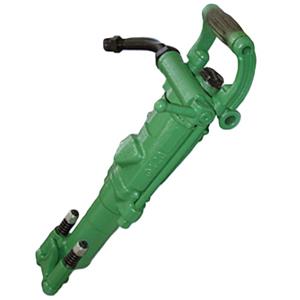
Impact power determines the rod cross-section. Small hand-held pneumatic drills running at 2-3 kW can drive standard hex or round rods in the 22-25 mm range. Mid-size hydraulic drifters at 10-15 kW need rods in the 28-32 mm range with threads like R28 or R32. Large production drifters pushing 20 kW and above need heavier sections — 38 mm or larger with T38, T45, or even T51 threads. Put a lightweight rod on a high-power drifter and it'll fatigue at the thread root. Put a heavyweight rod on a low-power drill and you're wasting energy accelerating steel that's thicker than it needs to be.
Match the Rod to the Hole
Hole diameter and depth set the rod diameter and length.
For hole diameter: the rod body needs enough annular clearance for cuttings to flush past. Too tight, and flushing velocity spikes, increasing abrasive wear on the rod body and the hole wall. Too loose, and the rod can whip inside the hole, causing deviation and bending stress. A rough rule: rod body diameter should be about 60-70% of bit diameter for most applications.
For hole depth: rod length needs to match the feed length of the drill and the total hole depth. For shallow holes under three meters on a single-feed rig, one rod per hole. For deeper production drilling, you're running strings, and each rod in the string needs to match the feed stroke so the couplings land at accessible positions for adding and removing rods. Standard rod lengths — 3.05 m, 3.66 m, 4.27 m (10, 12, 14 feet in imperial markets) — are standard because they match common feed lengths. Don't custom-order odd lengths unless your feed stroke genuinely requires it.
Choose the Thread Standard
Thread selection isn't just about what fits the shank. Different thread types have different characteristics:
R-threads (R28, R32, R35, R38) are rope threads — a rounded profile designed for easy coupling and uncoupling. They're the most common standard for tunneling and drifting rods. R32 is the workhorse for mid-size drifters. R38 bridges the gap between mid-size and heavy production.
T-threads (T38, T45, T51) are trapezoidal threads — a flat-crested profile that handles higher torque. They're used on larger production drills where rotation torque is higher. T38 is common on jumbos in mining. T45 and T51 are for the heaviest production drilling.
Tapered connections (typically 7°, 11°, or 12° tapers) use a friction fit instead of threads. They're standard on hand-held pneumatic tooling and small rigs. The rod has a male taper, the bit has a female socket. No threads to wear or cross-thread, but the taper fit has to be precise — insertion depth at least 25 mm, contact area at least 60%.
Don't mix thread standards in the same string. An R32-to-T38 adapter might exist in a catalog somewhere, but every adapter adds a joint, and every joint is a stress concentration and a potential failure point.
Factor in the Rock
Hard, abrasive rock demands rods with better surface hardness and deeper case depth. The rod body rubs against the hole wall, and in abrasive formations, that contact wears the rod diameter down. A rod with shallow case hardening will wear through the hardened layer before the threads are done, exposing soft core steel that erodes fast.
Fractured, blocky ground demands rods with higher toughness and better fatigue resistance. Rods in fractured ground see more bending — from hole deviation, from the bit catching on fracture planes, from the string flexing through broken zones. A rod that's optimized for abrasive wear (high surface hardness, shallow case) may be too brittle for fractured ground.
Soft, uniform ground is forgiving of most rod types, which is why rod selection rarely gets attention on easy drilling. The problems show up when the rock gets difficult.
Steel Quality: The Stuff You Can't See
Two rods can look identical on a spec sheet — same thread, same diameter, same length — and perform completely differently underground. The difference is in the steel and the heat treatment.
What to look for in a quality rod: the steel grade should be a dedicated drill steel alloy (not generic structural steel), the case depth should be specified and consistent, the hardness transition from case to core should be gradual (not a sharp drop that creates a stress discontinuity), and the thread surface finish should be smooth with no visible machining marks at the root.
A supplier who can provide hardness profiles, microstructure images, and dimensional inspection data is a supplier who controls their process. A supplier who says "trust me, it's good steel" is a supplier you might want to test before committing to a bulk order.
The Decision Sequence
Next time you're ordering rods, work through this in order:
What shank thread does the drill use?
What's the impact power class?
What's the hole diameter and depth?
What thread type matches the application (R, T, or taper)?
What's the rock — abrasive, fractured, or uniform?
Can the supplier prove their quality, or are you taking their word?
The right rod is the one that fits your drill, matches your hole, handles your rock, and comes from a supplier who can tell you what's in the steel. Everything else is a compromise you might regret at meter 300 when the thread root lets go.