DTH Drill Rods Uncovered: How These Heavy-Duty Tools Power Underground Engineering
In mining, tunnel excavation, and geological exploration, one tool quietly takes on the role of a frontline rock breaker: the DTH drill rod. As a core component of drilling operations, it works with the down-the-hole hammer to deliver impact energy deep into rock formations, enabling fast and effective rock fragmentation. Let’s take a closer look at how this powerhouse tool really works.
The fundamental job of a DTH drill rod is to transmit impact energy and carry flushing media. When the drilling system starts, the hammer at the front end generates high-frequency impacts that travel section by section through the rod string to the drill bit. At the same time, compressed air or drilling fluid moves through the central passage to the hole bottom, where it lifts broken cuttings out of the borehole and sustains a continuous drilling cycle.
This process is much like a relay race: each rod section passes on energy while also serving as a debris removal channel. The design therefore must balance strength and toughness. It needs enough durability to withstand repeated hammer blows, yet enough resilience to avoid brittle failure. For this reason, DTH drill rods are usually made from high-strength alloy steel and further optimized through heat treatment.
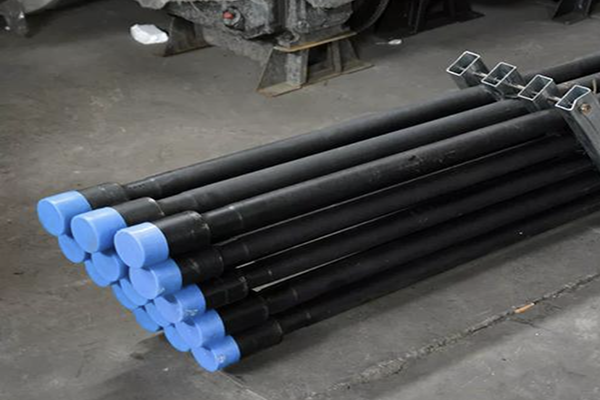
A DTH drill rod system is not a single part but a long, modular string built from multiple threaded sections. Depending on project needs, total length can range from a few meters to several dozen meters, and extension rods can support ultra-deep drilling. Structurally, the system has three key elements: the rod body, a hollow cylinder that carries flushing flow internally while bearing torque and axial loads externally; threaded joints, with male-female threads that ensure tight connections and efficient power transfer; and the drive end, which interfaces with the rig chuck for rotation and feed control.
This modular architecture allows flexible assembly based on hole depth and simplifies maintenance. If one section wears out, only that section needs replacement, rather than the entire rod string, which significantly reduces operating cost.
DTH drill rods are highly adaptable and widely used across industries. In surface mining, they drill blast holes for accurate explosive placement. In tunneling, they support advance drilling to investigate geology and relieve ground stress. In hydraulic infrastructure projects, they create drainage holes for dam reinforcement and seepage control. In geological exploration, they recover core samples for subsurface resource analysis.
Different working environments impose different requirements. Hard-rock formations call for higher-strength rods to handle stronger impact loads, while softer formations require optimized flushing channels to prevent hole blockage. This ability to adapt to local conditions is exactly what makes DTH drill rods such a versatile engineering solution.
As project demands have evolved, DTH rod technology has advanced from coarse, one-size-fits-all designs to precision-engineered systems. Early rods often used single materials and simple thread profiles, while modern rods integrate multiple innovations: surface enhancement through coating or spray technologies for better wear resistance and longer life; intelligent monitoring in high-end models with embedded sensors that report torque, temperature, and other data in real time; and lightweight design using high-strength, low-mass alloys to reduce rig load and improve efficiency.
These upgrades improve both tool performance and overall drilling process capability. In one mining application, for example, a new-generation drill rod system increased penetration rate by 30 percent while reducing energy consumption by 20 percent.
Looking ahead, under global carbon-reduction and sustainability goals, DTH drill rod development is moving toward greener, smarter solutions. On one side, materials and manufacturing processes are being optimized to cut resource use and waste. On the other, integration with automated rigs and remote-control platforms is enabling reduced-crew and even unmanned operations.
From remote mountain mines to urban underground construction, DTH drill rods provide the hard-core performance that modern engineering depends on. Every rotation and impact pushes human infrastructure deeper and farther. The next time you pass an active jobsite, take a moment to think about the rock-breaking specialists working below the surface—their story is far more impressive than it appears from above.