Why More Mines Are Paying Attention to DTH Drilling Tools
On a mining site, the drilling rig usually gets the attention.
It is large, loud, and constantly moving. That makes it easy to assume the rig determines drilling efficiency. But anyone who has worked in a mine for long knows the more complete answer:
The rig determines whether the job can be done. The drilling tools determine how long it takes, how fast it runs, and whether the economics make sense.
This is why more mining companies are beginning to look closely at DTH hammers, DTH bits, drill rods, and the rest of the down-the-hole drilling system.
A DTH system is more than a drill bit
When people talk about DTH drilling tools, they often think only about the bit.
In practice, a complete DTH system may include:
DTH hammer
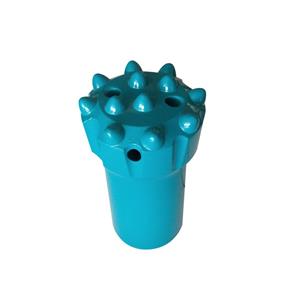
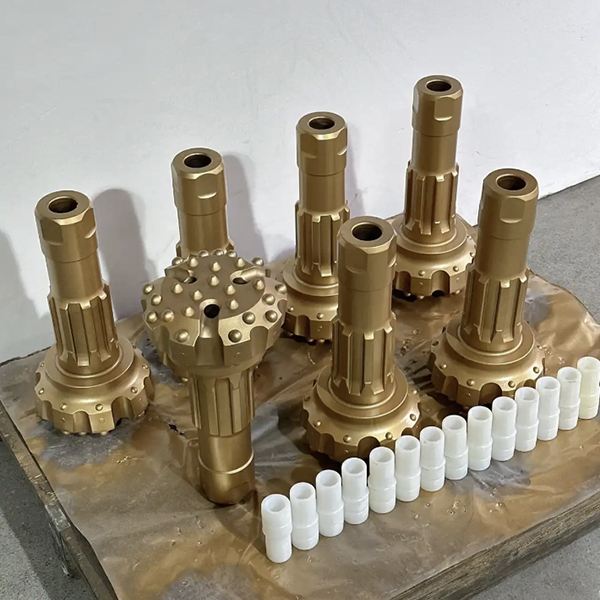
DTH drill bit
Drill rods
Shank or connection components
Air-distribution parts
Carbide buttons and bit-body design
The hammer produces impact energy. The bit transfers that energy into the rock. The drill rod transmits impact and compressed air. The air system drives the hammer and removes cuttings.
A weakness in any one of these parts can reduce overall drilling performance.
The real cost is also larger than the purchase price of the tool. A mine should consider:
Penetration rate
Tool life
Air and fuel consumption
Rod-change frequency
Unplanned downtime
Failure rate
Cost per drilled meter
A cheap tool that causes repeated interruptions may be more expensive than a higher-quality tool with a longer service life.
Why the same rig can produce very different results
Two mines can use the same drilling rig and still achieve very different daily output.
One crew may drill more than 200 meters per day while another manages only 150 meters. One bit may last a week in a formation while another wears out in three days.
The difference is often not the rig. It is the match between the drilling tools, the compressor, the rock, and the operating method.
A DTH hammer that is too small for the hole and formation may lack impact energy. A bit with the wrong button layout may wear quickly. A drill rod with poor alignment or damaged threads can waste energy throughout the string.
The equipment nameplate does not tell the whole story.
1. Stable impact efficiency matters
A DTH hammer is a high-frequency impact engine. Its internal air distribution controls piston movement and therefore controls the energy delivered to the bit.
If the air path becomes unstable or internal wear increases, the crew may notice:
Lower impact frequency
Energy loss
Falling penetration rate
Higher air consumption
Increasingly inconsistent drilling
Occasional slow drilling is not the main concern. The larger problem is a continuous drop in efficiency over a long shift.
A mature DTH hammer should continue to produce stable output after extended operation, provided the air supply, lubrication, flushing, and maintenance are correct.
When evaluating a hammer, do not ask only how fast it performs in a new condition. Ask how well it holds performance after sustained drilling.
2. Bit wear depends on more than carbide size
The drill bit is the part that directly contacts the rock. Hard rock, fractured rock, and weathered layers place different demands on the bit.
Many buyers still compare bits by price, carbide-button size, or how thick the body looks. Those details matter, but they are not enough.
Other factors include:
Button layout
Face design
Cuttings-removal capacity
Steel-body heat treatment
Gauge protection
Compatibility with the hammer and formation
Flushing is especially important in hard formations. If cuttings cannot leave the hole efficiently, the bit may repeatedly crush the same rock fragments. That increases wear, creates the risk of jamming, and may contribute to hole deviation.
Poor flushing does not only shorten bit life. It can also increase stress on the drill rod and hammer.
3. Drill rod quality controls system stability
Some of the most invisible losses on a mine site come from the drill rods.
Common rod problems include:
Fast thread wear
Rod breakage
Air leakage
Poor concentricity
Bending
Inconsistent connection fit
When rod accuracy is poor, the consequences accumulate over time. The hole may deviate from the planned position, impact energy may be lost, and the complete drilling system may become less efficient.
In large open-pit mines, straight-hole accuracy is increasingly important because it affects the final blast pattern. A drill rod is therefore not only a consumable item. It can influence fragmentation, vibration, and the performance of the entire drilling-and-blasting cycle.
The metric that matters: cost per meter
Mining procurement is gradually moving away from the lowest purchase price.
More operators now calculate cost per drilled meter. This gives a clearer picture of the tool's actual value.
A low-priced DTH tool may become expensive if it causes:
Slow drilling
Frequent bit replacement
Repeated rod changes
High air or fuel consumption
More downtime
Poor hole quality
Secondary work after drilling
A more useful comparison includes:
Cost per meter
Average penetration rate
Bit and hammer service life
Downtime caused by failures
Suitability for the actual rock
Availability of replacement parts
Supplier response time
The best tool is not necessarily the tool with the lowest invoice price. It is the tool that delivers stable meters under real site conditions.
Why domestic DTH tools are gaining attention
Many mines once preferred imported drilling-tool brands by default. Domestic DTH tool manufacturers have improved significantly in recent years.
Progress can be seen in:
Heat-treatment control
Carbide materials
Precision machining
Product consistency
Rock-condition matching
Service-life performance
Domestic supply can also offer practical advantages:
Shorter delivery times
More stable spare-parts availability
Faster technical response
Easier communication
More competitive total cost
For a mine running continuous, high-intensity drilling, these operational benefits may matter more than brand reputation alone.
Build the complete drilling package
A DTH hammer should not be selected in isolation. The hammer, bit, rod, shank, compressor, flushing system, and rock formation must be treated as one package.
Before changing tools, review:
Hole diameter and depth
Rock hardness and abrasiveness
Fracture and water conditions
Compressor pressure and air volume
Rod and thread compatibility
Bit-face design
Required production rate
Actual cost per meter
Gaea Rock supplies DTH hammers, DTH drill bits, drill rods, shank adapters, and related drilling tools for mining, quarrying, construction, tunneling, and foundation work.
The drilling rig may be the most visible machine on site. But the tool string is where much of the productivity and cost is decided.