The Six Ways a DTH Job Goes Wrong: Accident Analysis From the Bottom of the Hole
Air-driven DTH drilling is ten times faster than conventional methods in hard rock. That speed is the whole appeal. But the same high-frequency impact that makes it fast also makes it unforgiving when something goes wrong. A DTH accident doesn't develop slowly — it happens at fifty blows per second, and by the time you notice, the damage is done.
Here are the six ways a DTH job goes wrong, what causes each one, and what to do before and after.
1. Hammer Head Fracture — The Fatigue Break at the Spline Shoulder
The hammer head almost always breaks at the same place: the diameter transition just above the spline section. That's a geometric stress concentration — where the cross-section changes, stress piles up. It's also where the bit transmits torque through the splines, adding shear stress to the axial impact load.
Two things push a hammer head past its fatigue limit. The first is poor manufacturing: low-quality steel, residual stress from machining, insufficient fatigue strength. The second is operating conditions: excessive feed pressure that bends the string and amplifies vibration, or drilling through soft-hard transitions where the torque fluctuates constantly.
Prevention starts with buying from a manufacturer who can prove their quality. Then it's about drilling discipline: reduce parameters when entering fractured or heterogeneous ground, start with light feed when the formation is unknown, and ease off in soft layers where the inserts can dig in too deep and spike the torque.
Two practical safeguards: use a hammer with a retaining sleeve so a broken head doesn't drop to the bottom, and if the head does break, fish it out immediately before it wedges permanently.
2. Insert Breakage — The Outer Edge Goes First
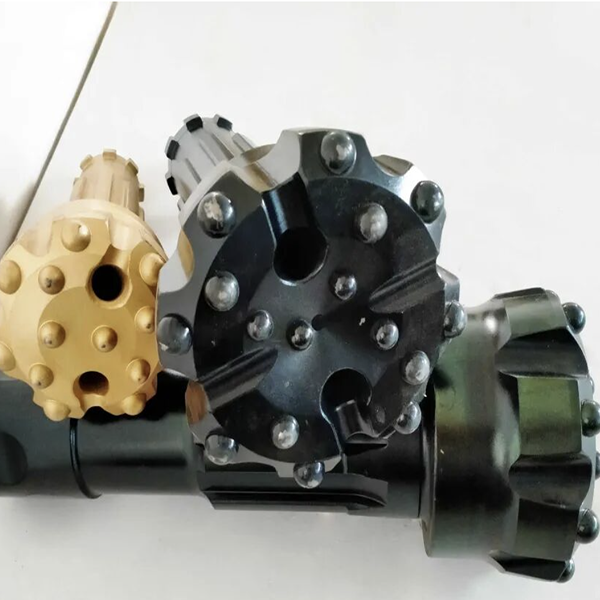
In normal drilling, insert wear is gradual. Most insert failures are sudden breakage, and the inserts at the extreme outer edge of the bit face are the most vulnerable. They take the highest impact loading, the most abrasive contact with the hole wall, and the most bending stress.
The causes split into three categories: formation (hard, fractured, or mixed ground), drilling parameters (too much feed, too much rotation speed), and operation (erratic feed, bouncing, blank firing).
The prevention is the standard discipline: light feed when starting, reduced parameters in difficult ground, smooth and steady feed pressure, and — most importantly — choose a bit whose insert grade and face design match the formation. An insert that's breaking in a formation it wasn't designed for isn't a quality problem. It's a selection problem.
3. Hammer Blockage — The Debris That Comes From Your Own Pipes
This one is embarrassing because it's entirely self-inflicted.
New drill pipe comes with rust scale, mill scale, and manufacturing debris on the inside wall. When compressed air starts flowing, that debris breaks loose and travels down the string — straight into the top of the hammer. It packs against the air passages and the check valve, restricting or blocking air flow.
The fix is simple and universally skipped: clean every pipe before it goes down the hole. Blow it out with compressed air. For new pipe, wire-brush the bore or run a cleaning swab. And clean the surface air lines too — especially the valves and elbows where debris accumulates.
4. Backflow — The Pressure Differential That Sucks Cuttings In
This is the most insidious DHT failure mode because it happens when the hammer isn't even running.
When the hole contains thick, slurry-like cuttings and the hammer stops, a pressure differential develops. If the check valve doesn't seal perfectly, or if the internal clearances are worn, that pressure differential sucks cuttings backward — up through the hammer's internal gaps and into the piston and spline clearances. The cuttings pack in. The piston jams. The splines seize. The exhaust ports block.
The root cause is usually a worn or damaged check valve, or worn piston-cylinder clearances that no longer seal. The prevention is inspection: check the check valve before every trip, check the piston and cylinder clearances on schedule, and replace worn parts before they allow backflow.
A more sophisticated fix for deep holes: install a float valve joint 150-200 meters up the string. The float valve closes when air pressure drops, preventing the reverse flow that drives cuttings into the hammer.
The immediate response when air flow becomes restricted: work the string up and down vigorously to clear the blockage. If that doesn't work, pull the string and inspect — don't keep forcing air into a blocked hammer.
5. Mud Ring Wrapping — The Slow Choke
In wet conditions, cuttings don't blow clean. They stick — to the drill string, to the borehole wall, to the hammer body. A ring of packed cuttings forms. The annular clearance shrinks. Cuttings that used to flow past now pile up against the ring. The ring grows into a mud pack, and the mud pack eventually seals the annulus completely. The string is stuck.
The mechanism is progressive: each circulation cycle leaves a little more material on the ring, and the ring makes the next cycle less efficient. By the time anyone notices the circulation is degrading, the pack is already forming.
Prevention is about keeping the annulus clean: adequate air volume, regular strong flushing, and attention to return flow. If the return is slowing, flush hard before it stops entirely.
6. Stuck and Buried — The Formation Fights Back
The final failure mode is the most expensive: the string is stuck, and the longer it sits, the more stuck it gets.
Formation factors include fractured or faulted rock that collapses into the hole, and water-bearing layers that cause shales to swell and disintegrate. Technique factors include the high-frequency vibration that loosens the borehole wall, the high-velocity air that erodes unstable rock, and the lack of any wall-supporting fluid in air drilling.
When the walls start to fail, the sequence is predictable: blocks fall, the hammer gets jammed, and if the hole collapses, the hammer gets buried.
The response ladder is graduated. Start with observation — watch the return flow, watch the torque, watch for changes in penetration. Keep the string moving — frequent short trips, regular up-and-down movement to prevent settling. At the first sign of trouble, stop and address it. Use foam injection to carry out heavy cuttings. Trip short to check the borehole wall condition. If the hole won't stay open, switch tactics — foam drilling, or a wall-supporting fluid, or casing. As a last resort, milling to free a stuck string.
The Pattern
DTH drilling is fast, but it rewards attention and punishes neglect. The six accident types have one thing in common: almost all of them are preventable with inspection, cleaning, and drilling discipline. The hammer that fails because of debris in a dirty pipe, or a worn check valve, or excessive feed pressure — those failures aren't bad luck. They're the predictable result of skipping the boring steps.