Where DTH Hammers Work Best: Five Hard-Rock Drilling Applications
A down-the-hole hammer, also called a DTH hammer, is a compressed-air drilling tool that delivers impact directly at the bottom of the hole.
The piston and drill bit work inside the hole instead of transferring impact energy from the surface through a long drill string. This reduces energy loss and makes DTH drilling highly effective in hard rock.
But a DTH hammer is not selected by diameter alone. The hammer, bit, drill rods, rig, compressor, flushing system, and geological conditions must work as one package.
Here are five common applications.
1. Mining and quarry blast holes
Mining and quarrying remain the most familiar DTH hammer applications.
Typical hole diameters range from approximately 90 to 200 mm. DTH rigs are used for:
Open-pit bench blasting
Quarry production drilling
Road-cut excavation
Waste-rock drilling
Construction site rock removal
The hammer is commonly mounted on a crawler-mounted DTH drill rig. The rig may drill vertical, inclined, or horizontal holes depending on the bench and blast design.
Air supply is one of the most important performance factors. High-pressure, high-volume air is needed to drive the piston and remove cuttings from the hole. If the compressor cannot maintain the required air flow, penetration rate falls and the hole may not clean properly.
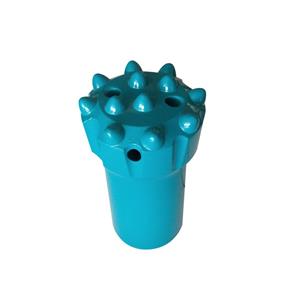
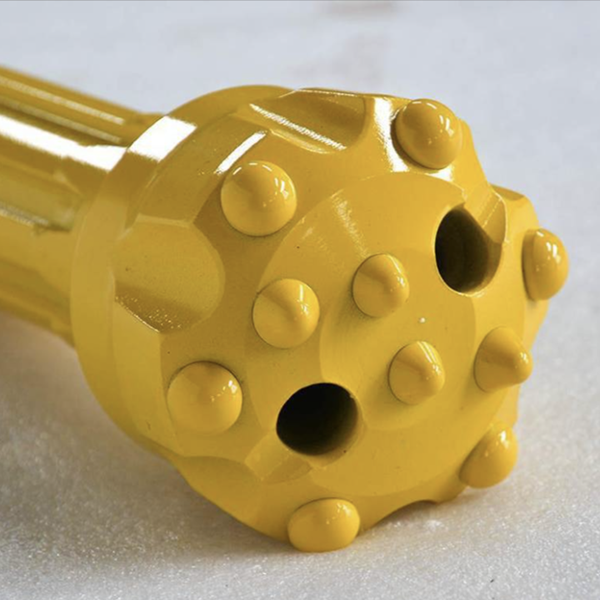
The bit must also match the rock hardness and the hammer model. A hammer that is correctly selected but paired with an unsuitable bit will still deliver poor results.
2. Large-diameter rock-socketed piles
Rotary drilling can struggle when a project reaches hard granite, basalt, or other competent rock. In these conditions, a large-diameter DTH hammer can be used to drill rock-socketed foundation piles.
Typical hole diameters may range from approximately 600 mm to more than 2,000 mm, depending on the project.
Applications include:
Bridge foundations
High-speed rail projects
Offshore or marine structures
High-rise building foundations
Large-diameter pile construction
Several equipment configurations are common.
A rotary drilling rig can directly connect to a DTH hammer through the drill string. This arrangement is flexible and widely used.
A large piling rig with a DTH hammer can provide better control of hole depth and verticality.
A full-rotation drilling system can advance casing while the DTH hammer works inside or ahead of the casing. This is useful in unstable ground, collapsed formations, and karst conditions where maintaining the hole wall is difficult.
The key challenge is not only breaking the rock. It is maintaining alignment, removing cuttings, controlling casing, and keeping the pile hole stable throughout the operation.
3. Water wells and geothermal drilling
DTH hammers are also widely used for water-well and geothermal drilling in hard-rock areas.
Typical hole diameters range from approximately 150 to 500 mm. Common applications include:
Agricultural irrigation wells
Domestic water wells
Geothermal exploration
Rural groundwater development
Bedrock investigation
During drilling, compressed air drives the hammer and carries rock cuttings back to the surface. In suitable formations, this air-lift method reduces the need for continuous mud circulation.
That can help keep the formation cleaner and reduce the risk of contaminating the water-bearing zone with drilling fluid. It also provides a clear indication of the formation being drilled and can help identify water inflow.
Truck-mounted and trailer-mounted multi-purpose water-well rigs are commonly used for this work.
The drilling team still needs to manage dust, air pressure, water inflow, hole stability, and local groundwater protection requirements. A clean hole is valuable, but protecting the aquifer is part of the job.
4. Ground anchors and slope stabilization
When a project requires relatively small but deep holes in hard rock, a DTH hammer is often an efficient choice.
Typical hole diameters range from approximately 90 to 250 mm. Applications include:
High-slope anchor holes
Rock-bolt holes
Foundation-pit support
Anti-slide piles
Tunnel pipe-roof support
Geological hazard control
DTH drilling can perform well in fractured rock, cobble layers, and formations where conventional drilling struggles to maintain a stable hole.
Split-type and integrated DTH drill rigs are both used. Anchor drilling rigs are also common where the work area is narrow or the drilling angle must be controlled precisely.
For slope stabilization, hole direction and depth are just as important as penetration speed. The drilling system must follow the engineering design so that anchors or reinforcement elements reach the intended rock mass.
5. Underwater and marine construction
Underwater rock drilling is one of the more specialized DTH applications.
Large-diameter underwater holes may exceed 800 mm. Typical projects include:
Removing underwater reefs near ports
Excavating trenches for submarine pipelines
Drilling rock sockets for offshore wind foundations
Marine foundation construction
Harbor and channel improvement
Specialized systems may use double drill rods. High-pressure air is delivered through one passage while cuttings and return flow are managed through another. This allows the hammer to operate at significant water depths.
The equipment may be mounted on a drilling barge, marine platform, or specialized offshore rig.
Underwater drilling requires careful control of water pressure, air delivery, cuttings removal, visibility, casing, and marine safety. The hammer must be selected for the actual depth and diameter rather than simply adapted from a land-based drilling setup.
Match the hammer to the complete system
Across all five applications, one principle remains the same: DTH performance depends on system matching.
Before choosing a hammer, check:
Required hole diameter and depth
Rock hardness and fracture condition
Rig type and available feed force
Compressor pressure and air volume
Drill rod and thread compatibility
Bit design and button configuration
Flushing and cuttings-removal method
Access, angle, and environmental constraints
A powerful hammer cannot compensate for insufficient air. A large bit cannot perform well if the rig lacks feed capacity. A suitable hammer can still suffer premature wear when the rod, bit, or compressor is mismatched.
Gaea Rock supplies DTH hammers, DTH drill bits, drill rods, shank adapters, and related drilling tools for mining, quarrying, foundations, water wells, tunneling, and marine construction.