DTH Hammer and Bit Matching: Why Hard Rock Drilling Problems Are Usually an Equipment Mismatch
If you've ever stood next to a DTH rig in hard granite watching the penetration rate crawl to a standstill while the compressor screams at full output, you've probably heard someone say it: "This rock is just too hard." And sometimes that's true. But a lot more often, the rock is exactly as hard as it's supposed to be — the problem is that the hammer and bit combination was chosen for a different job.
Down-the-hole drilling is a system. The hammer, the bit, the air pressure, and the rock all have to agree with each other. When they don't, you get the symptoms everyone blames on the ground: slow penetration, stuck bits, excessive wear, holes that wander off course. Fix the match, and the rock suddenly gets a lot more cooperative.
The 115-Millimeter Standard: When a 4-Inch Hammer Is the Smart Money
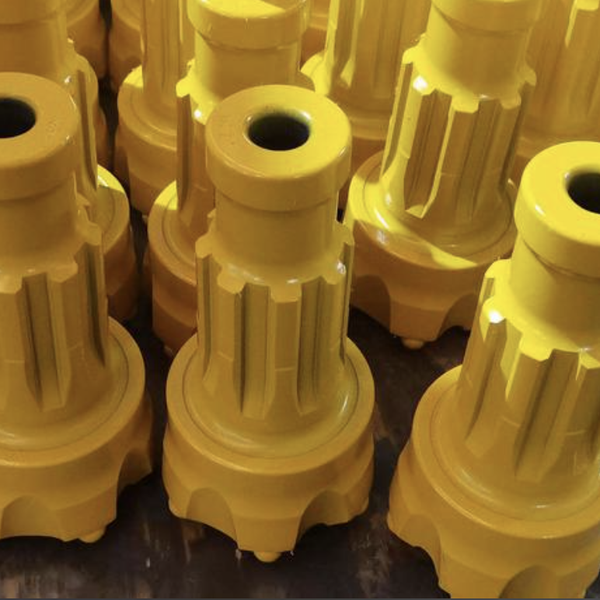
For blast holes, water wells, and exploration drilling in the 115-millimeter diameter range through medium to hard formations — limestone, coal measures, and most gold and molybdenum deposits — the 4-inch DTH hammer paired with a 115 mm bit is the combination that balances speed, cost, and reliability better than anything else in its class.
Why 4-inch for 115 mm? The piston diameter in a 4-inch hammer provides enough impact face area to deliver percussive energy that matches what a 115 mm bit face can usefully absorb. Go smaller — say, a 3.5-inch hammer driving a 115 mm bit through an adapter — and the impact energy per blow is too low for the bit diameter. The bit face doesn't get enough energy density to create proper craters in hard rock, and penetration rate suffers even though the compressor is working just as hard.
Go larger — a 5-inch hammer on a 115 mm bit — and you're pounding more energy into the bit than the bit body and carbide inserts are designed to handle. The excess energy doesn't translate into faster drilling; it translates into shock loading that chips carbide inserts, peens the bit shank, and sends vibration up the drill string that shortens the life of everything above the hammer.
The 4-inch/115 mm pairing lands in the sweet spot. The hammer cycles fast enough to maintain a high blow frequency — important in hard rock where you need lots of impact events per minute — but each individual blow carries enough energy to fracture the rock rather than just bounce off it. And because the system isn't over-pressured, air consumption stays manageable. You're not running the compressor at redline all shift just to keep the hammer cycling.
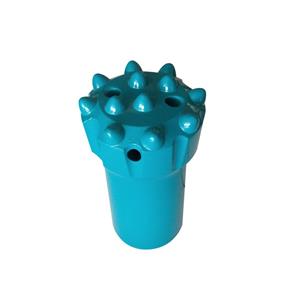
In practical terms, this combination handles limestone and coal measure rock comfortably on moderate air pressure. In harder formations — granite, basalt, quartzite — you'll need to bring the pressure up, but the hammer and bit are designed to take it. The carbide button profile on a properly spec'd 115 mm DTH bit for hard rock will be spherical or ballistic rather than conical, giving you impact resistance at the expense of some penetration speed. That trade-off is worth making when the alternative is chipped buttons and a bit pull mid-hole.
The 140-Millimeter Challenge: When You Need Bigger Everything
Step up to 140 mm diameter holes in high-hardness formations — iron ore, dense copper porphyry, unweathered basalt — and the game changes completely. The bit face area increases by nearly 50% compared to 115 mm, which means the hammer needs to deliver proportionally more impact energy per blow just to maintain the same energy density at the rock face. A 4-inch hammer can't do it. You need a 5-inch.
The 5-inch DTH hammer brings a larger piston with a longer stroke, delivering the deeper, heavier blows that a 140 mm bit face needs to fracture hard rock efficiently. The blow frequency is lower than a 4-inch hammer — that's the trade-off for higher per-blow energy — but in large-diameter hard rock, blow energy matters more than blow frequency. A hundred heavy blows that actually fracture the rock will advance the hole faster than two hundred light blows that just chip the surface.
The bit design changes too. A 140 mm DTH bit for hard rock needs a more robust body with deeper junk slots to handle the higher volume of cuttings produced per meter. The flushing holes are larger and positioned to direct air exactly where the gauge row needs cooling — the outer buttons do more work per rotation than the center buttons because they travel farther, so they need more active cooling. If the flushing isn't right at the gauge, the outer buttons overheat and wear prematurely, and the hole diameter starts shrinking within the first twenty meters.
Deep-hole 140 mm drilling adds another complication: cuttings evacuation over long distances. At 50 meters and beyond, the air velocity in the annulus can drop enough that heavier chips start settling instead of flowing out. The 5-inch hammer's higher air consumption — which is a cost consideration in shallow holes — becomes an advantage in deep holes because the higher air volume maintains better annular velocity and keeps the hole cleaner.
How to Spot a Mismatch Before It Costs You a Shift
The signs of a bad hammer-to-bit match show up fast if you know what to look for:
Penetration rate drops off a cliff in hard rock but the compressor is running fine. The hammer is undersized for the bit diameter. You're not getting enough impact energy per blow to fracture the rock, so the bit is essentially hammering in place.
Carbide buttons are chipping or shattering within the first few holes. The hammer is oversized for the bit. The impact energy is too high, and the carbide inserts — which are spec'd for a specific energy range — are taking impact loads beyond their design envelope. The fix is either a smaller hammer or a bit with heavier-duty carbide buttons rated for higher impact.
The hole is drifting, especially at depth. This can be a hammer issue (the piston isn't striking true) or a bit issue (the gauge row is wearing unevenly), but it's often a matching problem where the hammer's blow energy isn't centered on the bit's mass distribution. Make sure the bit shank length and hammer chuck are compatible — a bit that's too short or too long for the hammer will receive off-axis impact.
Excessive air consumption with no corresponding penetration improvement. You're running higher pressure than the system needs, usually because someone is trying to compensate for a mismatch by cranking up the compressor instead of fixing the hammer-and-bit pairing. More air doesn't fix a fundamentally wrong hammer size.
The Bottom Line
In DTH drilling, the hammer and bit are a matched pair. They're designed as a system, tested as a system, and they perform as a system. Mixing brands or sizes because "it fits" or "it was what we had on the truck" is how you turn a routine drilling program into a troubleshooting exercise. Pick the hammer for the hole size, pick the bit for the rock, and make sure they're designed to work together. Do that, and hard rock stops being the problem — it just becomes the job.