DTH Hammer Stopped Mid-Hole? Don't Panic — Here's Where to Look First
A DTH hammer that's been cycling hard all shift and suddenly goes silent is one of the worst sounds on a drill site. The compressor is still running. The rig still has power. But down the hole, nothing. No impact. No rotation. Just silence and the sinking feeling that you're about to lose a shift to troubleshooting.
Before you start tearing things apart, take a breath. Most DTH hammer stoppages fall into three categories, and the fix is usually quicker than your first instinct suggests. Here's the field-tested sequence for getting back to drilling without making things worse.
Step One: Check the Obvious — Your Air Supply
This is where most stoppages live, and it's where you should always start because it's the easiest to verify and the fastest to fix.
Put your hand on the air hose near the hammer connection. Can you feel flow? If not, work backwards: check the hose for ruptures, kinks, or blown seals at the couplings. A hose that's been dragged across sharp rock for months can develop a pinhole leak that bleeds just enough pressure to drop the hammer below its cycling threshold. You might hear it before you see it — a hissing at the coupling or a whistle along the hose body.
If the hose is intact, check the compressor. Is it still running under load, or has it tripped? Compressors shut down for predictable reasons: low oil level, overheating from clogged cooling fins, or an overload trip from running at maximum output too long. Check the oil sight glass first — nine times out of ten, a compressor that stopped mid-shift was low on oil. Check the temperature gauge: if the compressor is too hot to touch, let it cool before restarting. Restarting an overheated compressor just trips it again and risks damaging the pump.
If you're running multiple hammers or tools off the same compressor, check whether someone else on site opened another air line. A second hammer starting up on the same circuit can drop the supply pressure below what your hammer needs, and it'll stop cycling without anything actually being broken.
Step Two: The Hammer Isn't Cycling — Is Something Seized Inside?
If air supply is good and the hammer still won't cycle, the problem is inside the hammer itself. The two most common internal failures are piston seizure and drill bit jamming.
Piston seizure happens when the piston and its liner — which run with clearances measured in hundredths of a millimeter — lose lubrication. The film of oil that separates piston from liner is the only thing preventing metal-to-metal contact. If that oil film breaks down — because the lubricator ran dry, because the oil is the wrong viscosity for the operating temperature, or because water has contaminated the oil — the piston and liner gall against each other. Once galling starts, the piston stops moving, and the hammer goes silent.
The telltale sign of a seizure is that the hammer was running fine, then the impact sound started to change — it got duller, less crisp — before stopping entirely. That's the sound of the piston losing clearance as the galling builds up. If you hear that change in impact tone, stop drilling immediately. Continuing to cycle a galling piston turns a cleanable scuff into a replacement job.
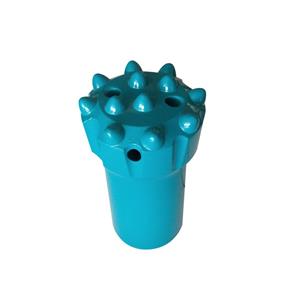
Drill bit jamming inside the hammer chuck is the other common internal stoppage. This happens when the bit — specifically the bit shank that sits inside the hammer — binds against the chuck due to lack of lubrication, ingress of rock dust past the bit retaining ring, or a bent bit shank from excessive side loading. When the bit can't slide freely in the chuck, the piston can't strike it properly, and the hammer either cycles weakly or stops entirely.
The field check for bit jamming: with the air off, try to move the bit in and out of the chuck by hand. It should slide freely through its full stroke — typically 40 to 60 millimeters depending on hammer size. If it's stiff, won't move, or moves only partially, the bit is jammed. Pull it, clean the chuck bore and bit shank, inspect for galling or scoring, and replace the bit retaining ring if it's worn. A worn retaining ring lets rock dust into the chuck, and rock dust is basically lapping compound — it'll wear the precise clearances out of both the bit shank and the chuck in a single shift.
Step Three: Check the Connection — Where Hammer Meets Drill Rod
The junction between the DTH hammer and the drill rod above it takes every blow that the piston delivers. The hammer body transmits the impact reaction force upward into the rod connection with every strike, and over thousands of strikes, that threaded connection can fatigue, loosen, or fail.
If the hammer was running but suddenly lost rotation — the air is still flowing but the bit isn't turning — check the connection between the hammer and the drill rod. A connection that's backed off partially will still transmit some rotation but not full torque. A connection that's sheared completely will leave the hammer and bit at the bottom of the hole with no mechanical link to the surface.
Listen at the collar while someone else watches the rotation gauge. A clattering sound from downhole combined with erratic rotation readings usually means a loose or failing connection. Stop immediately, pull the string, and inspect the threads on both the rod box and hammer pin. Any galling, deformation, or cracking means the parts need replacing before you go back in the hole.
Step Four: Did a Safety System Trip?
Modern drill rigs and compressors have protection systems that will shut everything down when parameters go out of range. These aren't failures — they're the safety systems doing their job. But knowing what tripped them tells you where to look.
Compressor overload trips usually mean the hammer was demanding more air than the system could deliver at stable pressure — often because the bit face was packing with cuttings and the hammer was working harder to cycle against back-pressure. Clear the hole before restarting.
Temperature trips on the compressor or hydraulic system mean something was running hot — low oil, clogged cooler, or ambient temperatures beyond the equipment's rated range. Fix the cooling issue before restarting, not after.
In underground operations, gas monitoring systems can trigger an automatic shutdown of all equipment if methane or other hazardous gas concentrations exceed safety thresholds. If this happens, there is no troubleshooting procedure — evacuate, ventilate, and re-test before anyone goes near the equipment.
The One Rule That Prevents Most of This
Every stoppage described above — seized pistons, jammed bits, failed connections, overheated compressors — shares a common root cause: something that should have been caught during pre-shift inspection wasn't. Check the lubricator oil level. Check the air hose for damage. Check the bit shank for free movement. Check the rod connections for tightness and thread condition. Five minutes at the start of the shift prevents hours of troubleshooting in the middle of it.