Eight-Wing PDC Drill Bits: When More Cutters Actually Mean Lower Costs
Let's be honest: when someone pitches you a drill bit with more wings, more cutters, and a higher upfront price, the instinct is to ask "why should I pay extra for the same hole?" Fair question. But if you've ever pulled a four-wing PDC bit out of a mixed-formation hole and found the gauge cutters half gone while the center teeth looked brand new, you already know the answer. Uneven loading kills bits. And the fix, more often than people realize, is simply more contact points.
Eight-wing PDC bits aren't new, but they're still underused — partly because the initial cost looks higher on the purchase order, and partly because a lot of drilling programs default to whatever bit they've always used. Here's what changes when you go to eight wings, and why the math works out in your favor once you look past the sticker price.
Stability: The Problem You Don't Notice Until the Core Barrel Comes Up Empty
In layered or fractured formations — sandstone over shale, limestone with chert stringers, interbedded coal measure rock — a four-wing or six-wing bit doesn't have enough contact points to neutralize the side forces that come from hitting hard and soft layers in rapid succession. The bit deflects. The hole wanders. And if you're coring, you end up with broken, missing, or jammed core that's useless for geological analysis.
Eight wings change the dynamic. With eight evenly spaced cutting surfaces around the bit face, the side forces from formation transitions get absorbed and canceled out before they can push the bit off track. Think of it like the difference between a four-legged stool and an eight-legged one — both will hold you up on flat ground, but put them on uneven terrain and the eight-legged version stays level while the four-legged one rocks.
This stability doesn't just keep the hole straight. It also protects your drill rods. A bit that deflects sideways transmits those lateral forces up the drill string. Each deflection puts bending stress on the rod connections, and over hundreds of meters of drilling, that adds up to accelerated thread wear, fatigue cracking, and the occasional snapped rod at the worst possible depth. A stable bit means a longer life for everything above it.
Wear Life: It's Just Arithmetic
The wear argument for eight-wing bits is simpler than most technical discussions in drilling. A PDC cutter has a finite amount of rock it can cut before the diamond table dulls past usefulness. Spread that total workload across more cutters, and each one does a smaller share. Smaller share = slower wear = longer bit life.
In practice, what does that look like? In medium-hard formations like sandstone and limestone, operators running eight-wing PDC bits report 30% or more additional footage per bit compared to four-wing or six-wing equivalents. That's not a marginal improvement — it's the difference between finishing a drilling program with one bit change versus three or four.
The economics are straightforward. If an eight-wing bit costs, say, 40% more than a four-wing but lasts at least 30% longer, you're already close to break-even on consumable cost alone. But the real savings come from what's not on the invoice: the tripping time for a bit change at 200 meters depth, the crew standing around while the rig is idle, the wear on hoisting equipment from an extra round trip. Factor those in, and the eight-wing pulls ahead by a comfortable margin on most medium-hard to hard formation jobs.
Mixed Cutter Geometry: Round for Impact, Sharp for Speed
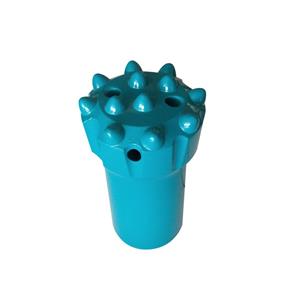
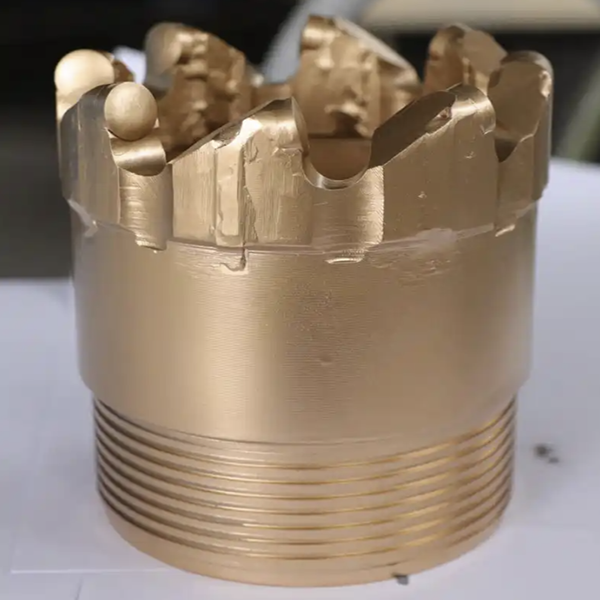
One design detail that separates a good eight-wing bit from a marketing gimmick is cutter geometry. The smart approach — and what you should look for when spec'ing a bit — is a mixed layout: spherical or dome-shaped PDC inserts for the primary cutting zone and prismatic or flat cutters around the periphery.
Why mix them? Different parts of the bit face do different jobs. The center cutters take the brunt of the impact load when the bit first engages the rock. Spherical PDC inserts spread that impact across a larger contact area, which means fewer chipped edges and less catastrophic failure when you hit a hard nodule unexpectedly. The gauge cutters, meanwhile, are primarily scraping — maintaining hole diameter and finish. A sharper, flatter cutter profile at the gauge gives you cleaner hole walls and better cuttings clearance around the bit shoulder.
This combination makes eight-wing bits unusually versatile across formation types. In hard limestone, the round inserts hold up. In abrasive sandstone, the extra cutters share the wear. In mixed ground, the stability keeps things tracking straight. It's not a one-trick design.
The Tricone Comparison Worth Making
If you're coming from a background of running tricone bits in hard rock, the eight-wing PDC is the closest thing to a direct replacement that still gives you the benefits of fixed-cutter technology. Tricone bits handle hard formations by crushing — high weight, relatively slow rotation, mechanical rock failure under point loading. A well-designed PDC bit with enough wings shears instead of crushes, which is faster and more energy-efficient when the formation allows it. The eight-wing layout gives you the structural integrity to apply the kind of WOB that tricone drilling demands, without the moving parts and bearing failures that eventually ground every roller cone bit.
The Real Decision Point
Eight-wing PDC bits aren't the right call for every hole. In soft, homogeneous clay or coal, a three-wing bit will outrun them on penetration rate and cost less doing it. In extremely hard, abrasive quartzite, even eight wings won't save you from rapid wear — that's diamond-impregnated territory.
But for the broad middle of the drilling world — medium-hard to hard formations, mixed lithologies, holes where deviation actually matters — going to eight wings is one of the few equipment changes that pays for itself on the first job. The trick is getting past the purchase-order price and looking at the cost per meter. That's where the extra wings earn their keep.