Enhanced Triangular Alloy Drill Rod: A Practical Guide for Complex Formation Drilling
In coal mining, geological exploration, and other drilling projects, soft, fractured, and collapse-prone coal seams are among the most difficult formations to handle. When conventional drill rods are used in these conditions, problems such as borehole collapse, rod sticking, and poor cuttings discharge often occur. These issues not only reduce drilling efficiency, but also create serious safety risks.
The enhanced triangular alloy drill rod was developed specifically to solve these challenges. With a specialized structural design and high-strength alloy construction, it has become a reliable tool for drilling in difficult formations. In this article, we’ll take a closer look at what makes this high-performance drill rod so effective.
Why Soft and Fractured Coal Seams Are Difficult to Drill
Soft, broken, and unstable coal seams usually have a loose internal structure and lack the strength needed to support the borehole wall. In many cases, they also contain moisture and gas, which further increase the risk of collapse.
When a standard round drill rod is used in this kind of formation, several common problems can occur:
The borehole wall is easily damaged or collapsed because the rod cannot compact the loose coal effectively.
The cuttings discharge channel is too narrow, causing coal debris to accumulate and jam the rod.
Rod sticking may stop the drilling process, damage equipment, and in severe cases even increase the risk of gas leakage.
Conventional rods often have limited torsional and bending resistance, making them more likely to deform or break during deep-hole drilling.
Because of these limitations, standard drill rods are often not suitable for demanding drilling work in unstable formations.
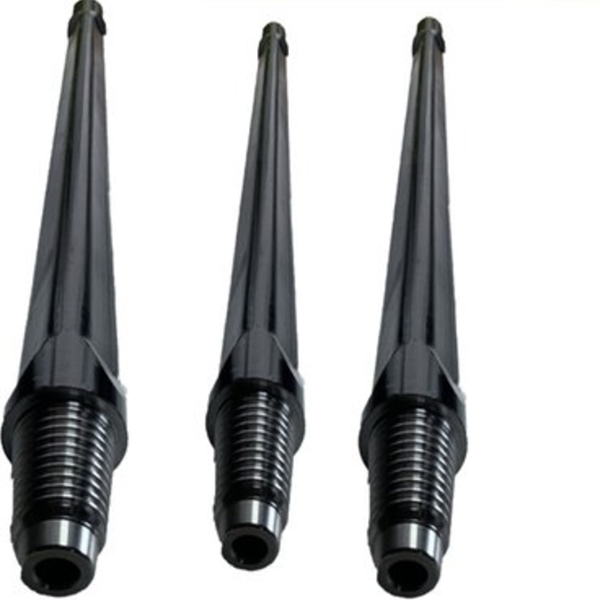
What Is an Enhanced Triangular Alloy Drill Rod?
The enhanced triangular alloy drill rod is built around two key features:
a triangular structural design,
and high-strength alloy steel material.
Combined with reinforced construction details, this drill rod is specifically designed to meet the demands of complex formations. Its core advantages can be summarized in five key areas:
prevention of borehole collapse,
reduced risk of rod sticking,
faster cuttings removal,
higher torque capacity,
deeper drilling capability.
These features directly address the main pain points of drilling in soft and unstable coal seams.
How the Triangular Structure Helps Prevent Borehole Collapse
Unlike a conventional round drill rod, this drill rod features a triangular body with arc-shaped sides.
As the rod rotates, the three curved surfaces press and smear the loose coal against the borehole wall. This compacts the surrounding material and forms a more stable “natural protective layer,” which helps reduce the risk of borehole collapse.
One major benefit of this design is that it improves borehole stability without requiring additional wall-support materials, helping reduce operating cost while improving drilling efficiency.
Better Cuttings Removal and Lower Risk of Rod Sticking
Another major advantage of the triangular structure is its ability to improve cuttings discharge.
The shape creates three independent semicircular cuttings channels between the rod body and the borehole wall. Compared with the narrow flow path around a conventional round rod, these channels provide much more space for coal chips and rock powder to move out of the hole.
This allows cuttings to be discharged more quickly and helps prevent material buildup that can cause the rod to become stuck. As a result, the enhanced triangular alloy drill rod significantly reduces the risk of:
rod jamming,
equipment damage,
drilling interruptions,
production delays.
Smoother Rotation and Higher Drilling Efficiency
The arc-shaped surfaces of the rod body also help reduce friction against the borehole wall.
This makes air or water flushing more effective, improves cuttings transport, and enhances overall drilling smoothness. With faster and more efficient debris removal, the drilling rate can be increased and the project cycle can be shortened significantly.
In difficult formations, this improvement in drilling efficiency can make a major difference in productivity.
High Torque Capacity and Stronger Mechanical Performance
The word “enhanced” in the product name is especially reflected in its mechanical strength.
The rod body is typically made from high-strength alloy steel such as 45Mn2 or DZ50 / R780, with a thickened seamless structure for greater durability.
The joints are usually manufactured from 42CrMoA alloy steel, treated through quenching and tempering, and integrally formed by friction welding for a stronger and more reliable connection.
This reinforced construction gives the drill rod:
torque capacity of approximately 3500–7500 N·m,
excellent torsional resistance,
strong bending resistance,
reduced risk of deformation or breakage during deep drilling.
These mechanical advantages make it far more suitable for heavy-duty underground drilling than standard drill rods.
Greater Drilling Depth for Deep-Hole Applications
Because it combines high torque, stable borehole support, and efficient cuttings removal, the enhanced triangular alloy drill rod can achieve drilling depths of approximately 50 to 250 meters.
This is significantly deeper than the typical 50-meter limit of many ordinary drill rods. As a result, it is well suited for applications such as:
coal mine gas drainage,
water exploration and discharge,
deep geological investigation,
other deep-hole drilling operations.
Wide Range of Applications
Although this drill rod was originally designed for soft coal seams, its application range is much broader.
In geological exploration, it can be used in:
loose and fractured formations,
interbedded coal and rock formations,
collapse-prone ground conditions.
In engineering and construction, it is also suitable for:
geophysical drilling,
anchoring projects,
water conservancy drilling,
slope stabilization,
support hole drilling in unstable formations.
Wherever borehole instability and poor cuttings discharge are major challenges, the enhanced triangular alloy drill rod can offer clear performance advantages.
Conclusion
The enhanced triangular alloy drill rod represents an important advancement in drilling technology for complex formations. With its triangular structural design and high-strength alloy construction, it directly addresses the major challenges of drilling in soft, fractured, and unstable coal seams.
By improving borehole stability, reducing sticking, increasing cuttings discharge efficiency, and supporting deeper drilling, it helps operators achieve both higher productivity and lower safety risk.
Built on the principle of designing according to real formation conditions, every structural optimization of this drill rod serves a practical purpose. Today, it has become an indispensable drilling tool in coal mining, geological exploration, and engineering construction, providing reliable support for difficult drilling environments.