Extending Drill Rod Life: Four Decisions That Determine Whether a Rod Lasts 200 Meters or 2,000
A drill rod's service life isn't determined underground. It's determined by decisions made before the rod ever touches rock — what you buy, how you match it to the job, how you run it, and what you do with it between shifts. Get any of these four wrong, and the best steel in the world will still fail early. Get all four right, and the same rod will outlast its cheaper cousins by a factor of three or more.
Here's the full lifecycle, from purchase to retirement.
Decision One: What You Buy Determines What You Get
The first decision — which rod to purchase — sets the ceiling on everything that follows. A rod with inadequate heat treatment, poor thread finishing, or substandard material cannot be saved by careful operation or diligent maintenance. The failure is baked in before the rod ships.
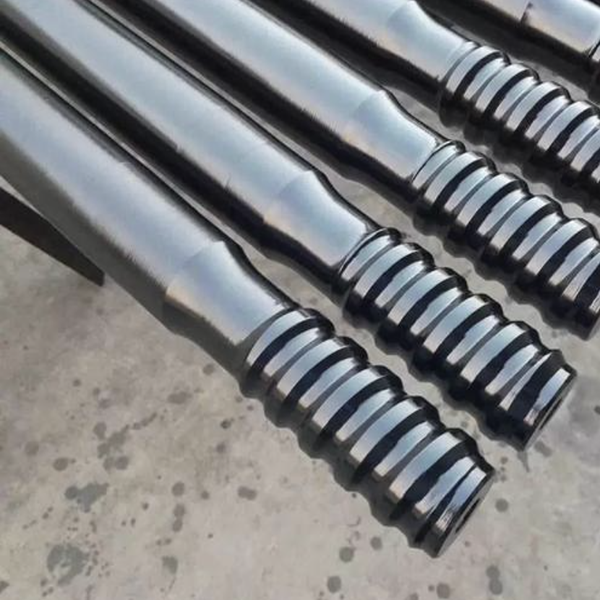
What to look for in a quality drill rod: the alloy should be a proper chromium-nickel-molybdenum grade — 42CrMo, 4140, or equivalent — with documented heat treatment records showing quench and temper to balanced strength and toughness. The thread finish should be smooth to the touch, with no visible tool marks, and the thread roots should have a visible radius rather than a sharp corner. Sharp thread roots are stress concentrators that initiate fatigue cracks. A quality rod will have undergone post-weld heat treatment if friction-welded, and the upset at the connection end should be visible as a smooth diameter transition rather than an abrupt step.
Ask for heat treatment records. Ask for inspection reports. A supplier who can't or won't provide these is telling you something about what's inside the rod — or what isn't.
Decision Two: Matching the Rod to the Job
A drill rod that's perfect for 45-millimeter holes in medium limestone will fail fast in 89-millimeter holes in hard granite. The rod diameter, wall thickness, and thread size all have to match the impact energy the drill is delivering and the resistance the rock is putting up.
The most common mismatch is undersized rods on high-power drills. The rod simply doesn't have enough cross-sectional steel to safely carry the impact energy. Every blow pushes the stress at the thread root beyond the material's fatigue limit, and the rod accumulates fatigue damage with every strike. An undersized rod might drill fine for a few shifts — long enough to convince everyone it's working — and then snap without warning because the accumulated fatigue finally reached critical crack size.
The opposite mismatch — oversized rods on low-power drills — is less dangerous but still wasteful. The excess rod mass absorbs impact energy that should be going into the rock. Penetration rate drops. The drill has to work harder to accelerate the heavier rod on every blow. The rod itself doesn't fail, but everything is slower and more expensive than it needs to be.
Match the rod specification to the drill manufacturer's recommendation and to the rock conditions. The manual exists for a reason.
Decision Three: How You Run It
Even a perfectly spec'd rod will fail early if it's abused in operation. Three operating mistakes dominate rod failures:
Starting the hole with the bit off the rock surface — "air hammering" or "blank firing." The full impact energy travels through the rod with no rock to absorb it, reflecting back as a tensile wave through every threaded connection. The threads take a beating every time this happens. The bit should be in contact with the rock before the hammer starts cycling. Always.
Drilling with the feed beam or drill not perpendicular to the rock face. An angled start puts the rod into bending from the first blow, and bending stress is additive to the impact and torsional stresses the rod is designed for. The combined stress at the thread root can exceed the material's fatigue limit even when each individual stress component is within spec. Square up before you start drilling.
Not adjusting parameters when the rock changes. If penetration slows because the bit hit harder ground, the answer is to reduce feed pressure and let the bit work at its new pace — not to crank the feed and force it. Excessive feed on a bit that's already struggling adds compressive buckling load to the rod, and a buckled rod in a rotating string is a fatigue failure waiting to happen.
Decision Four: What Happens Between Shifts
The maintenance that matters most for drill rod life isn't complicated. It's just easy to skip.
Clean the rod after every shift. Rock slurry left on the rod surface dries into a cement-like crust that's abrasive to everything it touches. It also traps moisture against the steel, promoting corrosion pitting — and corrosion pits are fatigue crack initiation sites. A quick rinse and wipe takes seconds.
Inspect the threads before storing the rod. Look for the earliest signs of trouble: hairline cracks at the thread root, discoloration at the first engaged thread (heat tint from fretting), deformation or flattening of the thread crests. Any of these means the rod is entering its decline phase and should be flagged for limited use or retirement. Catching a crack before it propagates to failure saves the rod and whatever it's connected to.
Apply rust preventive to the threads and to any area where the surface coating has worn through. A rod that rusts in storage is a rod that starts its next shift with built-in stress concentrators. Thread protectors go on before the rod hits the rack — always, no exceptions.
Store rods horizontally with support at multiple points — not leaning against a wall, not stacked in a pile, not resting on uneven surfaces. A rod that takes a sag set from improper storage will run with a permanent bend, and a bent rod is a fatigued rod.