From Specifications to Selection Principles: How to Match Geological Drill Rods with Rock Drilling Rigs
In geological exploration, coal mining, and related engineering projects, the right match between drill rods and drilling rigs is essential for both drilling efficiency and operational safety. Many field teams struggle with one common question: which rig should be used with which rod size? In practice, the answer comes down to two fundamentals—size compatibility and performance compatibility—chosen according to actual drilling requirements.
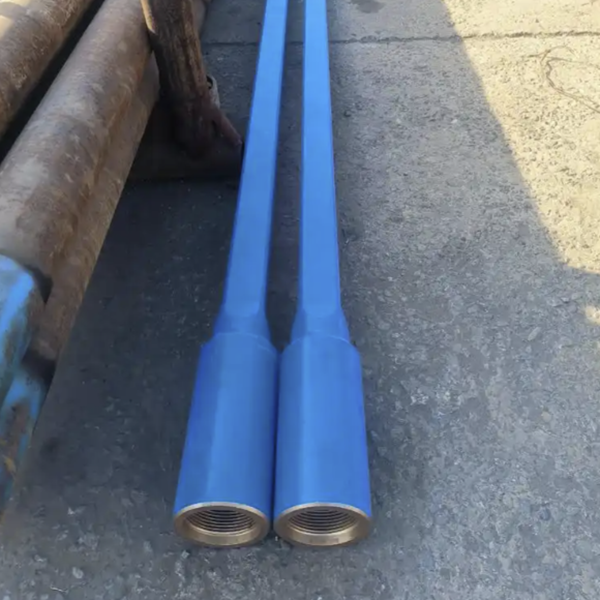
The first step is to classify by drill rod diameter. Small-diameter geological drill rods, typically 34–50 mm, are relatively compact and have moderate load capacity, so they do not require very high torque. They are generally suitable for rigs with torque below 1000 N·m. Two common rig categories are used in this range. One is the pneumatic column-mounted rig (models such as ZQJC160 to ZQJC1000), which is lightweight and flexible, making it suitable for shallow-hole work in small- and medium-scale exploration, roadway support drilling, and other confined-space applications. The other is the fully hydraulic underground coal-mine rig (such as ZDY400, ZDY540, ZDY650, and ZDY1200), which provides stable torque output and adapts well to complex underground conditions for routine shallow drilling.
For larger geological drill rods, especially 63.5 mm and above, load-bearing capacity is higher, but so are power demands. To maintain stable and efficient drilling, these rods should be paired with high-power fully hydraulic rigs. Common options include the fully hydraulic tunnel rig series (ZDY1900, ZDY3200, ZDY4000), which offers high torque and strong power for deep exploration and difficult formations, including hard rock. Another option is the crawler-type fully hydraulic tunnel rig (such as ZDY6000). Its crawler design improves mobility, and its strong power output makes it suitable for large-scale projects and complex outdoor terrain requiring long-distance, deep-hole drilling.
Beyond size matching, there is one key principle that should always be observed: hole diameter and achievable depth are inversely related. In simple terms, the larger the hole diameter, the shallower the practical drilling depth; the smaller the diameter, the greater the potential depth. This is because larger-diameter drilling creates higher resistance and requires greater torque, increasing the load on both the rig and the drill rod. In typical field use, our geological drill rods can achieve routine drilling depths of around 300 meters, though final selection should always be based on the required hole diameter, depth target, and actual jobsite conditions.
In summary, practical matching can be guided by two rules:
pair small-diameter rods with lower-torque rigs;
pair large-diameter rods with high-power fully hydraulic rigs.
If these rules are applied together with the diameter–depth inverse relationship and real operating conditions, teams can avoid common selection mistakes, improve drilling efficiency, and extend equipment service life.