Why Some Rock Drill Tools Stay Sharp and Tough: The Heat-Treatment Step You Cannot See
Two drill rods can be made from similar steel and still perform very differently underground.
One survives hundreds of holes. The other wears quickly, develops cracks, or breaks under impact. The difference is not always visible in the catalogue, and it is not explained by steel grade alone.
Often, the decisive factor is heat treatment.
For rock drill rods, shank adapters, drill bit bodies, and other percussion tools, heat treatment determines how the steel balances surface hardness with internal toughness. That balance is what allows a tool to resist wear without becoming dangerously brittle.
Hardness alone is not enough
A rock-drilling tool works in a difficult environment. It experiences repeated impact, vibration, friction, bending, and contact with abrasive rock.
A soft surface wears quickly. A tool with insufficient hardness may lose its geometry, reduce drilling efficiency, and damage the connection between the rod and bit.
But making the entire tool extremely hard creates another problem. Steel that is too hard throughout can become brittle. Under repeated impact, it may chip or fracture instead of absorbing the load.
The target is not maximum hardness everywhere.
The target is a hard, wear-resistant working surface supported by a tougher core.
Quenching creates the hard structure
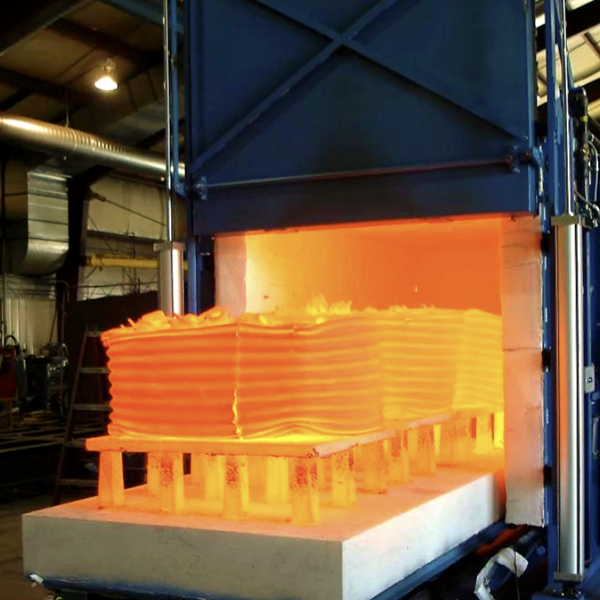
Quenching is the stage used to increase the hardness of the steel.
The steel is heated to a controlled temperature and then cooled rapidly under a defined process. This changes the internal structure of the material and creates a harder surface capable of resisting abrasive wear.
For a drill rod or shank adapter, proper quenching can help the tool withstand:
Repeated piston impact
Abrasion from rock dust
Contact wear at the taper or thread
Local deformation
High-frequency drilling cycles
The process must be controlled carefully. Cooling too quickly, too slowly, or unevenly can create distortion, residual stress, or inconsistent hardness across the component.
That is why a finished tool cannot be evaluated by surface appearance alone.
Tempering keeps the core from becoming fragile
Quenching improves hardness, but it can also leave internal stress in the steel. If the tool is used immediately in this condition, the hardened structure may be too brittle for percussion drilling.
Tempering follows quenching to reduce internal stress and improve toughness.
This is where the tool develops the balance often described as “hard on the outside, tough on the inside.” The surface resists wear, while the core can absorb impact without cracking easily.
A well-tempered tool does not need to be soft. It needs enough toughness to survive the shock wave travelling through the steel during every drilling cycle.
This is particularly important for:
Extension drill rods
Integral drill rods
Shank adapters
Coupling components
DTH hammer parts
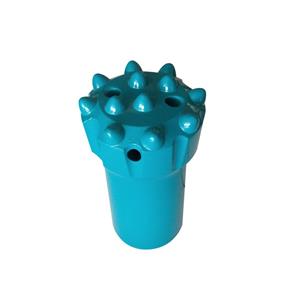
Percussion drill bit bodies
Carburizing and the hardness gradient
Some drilling components use carburizing or related surface-hardening processes. During carburizing, carbon is introduced into the outer layer of the steel. The surface can then be hardened while the lower-carbon core retains greater toughness.
The result is not simply one hardness value. It is a hardness gradient from the surface toward the centre.
For buyers, this raises several useful questions:
How deep is the hardened layer?
Is the hardness consistent around the component?
Does the core retain enough toughness?
Has the part been distorted during treatment?
Is the process suitable for the actual impact and wear conditions?
A shallow or uneven hardened layer may wear through quickly. An excessively hard or poorly supported surface may crack. The process must match the component design and the way the tool will be used.
Heat treatment cannot repair bad tool design
Heat treatment is important, but it is not a substitute for correct engineering.
A drill rod can still fail if:
The thread does not match the rock drill
The rod is bent during operation
The guide bushing is badly worn
The bit is used beyond its wear limit
Flushing is inadequate
The drilling angle creates excessive bending
The tool is assembled with excessive force
The steel grade is unsuitable for the application
The strongest heat-treated tool will not last if the drilling system is misaligned or operated outside its intended conditions.
That is why tool life depends on the complete combination of steel grade, geometry, heat treatment, machining accuracy, drilling equipment, and operator practice.
How to recognize a heat-treatment problem
Field symptoms cannot identify every metallurgical issue, but certain patterns deserve investigation.
If the surface wears unusually fast, the case may be too soft, too shallow, or inconsistent.
If the tool chips or breaks suddenly under normal loading, excessive hardness, residual stress, poor tempering, or an operational overload may be involved.
If only one area shows abnormal wear, inspect alignment, cooling, machining quality, and local heat-treatment consistency.
When failures repeat, do not simply order more of the same part. Record where the failure occurred, how long the tool worked, what rock was drilled, and whether the failure involved wear, bending, cracking, or thread damage.
That information helps separate a material problem from an equipment or operating problem.
What should buyers ask a supplier?
When purchasing rock drilling tools, ask more than “What steel is this made from?”
A practical supplier checklist includes:
What steel grade is used for the component?
Which heat-treatment process is applied?
Is the surface hardness tested?
Is the core toughness or hardness checked?
Is the hardened-layer depth controlled?
How is dimensional distortion measured?
Are samples tested from each production batch?
Does the product match the intended rock and drilling equipment?
Reliable manufacturers should be able to explain their quality-control process without hiding behind a single hardness number.
The visible result is longer tool life
Good heat treatment is invisible after the tool leaves the factory, but its effects are obvious at the worksite.
The rod keeps its shape. The shank adapter holds its thread. The bit body resists deformation. The tool survives repeated impact without premature cracking, and the drilling crew spends less time replacing parts.
Gaea Rock supplies rock drill rods, shank adapters, drill bits, DTH hammers, DTH bits, and related drilling tools. Correct heat treatment, accurate machining, and proper matching with the drilling system are essential for stable performance in mining, quarrying, tunneling, and construction.
The right question is not simply whether a tool is hard.
It is whether the tool is hard where it needs to resist wear, tough where it needs to absorb impact, and consistent throughout the production batch.