High-Pressure DTH Hammers: What the Extra PSI Actually Buys You
A standard DTH hammer running at 10 bar (0.56 MPa) drills a hole. A high-pressure hammer running at 25 bar (2.46 MPa) drills the same hole in roughly half the time, burns less fuel per meter, and wears out fewer parts doing it.
The physics is straightforward: more air pressure means harder piston blows, which means faster rock fracture at the bit face. But the design implications go deeper than just "turn up the compressor." A hammer built for high-pressure operation is a fundamentally different machine from one designed for standard pressure, and the differences show up everywhere from the internal piston geometry to the wear sleeve metallurgy to the maintenance schedule.
Here's what a properly engineered high-pressure DTH hammer delivers, and why it matters if you're drilling blast holes, water wells, or anchor holes for a living.
Faster Penetration — And Why It Compounds
The headline benefit: high-pressure hammers drill faster. At 1.7-2.5 MPa, penetration rates routinely double what you'd see at 1.0 MPa in the same rock.
The reason isn't just "harder hitting." It's that the internal piston geometry — the stroke length, the piston mass, the port timing — is optimized for the specific pressure range. A hammer designed from scratch for 25-bar operation achieves ideal energy transfer from compressed air to piston to bit. A standard hammer with the pressure cranked up doesn't get the same efficiency gain because the internals weren't sized for the higher energy input.
The compounding effect: faster penetration means the compressor runs fewer hours per meter of hole. Fuel consumption per meter drops. Labor cost per meter drops. And the rig moves to the next hole sooner, which matters a lot when you're drilling a pattern of dozens or hundreds of blast holes.
The Wear Sleeve That Works Twice
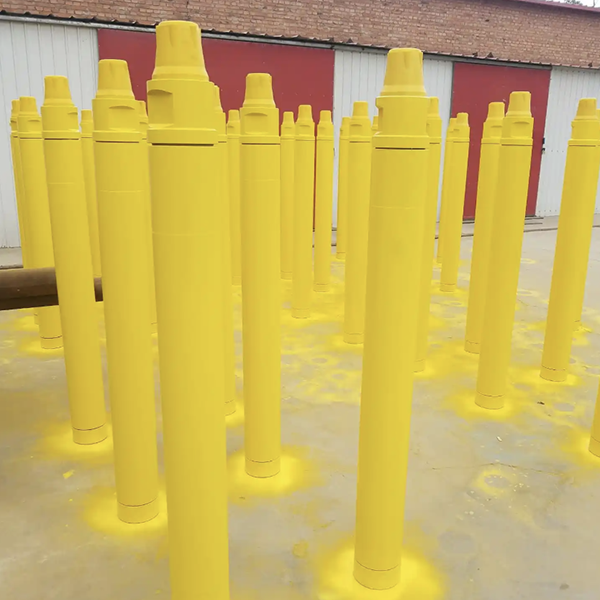
High-pressure DTH hammers run a hardened wear sleeve — the outer casing that takes the abrasion from cuttings rushing past at high velocity. It's a consumable, but a well-designed one can be reversed end-for-end when one end wears past tolerance, effectively doubling its service life.
This matters more than it sounds. The wear sleeve is the single most frequently replaced component on a DTH hammer after the bit. A sleeve that lasts twice as long cuts replacement parts cost and, more importantly, cuts the downtime to swap it. On a production drilling site where the hammer runs ten hours a day, every avoided sleeve change is an extra hour of drilling.
Fewer Parts, Simpler Service
Open up a high-pressure DTH hammer and you'll find a piston, a check valve, a distributor, a chuck, and a few wear parts. That's it. The internal structure is designed for reliability through simplicity — fewer components to fail, fewer interfaces to wear, fewer opportunities for something to go wrong at 200 meters downhole.
Field service is correspondingly straightforward. Disassembly requires basic tools and no special fixtures. Reassembly follows a sequence that's hard to get wrong. For a site where the hammer gets serviced between shifts by the drilling crew rather than a dedicated mechanic, simplicity isn't a luxury — it's the difference between a ten-minute service and a call to the shop.
The Application Range
High-pressure DTH hammers cover hole diameters from roughly 80 mm to 185 mm — the sweet spot for production blast holes in mining and quarrying. They'll handle everything from medium-hard limestone to the hardest granite and quartzite. The operating pressure window is wide: most high-pressure hammers work from about 0.56 MPa up to 2.46 MPa, so they'll run on a range of compressor outputs without retuning.
Beyond blast holes, the same hammers drill anchor holes for slope stabilization, grouting holes for dam foundation work, and water well holes where the formation is too hard for rotary drilling. The versatility means a contractor with one or two hammer sizes can cover a wide range of project types.
The Cost-Per-Meter Equation
Ultimately, every DTH hammer purchase is a cost-per-meter decision. The hammer itself has a price. The bits have a price. The compressor burns fuel. The crew costs money per hour. The arithmetic is simple: total cost divided by total meters.
High-pressure hammers improve that equation on every line. Faster penetration means fewer hours of compressor fuel and crew time per meter. Longer component life — from the reversible wear sleeve, from the hardened internal surfaces, from the optimized piston dynamics that reduce internal wear — means fewer replacement parts per thousand meters. Simpler field service means less non-drilling time.
The upfront price of a high-pressure hammer is higher than a standard-pressure equivalent. But the cost per meter, amortized over the hammer's service life, is almost always substantially lower. The math is straightforward. The hard part is convincing the purchasing department to look past the invoice price to the per-meter cost. If you're the one signing off on tooling budgets, run the numbers both ways. The cheaper hammer on the purchase order is often the more expensive one on the drill report.