Reading the Signs: How to Tune Your Hydraulic Rock Drill When the Ground Fights Back
Parameter adjustment on a hydraulic rock drill isn't a one-time setup. It's an ongoing conversation between the rig, the rock, and the tooling. When the ground changes — and it always does — the settings that worked on the last hole might be completely wrong for the next one. The trick is knowing which signs to read and which knobs to turn.
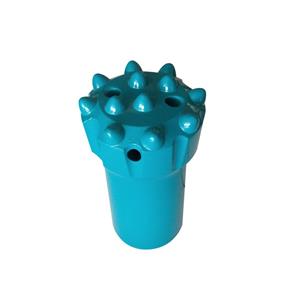
Hydraulic drilling parameters fall into two buckets. The first is the machine side: working pressure, hydraulic flow, and fluid temperature — these determine your impact energy, your system stability, and how long your internal components last. The second is the ground-and-tooling side: rock strength, button bit type, and flushing medium. Hard granite needs a different bit face design and a different energy profile than abrasive sandstone. Run the wrong combination and you'll feel it in penetration rate, you'll hear it in impact tone, and you'll see it on the steel when it comes out of the hole.
Here are three specific signs that your parameters are off — and exactly what to adjust.
The Coupling Sleeve Is Too Hot to Touch
This is one of the most reliable diagnostic signals on a drill string. Under normal conditions, the coupling sleeve near the drill end — about 40 millimeters back from the sleeve face — should run no hotter than 50°C. In extremely hard rock where impact energy reflects back up the string, 80°C is acceptable. But anything consistently above that is telling you the threads are being worked harder than they should be, and accelerated thread wear is already underway.
When you notice a coupling sleeve running hot, work through these adjustments in order:
First, consider switching from standard ball-button bits to ballistic-button bits. The sharper profile of a ballistic insert transfers energy into the rock more efficiently and generates less reflected energy back up the string. Different button geometry, different heat profile.
Second, reduce your rotation speed. Keep the penetration rate steady — don't chase speed at the cost of burning up your connections.
Third, back the impact pressure down in five-bar increments. Drop it five bar, drill a rod length, check the sleeve temperature. Still hot? Drop another five. Keep going until the temperature settles into an acceptable range. At each step, verify your feed speed is at least three times the maximum penetration rate — if the feed is lagging, the bit isn't staying engaged and you're effectively dry-firing, which is a major heat source.
Penetration Rate Is Too Low Despite Good Rotation and Feed
When your rotation pressure and feed pressure look right but the bit is still crawling, the most likely culprit is insufficient impact energy for the rock you're in. Increase impact pressure in five-bar increments and watch the penetration rate. Stop when you hit either the drill's maximum rated impact pressure or an acceptable penetration speed — whichever comes first.
Some rigs are power-limited and can't reach the drill's full rated impact pressure. In that case, work within the available power band. The goal is the highest impact pressure the rig can sustain without tripping limits or overheating the system. More impact within limits equals faster drilling. Past the limits equals expensive repairs.
The String Keeps Jamming
Frequent jamming has three fixable causes, and they're all worth checking before you blame the ground.
Anti-jam settings: Set the rotation pressure threshold on your anti-jamming circuit 15 to 20 bar above the normal drilling rotation pressure. Don't set it higher to "be safe" — too high a threshold means the system won't react fast enough when the bit catches, and the jam will be worse when it finally triggers.
Bit peripheral wear: In abrasive rock — anything with high quartz content — the outside edge of the button bit wears faster than the center. The bit profile changes from a positive taper to a negative taper. Instead of the bit being slightly wider at the face and tapering back, it becomes wider at the shoulder than at the face. The result is a hole that's undersized at the bottom, and the bit body drags against the wall on its way out. Every retraction becomes a fight. The fix is regular peripheral regrinding to restore proper taper geometry.
Button profile: If rotation pressure drops while you're at maximum feed pressure, the buttons have likely lost their protrusion and shape. The bit is rubbing more than fracturing. Regrind the buttons to restore their profile and standoff height. A bit that can't bite can't drill — it just heats up and wears out.
The Principle
These three signs — heat at the coupling, slow penetration, frequent jamming — cover the vast majority of parameter-related problems on a hydraulic jumbo. Each one has a specific cause and a specific fix. The skill isn't in knowing what the knobs do. It's in knowing which knob to reach for when the steel starts talking.