Industrial Explosives and Rock Blasting: A Field Guide to What Actually Works Underground
If you work in mining or civil excavation long enough, you learn that blasting isn't one skill — it's three. There's the chemistry: knowing what goes into the hole and why. There's the geometry: where you put the holes, in what order, at what angle. And there's the judgment: knowing when the textbook answer is wrong for the ground you're standing on.
This guide covers the first two. The third you earn the hard way.
The Explosives Kitchen: What's Available and When to Use It
Industrial explosives fall into three broad categories based on where you're legally allowed to use them, and understanding these categories will save you from the kind of paperwork mistake that shuts down a site.
Category one — the any-ground, any-job explosives. These are the safety explosives, sometimes called permitted explosives or coal-mine explosives. They're formulated to minimize flame temperature and duration, which means they can be used in underground coal mines where methane and coal dust make every spark a potential disaster. If you're blasting anywhere with gas risk, this is the only class you can touch.
Category two — general-purpose engineering explosives. Fine for tunneling, quarrying, and surface construction where there's no combustible gas or dust hazard. Not legal underground in coal.
Category three — surface-only. Open pits, quarries, road cuts. These are your high-energy, high-brisance formulations that would be wildly unsafe in a confined underground environment. Use them where the sky is your ventilation system.
By chemical composition, the workhorse of the industry is ammonium nitrate-based explosives — ANFO and its variants. Cheap, easy to mix on site, and safe to handle compared to the nitroglycerin-based dynamites of a hundred years ago. The trade-off: zero water resistance. Drop ANFO into a wet borehole and you've just made very expensive mud. For wet conditions, you step up to water gel explosives or emulsions, both of which can sit in groundwater for hours and still detonate reliably.
Emulsion explosives deserve a special mention because they've quietly become the standard for most serious blasting operations. High detonation velocity, excellent water resistance — better than water gels, actually — and they can be pumped directly into boreholes with mechanized loading systems. No manual handling of cartridges, fewer people near the face, shorter loading cycles. In underground hard-rock mining where every minute of downtime costs real money, that combination matters.
The Coal Mine Explosives Rulebook
Coal mines get their own safety classification system for explosives, and it's not optional reading. The rule is straightforward: higher gas risk means higher safety class. Five levels, numbered one through five.
Low-gas mines driving through rock (not coal) can get by with Class 2 explosives. The moment you're cutting coal or working a mixed coal-rock face in a low-gas mine, you need Class 3 minimum. High-gas mines require Class 4. And mines with a history of gas outbursts — the kind where methane blows out of the seam under pressure without warning — require Class 5, the safest formulations available.
One non-negotiable rule worth memorizing: every single shot in a coal mine must use explosives from the same type and the same safety class. No mixing. No "well, we ran out of the Class 4 so we'll use a couple of Class 3 cartridges to finish the round." That kind of thinking kills people.
Detonators: The Trigger That Changed Everything
If you've been in blasting longer than a decade, you remember the transition from pyrotechnic delay detonators to electronic ones. It wasn't smooth — old hands distrusted the electronics, and early systems had teething problems with underground signal transmission. But the industry has largely made the switch, and for good reason.
Electronic detonators give you timing precision that pyrotechnic delays simply can't match. A pyrotechnic delay has a natural scatter of several milliseconds even within the same nominal delay number. Electronic detonators fire within a fraction of a millisecond of their programmed time, every time. For blast designs that rely on precise sequencing — smooth blasting for tunnel perimeters, vibration control near sensitive structures — that precision translates directly to better results.
The other advantage nobody talks about enough: traceability. Every electronic detonator has a unique ID that's logged when it's programmed. If something goes wrong — a misfire, a cut-off, an unexpected vibration reading — you can trace exactly which detonator was where in the sequence and diagnose what happened. With pyrotechnic caps, you're guessing.
One hard number for underground coal: the total firing delay for a coal-mine electronic detonator must not exceed 130 milliseconds. That's the fire-and-escape window. Longer than that, and the risk of igniting a methane-air mixture climbs sharply.
Where You Put the Holes: Blast Geometry in Underground Drivage
A tunnel or drift round has three kinds of holes, and each one has a distinct job. Get the balance wrong, and you either blow a ragged, overbroken profile or leave a tight face that takes twice as long to muck out.
Cut holes go in first. Their job is to create a free face — an empty volume that the rest of the round can break toward. In a small-section drive where hole depth is shallow, angled cuts work fine and they're easier to set up. For deeper rounds and larger sections, straight cuts with uncharged relief holes are the standard — they drill faster with mechanized jumbos and give you better advance per round.
Production holes — often called easer or breaking holes — do the heavy lifting. They're the bulk of the round, fired after the cut has opened up, and they break the main rock volume into the cavity the cut created. Even spacing, consistent burden, and proper delay timing between rings are what separate clean fragmentation from a mess of oversized boulders.
Perimeter holes are where blasting becomes an art. These holes define the final tunnel profile. Too much explosive, and you overbreak — blowing rock beyond the design line, which means extra ground support and more concrete in the lining. Too little, and you underbreak, which means a secondary scaling crew needs to go back in and knock down the tight spots. Smooth blasting technique — smaller-diameter cartridges, decoupled charges, precise electronic timing — gives you finished walls with visible half-barrel drill traces and under 50% overbreak. That's the gold standard.
Surface Blasting: The Numbers That Actually Matter
Open-pit blasting is simpler in concept than underground work but the scale makes every mistake expensive. A poorly designed bench blast doesn't just waste explosive — it leaves a bad face for the next round, creates oversized boulders that need secondary breakage, and sends flyrock toward whatever's in the danger zone.
For bench heights between 8 and 12 meters — the sweet spot for most quarry and surface mining operations — the hole spacing to burden ratio should land between 1.2 and 1.5. Sub-drilling below the bench floor should be 15% to 25% of the bench height to avoid leaving toe. Stemming length must at least match the burden at the collar; shorter than that and you're risking blowouts that send stemming material and flyrock out of the hole like a cannon.
Firing sequence matters more than most people think. Straight row-by-row firing is simple to wire but tends to throw the muckpile forward and give uneven fragmentation. V-pattern firing, where the sequence starts in the middle and fans outward toward both sides, keeps the muckpile tighter and gives better fragmentation from inter-particle collision during throw. Diagonal firing is the workhorse for most production blasts — good fragmentation, simple tie-in, predictable results.
Where This All Leaves Us
Blasting engineering is really a decision tree disguised as a checklist. What formation? What hole size? Wet or dry? Gas risk or none? Surface or underground? Near a structure or in the middle of nowhere? Every answer changes the explosive choice, the timing design, and the safety protocols.
And then there's the question that's been gaining traction in the last few years: do you need conventional explosives at all? For projects near sensitive infrastructure — highways, railways, pipelines, residential areas — non-explosive rock breaking technology is increasingly the first call rather than the fallback. Systems that use gas expansion rather than detonation eliminate flyrock, vibration, and the permitting headache that comes with handling Class 1 dangerous goods. When you don't need a blast exclusion zone measured in hundreds of meters, your project timeline and community relations both improve.
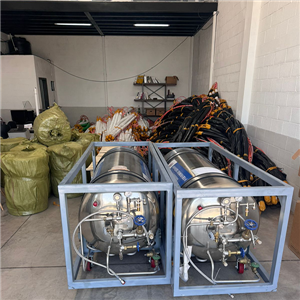
The O2 rock blasting system, which uses liquid oxygen phase-change expansion instead of chemical detonation, has carved out a growing niche in exactly these applications — urban demolition, infrastructure-adjacent quarrying, underwater rock removal. Zero flyrock, minimal vibration, no toxic gas. It doesn't replace conventional blasting in every scenario — a massive open-pit production blast still needs ANFO by the truckload — but for the jobs where blasting restrictions are the primary constraint, it's an option worth understanding.
Quick Reference: The Numbers to Keep in Your Head
| Parameter | Value |
|---|---|
| Coal mine electronic detonator max delay | 130 ms |
| Smooth blasting perimeter hole trace retention | ≥ 50% |
| Bench sub-drill depth | 15-25% of bench height |
| Optimal hole spacing-to-burden ratio (surface) | 1.2-1.5 |
| Stemming minimum length | ≥ burden at collar |
| Post-blast wait time (surface) | ≥ 15 min (30 min if suspected misfire) |
| O2 system safety distance | 100 m (operating distance 2-3 m) |