How to Choose a Mining Blasting Method When One Set of Parameters Is Not Enough
Blasting sits between drilling and loading. If the blast performs poorly, the problem does not end at the face. Oversized rocks slow the crusher, unstable slopes increase risk, equipment takes more abuse, and the cost of secondary breaking starts to grow.
That is why modern mining operations are moving away from the idea of using one familiar blast design everywhere. The best method depends on the rock, the bench, the surrounding environment, and the production target.
From simple blasting to controlled energy release
Many smaller mines once relied on basic simultaneous initiation. The method was familiar, but it often produced high vibration, uneven fragmentation, and greater pressure on nearby slopes.
As safety requirements became stricter, millisecond delay blasting became more common. By separating energy release into controlled time intervals, mine operators can improve rock movement and fragmentation while reducing the shock effect of firing the entire pattern at once.
Near permanent slopes, industrial facilities, or other structures, pre-splitting and smooth blasting are used to protect the final wall. These methods aim to create a controlled fracture line instead of allowing excessive damage to spread into the remaining rock mass.
Electronic detonators have added another level of control. Their timing can be programmed more precisely than conventional delay systems, helping engineers manage vibration, improve fragmentation consistency, and reduce the amount of oversize material.
The technology is valuable, but it is not automatic. Better initiation equipment cannot compensate for poor drilling or an unsuitable hole pattern.
Match the method to the working area
Different parts of a mine require different priorities.
Large production faces: Millisecond delay blasting can balance output, fragmentation, and practical loading conditions. It is commonly selected where the mine needs volume without losing control of the muck pile.
Permanent slopes and industrial areas: Pre-splitting or smooth blasting may be necessary to limit damage to the final wall and reduce vibration near sensitive assets.
Environmentally sensitive sites: Mines near towns, roads, railways, or industrial facilities may need reduced vibration and tighter control of charge per delay. The objective is not just to break the rock, but to keep the surrounding environment within acceptable limits.
Mixed or layered formations: A hard band over a softer layer cannot always be treated with the same burden, spacing, and charge structure. Using old parameters without checking the geology often creates toe problems, uneven fragmentation, and oversize boulders.
Why fixed blast parameters create hidden costs
A blast pattern that worked last month may perform poorly after the geology changes.
Hard rock may require a tighter hole pattern to distribute energy effectively. Softer rock may need a lighter charge to avoid excessive fly rock and unwanted fines. Water, joints, bedding planes, and changes in bench geometry can all affect the result.
When a mine continues to use one fixed design, several symptoms often appear:
Large boulders requiring secondary breaking
Unbroken toe at the bottom of the bench
Excessive fly rock
High vibration readings
Poor muck-pile shape
Increased wear on loading and crushing equipment
The cost is not limited to explosive consumption. It can also include drilling extra holes, moving equipment back into the face, delaying hauling, and repairing machinery exposed to oversized material.
Dynamic optimization starts with drilling quality
Blast improvement begins before charging.
Hole diameter, depth, inclination, burden, spacing, stemming, charge distribution, and initiation sequence should be checked against current geological conditions. The actual drilled position also matters. A design can be correct on paper and still fail when holes deviate from the planned pattern.
A practical optimization cycle should include:
Review the rock conditions and bench geometry.
Verify hole depth, diameter, and position.
Compare the planned and actual burden and spacing.
Monitor fragmentation, vibration, fly rock, and toe formation.
Adjust the next pattern based on measured results.
This is why drilling and blasting should be planned as one system. Better drilling accuracy gives the blast designer more control and makes performance more repeatable.
When a non-explosive method may be more practical
Some sites cannot tolerate the vibration, fly-rock risk, licensing requirements, or exclusion zones associated with conventional explosives.
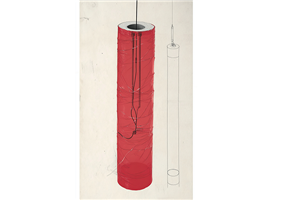
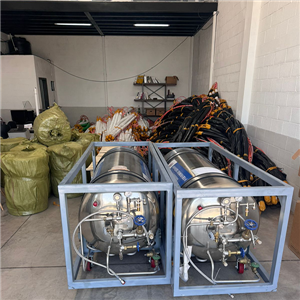
For rock breaking near buildings, active roads, high-voltage lines, railways, or sensitive infrastructure, Gaea Rock's O2 Gas Energy Rock Splitting System offers another option. It uses liquid oxygen and a combustible absorbent inside a fracturing tube. After ignition, the liquid oxygen undergoes rapid phase expansion, creating pressure that fractures the rock.
The O2 system is not an explosive. It is a physical rock-splitting process designed for controlled applications where traditional blasting may be difficult to authorize or manage.
Its potential advantages include:
Much lower shock-wave intensity than conventional explosives
Minimal vibration in sensitive working areas
No potassium perchlorate in the system
Ordinary-cargo export classification
No conventional explosive storage requirement
Suitability for selected quarry, construction, mining, and infrastructure projects
The method still requires proper drilling, soil stemming, remote ignition, exclusion control, and trained operators. A lower-impact system still needs disciplined execution.
The right decision is a site decision
New technology should not be adopted simply because it is new. The correct choice depends on geology, production scale, regulatory requirements, nearby structures, equipment, and total operating cost.
Conventional millisecond blasting may remain the most efficient option for a large, open production face. Pre-splitting may be essential beside a permanent slope. A reduced-vibration method may be more suitable near a town or highway. In a highly restricted location, a non-explosive O2 rock-splitting system may solve a problem that conventional blasting cannot.
The best result comes from treating rock breaking as an integrated process: accurate drilling, suitable energy, controlled initiation, measured performance, and continuous adjustment.
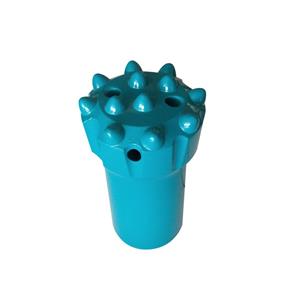
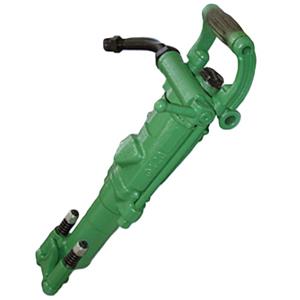
Gaea Rock supplies O2 rock blasting systems, fracturing tubes, liquid oxygen storage equipment, and drilling tools for mining, quarrying, construction, and infrastructure projects.