The Mining Tricone Bit That Lasts: Tooth Shape, Bearing Care, and the Details That Matter
A tricone bit in a production mine drills thousands of meters before it retires — if everything goes right. The difference between a bit that lasts and one that doesn't isn't usually visible in the bit itself. It's in the decisions made around it: which tooth shape went down the hole, how the operator treated the bearings, and whether anyone checked the cone temperature after the last hole.
Here's how mining operations squeeze maximum life out of tricone bits, broken into the four areas that actually move the needle.
First, Get the Tooth Shape Right
This is the decision that determines everything downstream. Two tooth shapes dominate mining tricone bits, and they're built for opposite ends of the hardness spectrum.
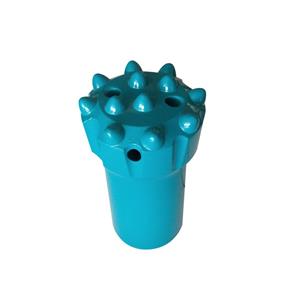
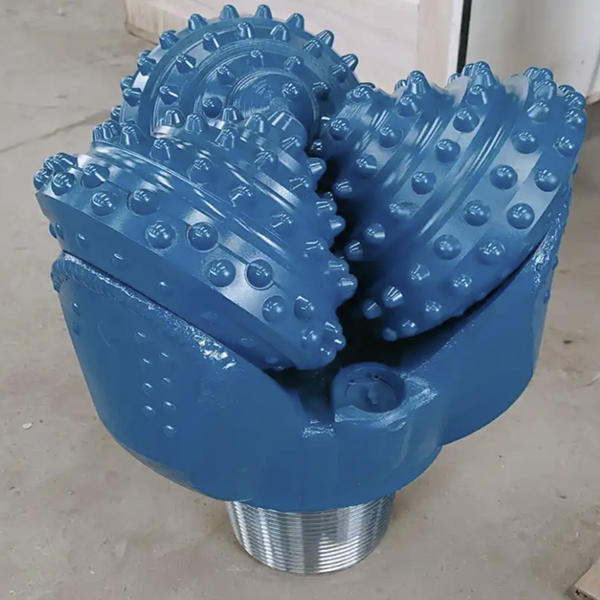
Ball teeth (button inserts): short, rounded carbide buttons set densely across the cone surface. Short teeth mean short lever arms, which means the inserts resist bending and breaking under heavy load. Dense spacing means the load distributes across many contact points. Ball-tooth bits handle extreme axial pressure and survive in hard, abrasive formations where anything longer would snap.
Wedge teeth (milled/chisel teeth): long, pointed teeth machined into the cone body, spaced farther apart. Long teeth penetrate deeply into soft rock with relatively low contact pressure. Wide spacing prevents the bit from balling up in plastic formations.
The failure mode when you get it wrong is instructive. Put a ball-tooth bit in soft rock, and it drills — but slowly. The short buttons can't penetrate deeply, and the bit grinds instead of gouges. The bit lasts a long time, but the per-hole cost is high because the rig sits on the hole forever.
Put a wedge-tooth bit in hard, abrasive rock, and the teeth break or wear flat in a fraction of the expected life. The long teeth take too much bending load, and the abrasive rock chews through the softer milled teeth.
Match the tooth shape to the compressive strength and abrasiveness of the formation. The bit that costs a little more for the right tooth shape returns the difference many times over in meterage.
Then, Manage the Three Parameters Around the Bearings
Tricone bits fail in two places: the teeth and the bearings. The teeth you can see. The bearings you can't — and they usually fail first if the parameters are wrong.
Weight on bit: enough to drive the teeth into the rock, not more. Past the point where the rock fractures efficiently, additional WOB doesn't increase penetration — it just loads the bearings harder. Bearing life is inversely related to load. A bit run at 20% over its optimal WOB might lose 40% of its bearing life while gaining nothing in penetration.
Rotation speed: in soft rock, higher RPM means faster penetration because each tooth has less work to do and more time to recover. In hard rock, high RPM is self-defeating. The teeth don't have enough contact time to complete the fracture before rotating away, and the bearings — which heat up proportionally with RPM — wear faster. Hard rock calls for lower RPM, higher WOB. Soft rock calls for higher RPM, lower WOB.
Flushing air: the air does more than clear cuttings. It's the bearing's cooling system. Air flows through internal passages in the bit, cooling the journal bearings. If flushing air volume is inadequate, bearings overheat. The classic symptom: after pulling the bit, one cone is noticeably hotter than the other two. That hot cone has a blocked air passage or a failing bearing. Check all three cones after every hole. If one is hotter than the others, investigate before the bit goes back down.
The Operator's Checklist
These are the small habits that separate a bit that runs its full design life from one that dies early:
Run in a new bit. A brand-new bit has fresh bearings with tight clearances. Drop it in at full WOB and the bearings can gall before they've had a chance to bed in. Run the first several meters at reduced WOB, then bring it up to normal. This break-in period is cheap insurance on the most expensive component in the string.
Keep the hole clean. Metal objects — a broken bit shank, a dropped tool, a piece of rebar — will destroy a tricone bit on contact. Keep the collar area clean. Don't let anything metallic go down the hole.
Collar straight. A crooked start puts the bit under bending load from the first rotation. The cones can't cut evenly. The gauge row wears unevenly. The bearings see off-axis load. Start slow and straight, and the bit runs true for its whole life.
Never stop the air with the bit in the hole. Cuttings settle into the bearing passages and the cone gaps. The next rotation grinds them into the bearings. If you have to stop drilling, lift the bit off bottom and keep the air flowing until the hole is clean.
Rotate the cones manually during any stoppage. If the bit sits in the hole for an extended period, periodically rotate the cones by hand and blow air through to keep the bearings free. A bearing that sits loaded and stationary in cuttings for too long will be stiff when you restart.
Don't run bent drill rods. A bent rod transmits an orbital whip to the bit. The bit runs off-center. One side of the gauge row takes all the wear. The bearings see cyclic side loads. A bent rod is the fastest way to ruin an otherwise good bit.
The Stabilizer Effect
A stabilizer mounted directly above the bit changes the drilling dynamics. It keeps the bit centered in the hole, which means the cones cut evenly, the gauge row wears uniformly, and the bearings see axial rather than off-axis load. The result is less vibration, less deviation, and measurably longer bit life.
Stabilizers with hardfaced or carbide-protected contact surfaces last longer than plain steel stabilizers. When the stabilizer wears undersize, it stops doing its job — the bit starts to wander, and you're back to uneven loading. Watch the stabilizer OD as carefully as you watch the bit gauge.
The Pattern
A tricone bit that dies early in a mining application has usually been given one of three problems: the wrong tooth shape for the rock, parameters that overloaded the bearings, or an operator habit that beat it up. The bit itself was probably fine.
Get the tooth shape right for the formation. Run the parameters for the bearings, not just the penetration. Build the operator habits that protect the bit. And put a stabilizer on it. None of this is expensive. All of it returns meterage.