Oil Drill Pipe vs. DTH Drill Rod: They Look Similar, But They're Not Even Related
A new guy on a mining crew once grabbed what he thought was a spare drill rod off the rack and tried to run it on a DTH hammer. The rod fit the chuck, more or less. The threads caught, sort of. The compressor fired up, the hammer started cycling, and within about twenty minutes the rod had twisted itself into a spiral at the first threaded connection. The rod wasn't defective. It was an oil drill pipe — designed for rotation, not percussion — and it had been asked to do a job it was never built for.
If you work across both mining and oil and gas, or if you're in procurement buying tooling for multiple job sites, you've probably seen oil drill pipe and DTH drill rods sitting in the same yard and wondered if they're interchangeable. They're not. Here are the four ways they're completely different animals.
Difference One: What They're Actually For
Oil drill pipe has exactly one job: get a drill bit to the bottom of a well that might be several thousand meters deep, deliver enough rotation to turn the bit, and pump drilling fluid through the center to carry cuttings back up. That's it. Everything about its design follows from the reality that it works in deep, high-pressure wells where the biggest enemies are internal corrosion from drilling mud, external wear from rubbing against casing, and fatigue from the cyclic loading of tripping in and out.
DTH drill rods live in a completely different world. Their job is to sit between a DTH hammer and the drill rig, transmitting rotation and feed pressure down to the hammer while channeling high-pressure air through the center to power the hammer's piston and blow cuttings out of the hole. They don't generate impact — the hammer does that — but they have to survive in the vibration-rich, abrasive environment right above the hammer where every blow sends a shock wave up the steel and rock chips are blasting past at near-sonic speeds.
Oil drill pipe: thousands of meters, rotation, mud circulation. DTH drill rods: tens to hundreds of meters, rotation plus vibration, compressed air. Different worlds.
Difference Two: What They Look Like Up Close
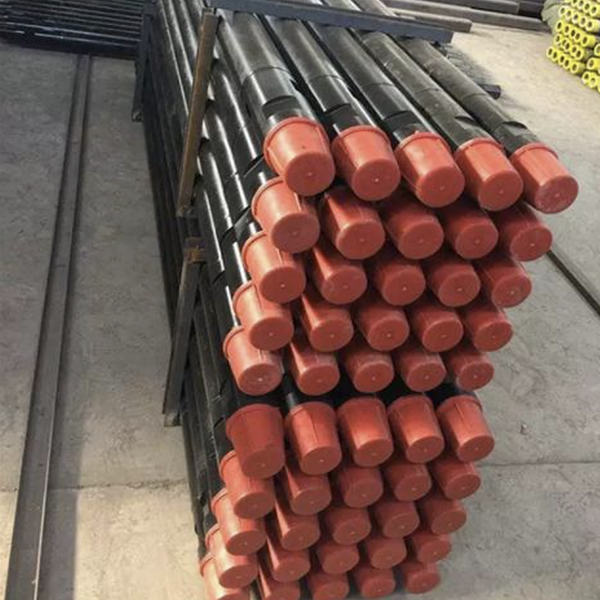
Pick up an oil drill pipe and the first thing you'll notice is the weight. It's a seamless steel tube, usually 9 to 11 millimeters in wall thickness, with a smooth circular cross-section from end to end. The ends terminate in API-spec threaded connections — IF, FH, NC, or similar designations that refer to thread profiles standardized across the oil industry. The threads are cut to tight tolerances because they have to seal against thousands of PSI of internal mud pressure while transmitting tens of thousands of foot-pounds of torque.
Now pick up a DTH drill rod. It's lighter for its length, and instead of a smooth round tube, most are hexagonal in cross-section. The hex shape isn't cosmetic — it provides flat surfaces for the rig's breakout wrench to grip during rod changes, and it gives the rod more bending stiffness in the directions that matter during percussive drilling. The center hole is for compressed air, not drilling mud, so the internal diameter is sized for air volume rather than fluid flow. The end connections are typically a shouldered, flat-faced design that transmits impact energy from the hammer to the rod without concentrating stress at the threads — completely unlike the API thread profiles on oil pipe.
If you're standing in a yard trying to tell them apart, look for the hex body. Round, heavy, with precision tapered threads? Oil pipe. Hexagonal, lighter per meter, with flat-faced connections? DTH rod. There's your answer.
Difference Three: How They Work Under Load
This is the distinction that explains why you can't substitute one for the other, ever.
An oil drill pipe lives its entire working life in rotation. The top drive or rotary table spins the entire string, and the pipe's job is to transmit torque efficiently without twisting off. The loading is primarily torsional shear, with some tension from the weight of the string below. There's no impact loading. None. The pipe rotates smoothly, or at least as smoothly as downhole conditions allow, and it's designed to handle millions of rotation cycles over its service life.
A DTH drill rod operates in a completely different load regime. The hammer at the bottom of the string is hitting the bit dozens of times per second — each blow is a percussive shock that sends a compression wave racing up the rod. On top of that, the rig is applying rotation — much slower than an oil rig, usually 20 to 60 RPM — and feed pressure. The rod experiences simultaneous torsion, axial compression, and high-frequency vibration, plus abrasive wear from rock cuttings blasting past the outer surface in the annular space.
Put an oil drill pipe in a DTH application, and the threaded connections — designed for smooth rotation — will fatigue-crack from the percussive vibration within the first shift. The pipe body, designed for torsion, will buckle under the combined compression and vibration. And the smooth round exterior, with no flat grip surfaces, will slip in the breakout wrench and frustrate every rod change.
Put a DTH rod in an oil well, and the hexagonal body will cause turbulence in the drilling mud, the flat-faced connections won't seal against formation pressure, and the rod — never designed for thousands of meters of rotation — will twist off at a fraction of the torque an oil pipe handles routinely.
Difference Four: What They're Made Of and How They're Graded
Oil drill pipe is specified by steel grade — E75, X95, G105, S135, with the number representing the minimum yield strength in thousands of PSI. S135 pipe has a yield strength of 135,000 PSI. These are high-strength, high-toughness steels, alloyed with chromium and molybdenum for corrosion resistance against drilling mud and formation fluids. The heat treatment is quench and temper, producing a uniform microstructure throughout the wall thickness that can handle high torsion without brittle failure.
DTH drill rods are made from different alloys with different priorities. The steel needs high surface hardness to resist abrasive wear from cuttings — typically achieved through carburizing or induction hardening of the outer surface — but the core needs to stay tough to absorb impact without cracking. This case-hardened structure is fundamentally different from the through-hardened structure of oil pipe. The alloy content is typically lower in nickel and higher in manganese and silicon, optimized for wear resistance rather than deep-well corrosion resistance.
The grading systems are different too. Oil pipe follows API specifications with well-defined grade numbers. DTH rods are typically specified by the manufacturer's own grading system tied to rock conditions and hammer compatibility. You don't buy a "grade S135" DTH rod — you buy a rod spec'd for a specific hammer size and rock abrasiveness class.
The Takeaway
Oil drill pipe and DTH drill rods look vaguely similar in the way that a highway truck and a rock-crawling jeep both have four wheels. They're both long hollow steel tubes that connect to drilling equipment. That's where the similarity ends.
If you're stocking a mining or construction drill site, you need DTH rods — hexagonal body, case-hardened, built for percussion and abrasion. If you accidentally get oil pipe on site, don't run it. The result will be a twisted, fatigue-cracked failure and a crew standing around watching the rig sit idle. The right tool for the right job isn't a suggestion — in drilling, it's the difference between making hole and making scrap.