PDC Non-Core Drill Bit Selection: Why Matching the Bit to the Ground Matters More Than the Price Tag
A few months back, a mine superintendent in Shanxi showed me a drawer full of dead PDC bits — thirty-something of them, all pulled from the same gas drainage project. The cutters weren't just worn. They were shattered. Chunks of diamond table missing, carbide substrates chipped clean off, some of them heat-blued from running dry. The culprit? Every single bit in that drawer was the same model. Standard three-wing, flat-face PDC, ordered in bulk because the price was right. Nobody bothered to check whether the formation actually matched.
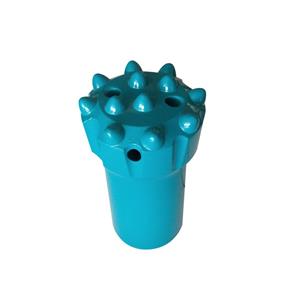
That drawer is a pretty expensive lesson in a simple truth: a PDC non-core drill bit is only as good as the formation you pair it with. Get the matchup wrong, and you'll burn through bits faster than you can order replacements. Get it right, and the same bit design can outlast three of its mismatched cousins.
Soft Formations: Don't Overcomplicate It
If you're drilling clay, mudstone, or coal seams — the kind of ground where a rig operator can feel the bit eating fast and the cuttings are coming back like wet paste — you don't need exotic cutter geometry. A standard three-wing PDC bit with flat-faced cutters will do the job and do it fast.
Why three wings? Wider junk slots. In soft ground, you're generating a lot of cuttings per second, and if those flutes can't evacuate them fast enough, you end up regrinding chips instead of making hole. Three wings give maximum clearance. Flat PDC cutters deliver the sharpest edge for shear-dominant cutting, and in soft formations, shear is all you need.
This configuration is ideal for most water detection holes, gas drainage drilling in coal, and shallow exploration where penetration rate matters more than bit longevity. Keep your drill rod speed steady and your flush medium flowing, and these bits will chew through coal measure formations all shift long.
Medium-Hard Formations: This Is Where Things Get Interesting
Sandstone, weathered granite, limestone — formations where the rock starts pushing back. This is the zone where a lot of operators get into trouble by sticking with flat cutters designed for soft ground. Flat PDC faces bite aggressively, but in harder rock, aggressive cutting translates to impact loading that flat cutters don't handle well. You start seeing micro-chipping along the diamond table edge, and once a chip starts, it propagates.
The fix is straightforward: switch to spherical or dome-shaped PDC cutters. The curved profile spreads impact force across a larger contact area instead of concentrating it on a single edge. It's not quite as fast in pure penetration rate, but you trade a few seconds per meter for a bit that actually finishes the hole.
For the bit body, step up to a reinforced four-wing design. The extra wing adds support points that keep the bit stable when it transitions between layers of different hardness. In interbedded sandstone and shale, where hardness can change within a single rod length, that stability keeps the hole straight and the drill rod from whipping.
Complex, Fractured Formations: When the Ground Won't Cooperate
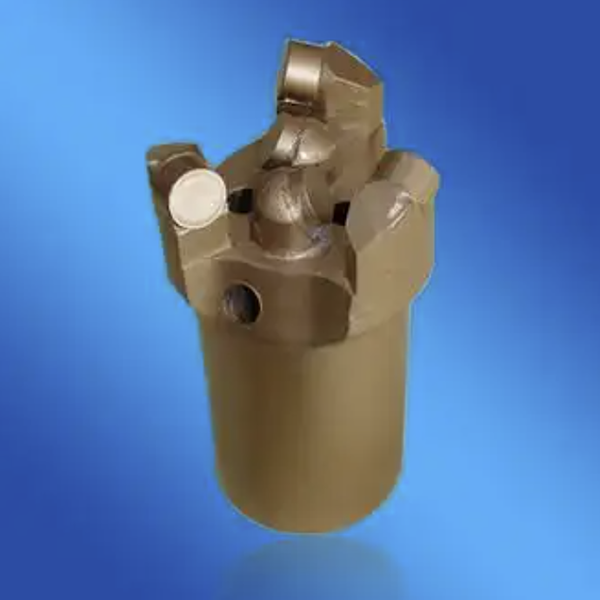
Fractured ground with hard interlayers is a special kind of headache. The bit hits a hard lens, deflects sideways into a fracture plane, and suddenly your borehole is wandering off course. This is where the rock drill rod takes lateral loads it wasn't designed for, and you get accelerated wear at the connections.
A four-wing high-strength PDC bit with mixed cutter geometry — spherical PDC teeth for the primary cutting zone and smaller flat cutters for gauge protection — gives you the best shot at holding trajectory through fractured sections. The key here isn't just the cutter shape; it's the total number of contact points keeping the bit centered in the hole while it cuts through unpredictable ground.
Drilling Parameters: The Stuff That Kills Bits Silently
You can pick the perfect bit for the formation and still destroy it in half a shift if your parameters are off. Here's what matters:
Weight on bit. For most PDC non-core bits in the 75-130 mm range, keep WOB between 5 and 15 kN. Below 5 kN, the cutters are skidding instead of engaging — that polishes the diamond table without actually cutting rock. Above 15 kN, especially in harder ground, you're inviting catastrophic cutter failure. I've seen operators crank the pressure because penetration rate dropped, not realizing the bit was already dull. More weight on a dull bit just snaps cutters off.
Rotation speed. 150 to 400 RPM covers most applications. The faster end of that range works in soft, homogeneous ground where heat buildup isn't a concern. In harder formations, keep it lower. High RPM plus high WOB equals thermal runaway at the cutter face — PDC diamond starts degrading above 350°C, and without adequate cooling, you'll hit that threshold in seconds.
Never run dry. This one sounds obvious, but it happens more than anyone wants to admit. A momentary loss of flush flow during a rod change, and the bit keeps spinning against dry rock. PDC cutters without cooling fail fast. No water, no air — no bit. Make sure your flush medium is flowing before you put weight on the bit, every single time.
Keeping Bits Alive Between Holes
A PDC bit that's properly maintained can go through multiple resharpening cycles before it's truly done. After pulling the bit, flush it clean — dried mud and rock dust left in the waterways will corrode the steel body and block coolant flow on the next run. The thread connections between the bit and drill rod need a light coat of anti-seize or rust inhibitor; a seized connection at the bottom of a deep hole is a recovery job nobody wants.
Inspect the cutter faces under good light. If you see uneven wear — say the outer gauge cutters are worn but the center ones look fresh — that tells you something about your parameter settings or formation transitions. Adjust accordingly. Light chipping on individual cutters doesn't mean the bit is scrap; those cutters can be replaced individually and the bit can go back into service for a fraction of the cost of a new one.
The bottom line: PDC non-core bits aren't disposable. They're tools that reward attention and punish neglect. Pick the right bit for the ground, run it within its envelope, and clean it up after every hole. Do that, and you'll stop filling drawers with dead bits.