Percussive-Rotary Drilling Explained: Why Hitting the Rock While Turning It Changed Everything
If you've ever drilled hard granite with a pure rotary rig, you know the feeling. The bit spins, the weight pushes down, and nothing much happens. The penetration rate drops to millimeters per minute. The bit glazes over. The crew starts checking their phones.
Now picture the same rock, but this time there's a hammer at the bottom of the hole, pounding the bit into the formation fifty times a second while the string turns above it. That's percussive-rotary drilling. And in hard rock, it's not just faster — it's often the difference between a viable project and one that bleeds money on meterage.
Where It Came From
The idea of combining rotation with percussion isn't new. European drillers were experimenting with it in the early 1800s. China's Ministry of Geology started serious research in 1958, and the technology took off in the 1970s as hydraulic and pneumatic systems matured. The appeal was straightforward: in hard formations, rotation alone scrapes. Add impact, and you shatter.
The three forces — impact pulse from the hammer, axial weight on bit, and rotary torque from the drill head — arrive at the bit simultaneously. The impact creates micro-fractures in the rock ahead of the bit face. The rotation indexes the bit to fresh rock with each blow. The feed pressure keeps the bit engaged so the impact energy actually goes into the rock instead of ringing back up the string.
The result: higher penetration rates, longer runs between bit changes, straighter holes (because the percussive action resists deviation better than pure rotation), and significantly lower cost per meter in hard formations.
Two Ways to Drive the Hammer
Percussive-rotary systems split into two families based on what powers the hammer:
Hydraulic-driven (liquid-driven) systems use drilling fluid — mud or water — pumped down the drill string to drive a piston hammer mounted above the core barrel or bit. The same fluid that powers the hammer also flushes cuttings. These systems are common in mineral exploration and geotechnical drilling, especially when the hole needs to stay clean for core recovery. They can even be combined with wireline coring, where the hammer and inner tube assembly is dropped into the rod string and retrieved with an overshot on a wire — no need to trip the whole string for each core run.
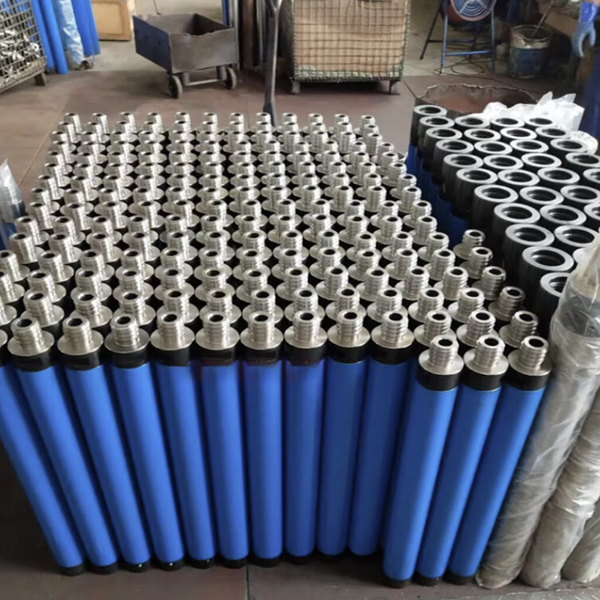
Pneumatic-driven systems — what most people mean when they say DTH (Down-The-Hole) — use compressed air. The hammer sits directly behind the bit at the bottom of the hole. The air drives the piston, and the exhaust air flushes cuttings up the annulus. DTH systems dominate in blast-hole drilling, water well drilling, and construction drilling where hole diameters are larger and air is practical. They deliver higher impact energy per blow than most hydraulic hammers and perform exceptionally well in hard, abrasive formations.
Frequency Classes: Fast Tapping vs. Hard Hitting
Not all percussive hammers work the same way. They divide into two frequency classes, and which one you use determines what kind of bit you run:
High-frequency hammers (above 40 Hz — more than 40 blows per second) are the fast tappers. They deliver lower energy per blow but at a much higher rate. In high-frequency mode, the primary rock-breaking mechanism is still rotation — the impact assists by keeping the bit face fresh and preventing bit-glazing in hard formations. These hammers pair with diamond bits, where the cutting action comes from the diamonds plowing through rock and the impact prevents the matrix from polishing over.
Low-frequency hammers (below 40 Hz) are the heavy hitters. Fewer blows per second, but each blow delivers substantially more energy. In this mode, impact is the primary rock-breaking mechanism and rotation mainly indexes the bit. These hammers pair with tungsten carbide insert bits — the large carbide buttons can absorb and transmit high single-blow energy without fracturing, which diamond segments generally can't.
The frequency choice is driven by formation hardness, bit type, and what you're optimizing for: penetration rate or bit life.
Why Any of This Matters for Tooling Purchases
If you're buying DTH hammers or bits for a project, the percussive-rotary principle matters because it determines what wears and how.
A DTH hammer is a precision device. The piston runs in a cylinder with clearances measured in thousandths of an inch. Contaminated air, insufficient lubrication, or running at the wrong pressure doesn't just reduce performance — it destroys the hammer internally. The piston galls the cylinder. The check valve sticks. The bit shank gets pounded out of tolerance. These are avoidable failures that cost real money.
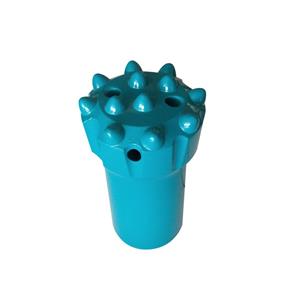
The bit has it even worse. A DTH bit takes impact, rotation, and abrasive flushing air simultaneously. The carbide buttons have to be tough enough to resist fracturing under high single-blow energy and hard enough to resist abrasive wear from cuttings rushing past at high velocity. That's a conflicting set of demands, and it's why good DTH bits are expensive and cheap ones fail spectacularly.
The Takeaway
Percussive-rotary drilling is the default answer for hard rock, and it has been for decades. The physics haven't changed much since the 1970s — what's improved is the metallurgy, the manufacturing precision, and the reliability of the hammers. The choice between hydraulic and pneumatic, high-frequency and low-frequency, comes down to your hole diameter, your formation, and whether you're coring or just making hole.
Know what class of hammer you're running, match your bits to the frequency regime, and maintain the hammer like the precision tool it is. Do that, and hard rock stops being the problem and starts being just another day's work.