Can a Raised-Center Button Bit Hold Gauge Longer Without Sacrificing Penetration?
When a threaded button bit is retired, it is often not because every carbide button has failed.
It is because the bit has lost gauge.
Once the outside diameter wears below the acceptable limit, the drilled hole becomes undersized. That creates problems downstream: poor hole accuracy, difficult charging, unreliable bolt-hole quality, and less predictable blasting results. In mining and tunnel development, a bit that no longer holds gauge can affect far more than its own cost per meter.
The obvious answer seems simple: add more gauge buttons.
But button-bit design is never that simple.
There is limited space on the face. Adding more or larger carbide buttons can reduce the impact force available at each button. Poor face layout can also restrict flushing and make it harder to evacuate cuttings. The result may be slower penetration, more re-crushing, or accelerated wear in a different part of the bit.
A raised-center face is one approach to solving that design problem.
Why gauge loss matters so much
The gauge buttons are positioned around the outside edge of the bit. Their job is to maintain hole diameter as the bit drills and rotates. They are exposed to severe abrasion from the borehole wall, especially in hard or abrasive rock.
When gauge buttons wear down, the bit begins cutting a smaller hole. That may seem minor at first, but the effects can accumulate:
Hole diameter becomes less consistent.
Drill-hole alignment may suffer.
Subsequent blasting or bolting operations become less predictable.
Regrinding intervals may shorten.
The bit reaches its discard diameter earlier.
For a drilling contractor, gauge life is often a major factor in the true cost of a threaded button bit. A bit with excellent penetration but short gauge life may not be the most economical tool on the job.
The challenge is to improve gauge protection without creating a face that drills poorly.
The trade-off in conventional bit faces
On a conventional button-bit face, space is limited. Gauge buttons, front buttons, flushing holes, and grooves all compete for the same area.
Increasing the number of gauge buttons can help distribute wear and preserve diameter. But it may also reduce the space available for flushing holes. If cuttings cannot leave the hole efficiently, they can be crushed again beneath the bit. That wastes impact energy and can slow penetration.
Adding larger carbide buttons brings another trade-off. The available impact energy is divided across more contact points. If the layout is not designed carefully, the crushing force applied to each button can fall. In hard rock, that can reduce the efficiency of the breakage process.
This is why a button bit should not be selected by button count alone. The position, height, angle, flushing layout, and face profile all influence performance.
What a raised-center face changes
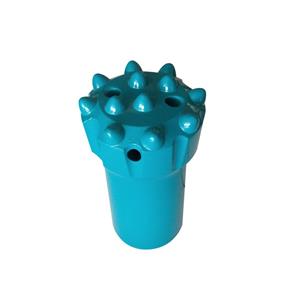
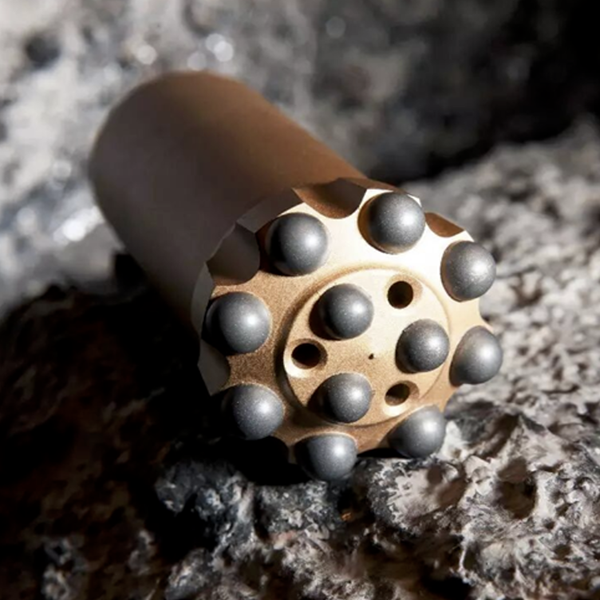
A raised-center design lifts part of the front face above the gauge-button level. A small number of central or front buttons sit slightly higher than the outer buttons, creating a more deliberate step in the face profile.
This extra vertical dimension gives the designer more room to work with.
The bit can accommodate additional gauge buttons while still leaving usable space for larger flushing holes and drainage grooves. The raised center can also create a mildly recessed hole-bottom profile during drilling. That changes how the front buttons engage the rock and how cuttings move away from the crushing zone.
The aim is not simply to make the face more complicated. The aim is to improve the relationship between three competing needs:
Gauge protection
Rock-breaking efficiency
Cuttings evacuation
When those three elements are balanced, the bit can hold diameter longer while maintaining a productive drilling cycle.
Better flushing can reduce unnecessary re-crushing
Flushing is easy to underestimate until it becomes a problem.
When crushed rock remains on the bottom of the hole, the bit spends energy breaking material that has already been broken. This is often called re-crushing. It does not advance the hole efficiently, and it can increase heat and wear on the bit face.
A raised-center bit design can create more room for larger or better-positioned flushing passages. If the flushing layout improves water and cuttings movement, debris can leave the face more quickly. That allows the carbide buttons to engage fresh rock more consistently.
The result may be a cleaner drilling action, reduced secondary breakage, and more stable penetration performance.
The real benefit depends on rock type, drilling parameters, air or water flushing conditions, and the rest of the drill string. But the principle is solid: a bit face that evacuates cuttings effectively gives its carbide buttons a better chance to work efficiently.
More buttons do not automatically mean slower drilling
It is reasonable to worry that adding gauge buttons will dilute impact energy.
However, a well-designed raised-center face can address that concern by controlling the height and engagement of the front buttons. Rather than forcing every button to contact the rock in exactly the same way, the stepped profile can guide how the face breaks the rock.
The raised front buttons initiate the breakage pattern. Gauge buttons maintain the hole wall. Larger flushing holes help carry cuttings away. The face is designed as a system, not as a collection of individual carbide inserts.
That distinction matters.
A poorly designed bit with more buttons may drill slower. A properly engineered bit with an improved face profile may maintain penetration by reducing re-crushing and improving cuttings removal.
This is why field testing remains essential. The same bit can behave differently in abrasive granite, fractured rock, wet ground, or a tunnel heading with variable geology.
Where raised-center button bits can be useful
Raised-center threaded button bits may be suitable for applications where hole quality and gauge life are especially important, including:
Underground mine development
Tunnel-face drilling
Production drilling in abrasive formations
Roof-bolting and ground-support holes
Projects where accurate collaring and hole diameter affect downstream work
They are not a universal answer for every drilling problem. Bit selection must still account for rock hardness, abrasiveness, drill type, hole diameter, flushing conditions, and the required drilling pattern.
A well-matched conventional face may still be the right choice in many situations. The value of a raised-center design appears when gauge wear, poor flushing, or excessive regrinding has become a recurring cost.
What to evaluate before changing bit design
Before changing to any new threaded button-bit profile, monitor the current drilling results.
Look at gauge wear, penetration rate, button breakage, bit-body wear, hole accuracy, flushing behavior, and regrinding intervals. These observations help identify whether the real problem is bit design, drilling parameters, inadequate flushing, poor alignment, or a mismatch between the bit and rock conditions.
Then compare candidate designs through controlled field trials.
The best button bit is not always the one with the most carbide, the largest flushing hole, or the most aggressive-looking face. It is the one that maintains gauge, drills efficiently, and produces a predictable cost per drilled meter in the actual ground.
A raised-center face is one more engineering tool for achieving that balance.