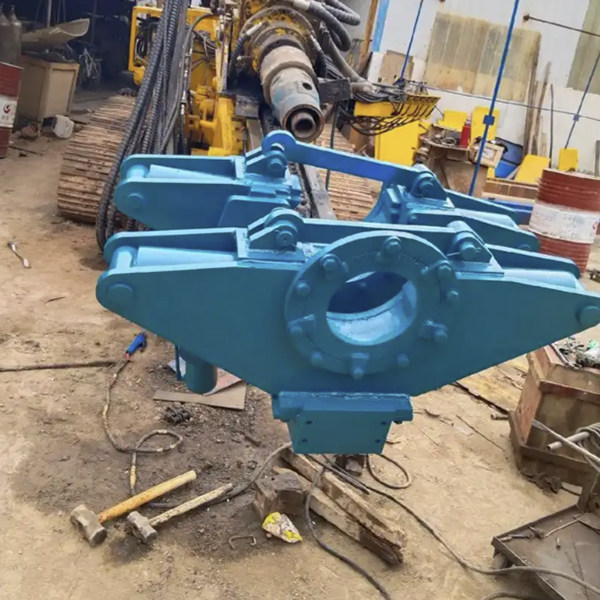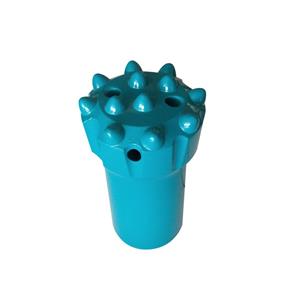
Rock Drilling Rig Clamp Troubleshooting: A Practical Guide to 4 Core Causes
As the key component that secures the drilling toolstring, the clamp directly affects both operational efficiency and jobsite safety. In field maintenance, common clamp faults usually appear as slip of the gripping dies, insufficient clamping force, oil leakage, or abnormal wear. Most issues can be traced and resolved through a structured diagnostic process—without blindly replacing parts.
Based on long-term hands-on experience, the following four-step sequence balances technical accuracy with practical usability, helping maintenance teams locate faults quickly and solve them efficiently.
Step 1: Check Die Wear (Slips/Gripping Blocks)
The dies are the parts in direct contact with the drill tool, so their wear and cleanliness directly determine clamping performance. They are also the most failure-prone components, so this should always be checked first.
Practical points:
Stop operation and clean dust, rock chips, and debris from die teeth.
In real field conditions, excessive dust and poor cleaning are major causes of early die slipping—more often than product quality issues.
After cleaning, inspect tooth tips:
If tooth tips are flattened and tooth profile is no longer clear, wear has reached the limit—replace immediately.
If tooth tips are still intact but slipping persists, verify whether clamping force settings match current working conditions before replacing dies.
Additional note:
Under normal conditions, die replacement is typically needed every 3–5 months. If slipping occurs within the first month, likely causes are dust buildup, improper clamping force adjustment, or insufficient cleaning. Optimize operating conditions and procedures first, then evaluate die quality.
Step 2: Check the Disc Spring Stack (Belleville Springs)
If dies are normal but clamping is still weak, inspect the disc springs. These springs provide core clamping force; damage or incorrect assembly will directly reduce clamping capacity.
Practical points:
Disassemble the clamp and remove the spring stack (commonly 9-piece or 12-piece sets).
Inspect each spring for:
cracking
collapse
incorrect order
reversed installation
Critical assembly rule:
Concave-to-concave paired stacking increases stiffness.
Concave-to-convex same-direction series stacking increases displacement.
Final stack quantity and combination must follow the drawing/spec for that model.
If springs collapse, clamping force drops immediately.
Additional note:
Disc springs often fail due to long-term loading or improper assembly. Once cracking/collapse appears, replace with springs of the same specification at once to prevent tool slip and safety risks.
Step 3: Check Guide Studs
Guide stud assembly accuracy directly affects clamp concentricity. Poor assembly can cause skewed clamping and secondary wear on the separation cylinder and booster cylinder. This is often overlooked but critical.
Practical points:
Verify tightening of the four guide studs:
Use alternating diagonal tightening only.
Tightening one side first, or uneven torque, can cause clamp misalignment (“skew clamping”).
Measure reserved clearances on both clamp sides with a steel ruler/tape.
Tolerance should be within 1 mm.
Excessive deviation can cause scratching/scoring of separation or booster cylinder bores, leading to oil leakage and power loss.
Additional note:
Disc spring specs and guide stud clearances vary by rig model. Always follow the technical standard for the specific model. Do not copy parameters from other models.
Step 4: Check Booster System and Oil Leakage
If the first three steps are normal but weak clamping, low power, or leakage remains, inspect the booster and sealing system. These are typically final-stage faults caused by seal failure or cylinder wear.
Practical points:
Inspect sealing points (booster cylinder and separation cylinder seals) for visible leakage traces.
For internal leakage (no obvious external leak but poor clamping), prioritize booster cylinder replacement.
If the separation cylinder is scored or deformed, sealing and force transfer cannot be maintained—replace the separation cylinder directly.
Additional note:
The booster system is the power core of the clamp. Cylinder scoring and seal aging are common failures. Use same-spec replacement parts, then test sealing performance and clamping force after assembly to confirm no seepage and stable clamping.
Field Summary
For frontline maintenance, clamp troubleshooting should follow this order:
Dies → Disc springs → Guide studs → Booster system
This sequence solves easy, low-cost issues first, then moves to deeper component disassembly—improving efficiency while reducing unnecessary part consumption. In many cases, failures are not due to part quality, but to dust control, assembly discipline, and parameter mismatch.
Daily best practices:
Clean dies regularly
Inspect disc spring condition periodically
Tighten guide studs with correct sequence and torque discipline
These measures can significantly reduce clamp failure frequency.
At the same time, maintenance personnel should be fully familiar with model-specific technical parameters, avoid blind assembly and arbitrary part replacement, and ensure professional, standardized diagnostics and repair—so the rig clamp remains stable and reliable throughout drilling operations.