Rock Drilling Tool Design, Manufacturing, and Maintenance Requirements
A rock drilling tool is a complete energy-transfer system. The rock drill creates impact and rotation, the shank adapter and drill steel transmit that energy, and the drill bit applies it to the rock. If any part of this chain becomes a weak link, drilling efficiency, hole accuracy, tool life, and operating cost are affected.
For mining, tunneling, quarrying, and infrastructure work, good drilling performance does not come from one component alone. It requires compatible equipment, correct tool design, stable manufacturing quality, suitable materials, proper heat treatment, and careful field use.
The goal is straightforward: transfer energy efficiently, break rock effectively, maintain reliable connections, reduce downtime, and achieve the lowest practical cost per drilled meter.
Core Requirements for Rock Drilling Tools
A reliable drilling tool system should meet several general requirements:
Efficient transfer of impact and rotation energy
Effective rock-breaking capability
Compatibility with the rock drill and rock formation
Simple, durable, and manufacturable structure
Practical maintenance and regrinding procedures
Stable service life and economical operation
Resistance to fatigue, abrasion, corrosion, and connection wear
Each component has different operating conditions. A drill rod must survive impact, bending, torsion, and corrosion. A bit body must support carbide inserts while resisting wear and cracking. A threaded connection must transmit energy without loosening or galling. These different demands must be considered during design and manufacturing.
Integral Drill Steel Design
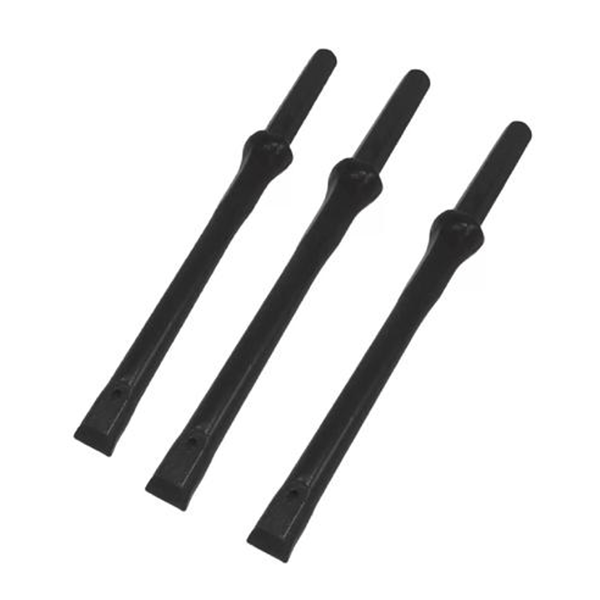
Integral drill steel combines the shank, rod body, and bit into one component. Because it cannot be separated into replaceable pieces, its design should aim for balanced service life across all sections.
If one section fails much earlier than the others, the economic value of the complete tool is reduced. For example, a strong bit is of little value if the shank end fatigues early, and a durable rod body does not compensate for rapid bit wear.
Heat treatment is especially important. Different areas of an integral drill steel may require different hardness and toughness levels. A softened zone created during manufacturing can affect fatigue life significantly. If this zone is located in a high-stress area where impact waves combine, the risk of fracture can increase.
The shank end needs good surface hardness for wear resistance and sufficient internal toughness to absorb repeated impact. The transition between hard and tough zones should be gradual. Abrupt changes in hardness or microstructure can create stress concentration and reduce reliability.
Straightness, Surface Condition, and Fatigue Life
Drill steel surface quality has a direct effect on fatigue performance. Small defects can become crack initiation points under repeated impact.
Potentially harmful defects include:
Scratches and dents
Corrosion pits
Decarburized surface layers
Oxide scale
Sharp identification marks
Rough machining marks
Small transition radii at shoulders
Out-of-straightness at the shank end
Non-perpendicular shank faces
A shank end that is not square to the rod axis can create eccentric impact loading. This may accelerate drill rod fatigue, damage the rock drill piston face, increase spline wear, and create unnecessary vibration and noise.
Manufacturers should use controlled machining, heat treatment, straightening, and inspection procedures. Contractors should remove damaged rods from service before surface defects develop into fatigue fractures.
Corrosion Protection and Shot Peening
Rock drilling tools often work in wet, corrosive environments. Mine water, drilling fluids, and storage humidity can create corrosion pits that reduce fatigue resistance.
Corrosion protection should cover both the outer rod surface and internal flushing hole where applicable. Phosphate-based coatings, protective oils, waxes, or other approved corrosion-prevention systems may be used according to the manufacturer’s process and local environmental requirements.
Shot peening can also improve fatigue performance. It introduces compressive stress into the surface layer, helping resist crack initiation. The exact shot size, velocity, coverage, and process control must be validated for the specific drill steel and geometry. Historical process values are useful references, but they should not be adopted without engineering confirmation.
Drill Bit Design and Carbide Selection
The drill bit must match the rock type, drilling method, hole diameter, and rig power. Blade bits, cross bits, button bits, and other designs have different strengths and limitations.
Blade-style bits are simple and can be useful in shallow or smaller-hole drilling. However, their cutting edges may wear unevenly and may be more limited in large diameters or demanding rock conditions.
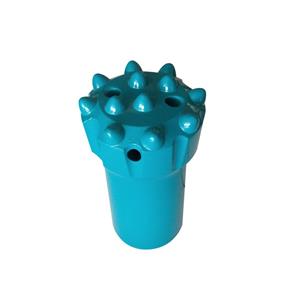
Button bits offer flexible button layouts and multi-point rock breaking. They can provide higher efficiency, better gauge retention, and longer regrinding intervals in suitable applications. Button number, diameter, projection, spacing, inclination, and flushing design must be selected as a system.
Carbide selection requires a balance between wear resistance and toughness. A harder carbide grade may resist abrasion better but can be more sensitive to overload, thermal shock, and poor regrinding. A tougher grade may better survive impact and variable rock but can wear faster in highly abrasive formations.
The correct carbide grade should therefore be confirmed through field trials, considering rock abrasiveness, hardness, fracture condition, drilling energy, flushing, and desired service life.
Button Retention and Bit Body Strength
Button bits may use hot insertion or cold pressing to secure carbide buttons. In hot insertion, the heated bit body expands, allowing the buttons to be installed before the steel contracts during cooling. In cold pressing, buttons are forced into holes through a controlled interference fit.
Both methods require accurate hole dimensions and proper interference. Excessive interference can crack the carbide or plastically deform the bit body. Insufficient interference can allow button movement or loss.
The bit body must remain strong enough to support the buttons during drilling, particularly at the gauge. Gauge buttons experience significant sidewall contact and abrasion. If button holes deform, gauge buttons can loosen and the bit may lose diameter quickly.
Good button-bit design also needs adequate flushing space. Poor chip removal increases regrinding, heat, abrasion, and energy consumption. Well-designed face grooves and flushing holes help carry cuttings away from the bottom of the hole.
Correct Field Use and Maintenance
Even premium drilling tools can fail early when they are used incorrectly. A disciplined operating routine is essential.
During collaring, apply controlled impact and lower feed force until the hole is established. Once the bit is properly guided, drilling can continue at the recommended operating settings. Excessive feed can increase bending stress and accelerate bit wear. Insufficient feed can create harmful tensile stress and inefficient drilling.
Avoid striking drill tools with hammers during installation or removal. Use dedicated removal tools. External damage from hammers, rocks, or unsuitable handling can sharply reduce fatigue life.
Keep threaded connections clean and lubricated with suitable thread grease. A hot coupling sleeve or thread area can indicate excessive friction, poor fit, contamination, or wear. Damaged couplings and rods should be repaired or replaced before they damage other components.
Never allow prolonged blank firing, where the drill piston impacts the drill steel without the bit supported against rock. This can create severe reflected tensile stress and damage carbide inserts, button retention, shank ends, and drill rods.
Regrind bits before wear becomes excessive. Overworn cutting edges are difficult to restore without wasting carbide and may already have created damage that reduces tool performance. Grinding should use appropriate wheels, moderate pressure, and proper cooling methods to prevent overheating and cracking.
Conclusion
Rock drilling tool performance depends on a complete system of design, materials, manufacturing, operation, and maintenance. Strong drill steel alone is not enough. Good bit geometry alone is not enough. The entire drill string must be compatible with the rig, the rock formation, and the drilling objective.
By controlling surface quality, heat treatment, corrosion protection, carbide selection, button retention, flushing design, and operator practice, drilling contractors can improve penetration consistency, reduce unplanned downtime, and extend the useful life of drilling tools.