The 10 Design Rules Behind Rock Drilling Tools That Actually Work
A rock drilling tool is never just a piece of steel.
A drill bit, drill rod, shank adapter, or coupling sleeve may look straightforward on a workshop bench. Put it into a mine, tunnel, quarry, or construction site, and it becomes part of a much larger system. It has to transfer impact energy, carry torque, remove cuttings, maintain alignment, survive wear, connect reliably, and produce a hole that supports the next stage of work.
If one part of that system is poorly designed, the problem rarely stays isolated.
A bit that does not flush efficiently can lose penetration rate. A rod that lacks straightness can cause hole deviation. A connection that is difficult to uncouple can increase downtime. A tool designed with too much material may be unnecessarily expensive; one designed with too little strength may fail long before its expected service life.
Good rock drilling tools are built around a group of connected design principles. Here are ten that matter in the field.
1. Break rock efficiently
This is the first job of any drilling tool.
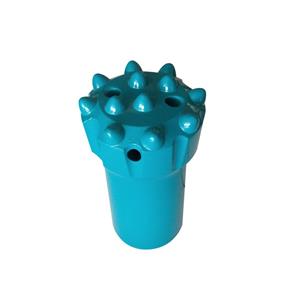
The bit face, carbide-button shape, button layout, attack angle, and force distribution should match the rock conditions. Hard, abrasive, fractured, and homogeneous formations do not respond the same way. A button pattern that performs well in one formation may produce poor penetration or abnormal wear in another.
Efficient rock breaking means using the available impact energy where it matters. It is not simply about adding more carbide buttons or making the face more aggressive. The tool must create effective fractures while keeping the drilling action stable.
A good design starts with the actual ground conditions, not a generic product drawing.
2. Remove cuttings quickly
Rock cuttings must leave the bottom of the hole.
If they remain beneath the bit, they form a layer that absorbs energy and causes unnecessary re-crushing. This can slow penetration, raise operating temperature, increase bit wear, and create unstable drilling conditions.
Flushing holes, grooves, air or water flow paths, and bit-face geometry all influence how well cuttings are removed. The goal is to keep fresh rock exposed to the carbide buttons and prevent crushed material from circulating around the face.
Poor flushing can make a good bit look like a poor one. Before blaming the carbide grade, check whether the cuttings have a clear route out of the hole.
3. Keep the geometry stable
Straight rods and symmetrical bits matter because drilling accuracy matters.
A bent drill rod, an off-center bit, or an unevenly worn connection can push a hole away from its intended path. In tunneling, mining, and blasting work, hole deviation may affect the entire drilling pattern. That can lead to uneven fragmentation, overbreak, underbreak, poor ground-support installation, or difficulty in the next operating step.
Stable geometry is not only a manufacturing requirement. It is also a maintenance requirement. Crews should inspect drill rods, threads, couplings, and bits for bending, abnormal wear, and damage before those issues become a production problem.
4. Build for strength and wear resistance
Rock drilling tools operate under repeated impact, torque, friction, water, dust, and corrosion. Their materials and heat treatment must provide a usable balance of strength, toughness, hardness, and wear resistance.
Too much hardness can create brittleness. Too much softness can lead to rapid thread wear, body deformation, or poor button support. The correct balance depends on the component and its job in the drill string.
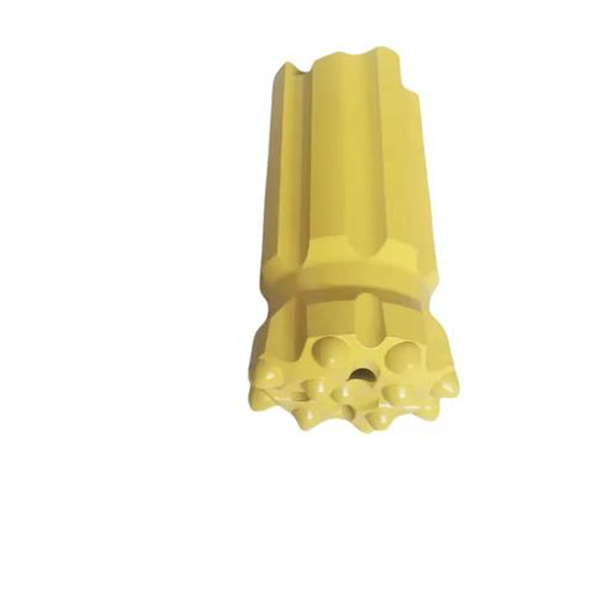
For example, a threaded button-bit body must protect the carbide inserts and resist abrasive wear. A drill rod must transmit energy while resisting fatigue. A coupling sleeve must maintain thread integrity without damaging the components it connects.
Material selection is only the starting point. Forging, machining, heat treatment, and inspection determine whether those material properties appear consistently in real production.
5. Use material where it earns its cost
More steel is not always better.
A smart design strengthens the areas that carry the highest loads: thread roots, transition areas, button seats, flushing passages, and other known stress points. Less critical areas should not receive unnecessary material or machining complexity.
This is how manufacturers balance performance and cost. The aim is not to make the heaviest tool. It is to make the tool that delivers the required service life at a sensible cost per drilled meter.
When a part fails repeatedly, the right response is not always to make everything thicker. First identify where the failure starts and why.
6. Keep rotation and feed movement smooth
A drilling tool must rotate, advance, and retract without creating unnecessary resistance.
This depends on accurate threads, correct component matching, reliable flushing, and proper alignment. A tool that binds, overheats, or resists uncoupling wastes time and increases wear across the entire system.
Smooth operation lowers energy loss and helps maintain a more stable drilling cycle. It also gives operators better control when moving between hole positions or adjusting drilling parameters.
7. Make connections reliable and practical
Connections must stay tight under impact, but they also need to be serviceable.
Shank adapters, rods, bits, and coupling sleeves are frequently assembled and separated in the field. Thread design and manufacturing accuracy must support reliable engagement without making uncoupling unnecessarily difficult.
A poor connection can create energy loss, leakage, heat, thread damage, and abnormal fatigue. This is why low-cost coupling sleeves can become expensive: they may damage the higher-value rods and shank adapters around them.
Whenever possible, select compatible components from a qualified system supplier and follow the recommended inspection and lubrication practices.
8. Drill holes that are round and straight
The quality of a drilled hole affects everything that follows.
For blasting, a round and straight hole helps maintain a predictable explosive charge distribution and energy release. For bolting, accurate holes support proper installation and anchorage. For tunneling, consistent hole quality helps crews follow the designed profile and control excavation results.
Oval or deviated holes can lead to uneven loading, poor fragmentation, overbreak, underbreak, or ground damage. Tool design, drill-string alignment, rig setup, and operator practice all contribute to hole quality.
9. Design for real manufacturing
A technically elegant design is not useful if it cannot be manufactured consistently.
The production process must be able to control critical dimensions, material properties, surface finish, heat treatment, and inspection. Tool designers should consider available forging, machining, drilling, threading, and quality-control capabilities from the beginning.
This does not mean simplifying every feature. It means designing features that can be produced repeatedly without creating uncontrolled variation.
Reliable mass production is one of the strongest forms of quality control.
10. Make the tool easy to identify and use
Appearance is not just cosmetic.
Clear geometry, sensible proportions, clean finishing, and recognizable product markings can make inspection, handling, and maintenance easier. A well-designed tool should be understandable to the people using it: which end connects where, how it should be inspected, and what wear signs matter.
Good form often reflects good function. If a feature looks awkward, creates sharp stress points, traps debris, or complicates handling, it may create a field problem as well.
Design is a system, not a checklist
These ten principles work together.
Efficient rock breaking depends on correct flushing. Flushing depends on face geometry. Geometry stability supports hole accuracy. Reliable connections protect energy transfer. Material selection and heat treatment determine whether the design survives the intended load.
That is why the best rock drilling tools are designed as part of a complete operating system.
When selecting drilling tools, look beyond price and surface appearance. Ask how the bit, rod, coupling sleeve, shank adapter, and drilling conditions work together. The right design does not merely drill a hole. It helps the whole operation move faster, safer, and with less waste.