Rock Drilling Tools: Where Materials Science Meets Mining Productivity
Rock drilling tools sit at the intersection of materials science, mechanical design, mining economics, and field experience.
A drill bit may be small enough to hold in one hand. A drill rod may look like a simple length of steel. But together they work in one of the harshest environments in industry: high-frequency impact, rotation, bending, abrasive rock, flushing water, heat, and corrosion.
That is why rock drilling tools have always evolved with mining and infrastructure.
From early impact drilling to modern hydraulic rigs, DTH hammers, automated jumbos, and tunnel-boring systems, every advance in drilling equipment has created new demands for stronger steel, better carbide, more reliable threads, and smarter bit designs.
The lesson is simple: better drilling performance does not come from one invention. It comes from improving the whole system.
Carbide changed the economics of rock breaking
The development of cemented carbide transformed rock drilling.
Before carbide inserts became common, drill tools depended mainly on steel cutting edges. Those tools could work, but their wear life and rock-breaking efficiency were limited. Harder formations quickly consumed the cutting edge, forcing frequent sharpening or replacement.
Cemented carbide changed that equation.
Carbide brought exceptional hardness and wear resistance to the bit face. It allowed drill bits to work in much harder rock, maintain a usable cutting profile longer, and transfer impact energy more effectively into the formation.
But carbide is not magic. It is hard and wear resistant, yet brittle compared with steel. That creates one of the central challenges in drill-bit engineering: how to support carbide inserts so they resist chipping, loosening, and breakage under repeated impact.
The answer involves more than carbide grade. Insert shape, diameter, height, button-hole geometry, bit-body steel, fixing method, heat treatment, flushing design, and field operating conditions all matter.
A strong carbide button placed in a weak body is still part of a weak tool.
The drill string is an energy-transfer system
A rock drill does not deliver useful work directly to the rock. It sends energy through a chain of components:
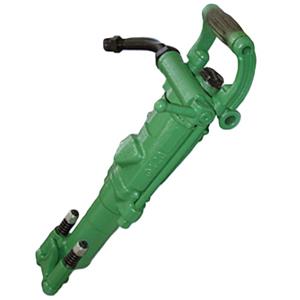
The rock drill or hammer creates impact energy.
The shank adapter transfers it into the drill string.
Drill rods carry the stress wave and torque.
Coupling sleeves maintain connection and alignment.
The bit converts the energy into rock breakage.
Every connection creates an opportunity for energy loss or failure.
A worn thread can reduce contact quality. A poorly matched coupling sleeve can create misalignment. A bent drill rod can increase hole deviation. A damaged shank adapter can disturb the stress wave before it reaches the bit.
This is why customers should not evaluate components in isolation. A premium button bit cannot deliver its intended performance if it is connected to worn or mismatched drill steel. Likewise, high-quality drill rods cannot compensate for an unsuitable bit face in the wrong rock formation.
The best results come from a matched drill-string system.
Steel quality determines how drill rods survive
Drill rods are often judged by visible features: straightness, thread form, and surface finish. Those are important, but long-term reliability begins inside the steel.
A rod operates under repeated impact and stress-wave loading. It also carries torsion from rotation and may be exposed to water, dust, corrosion, and bending. Small metallurgical defects, poor straightness, surface damage, or inconsistent heat treatment can become fatigue starting points.
Once a crack begins, high-frequency loading can drive it forward quickly.
This is why drill-steel manufacturing requires control from raw material through rolling, forging, machining, heat treatment, straightening, and inspection. The goal is not simply to produce a rod that passes a dimensional check. It is to produce a rod that survives a predictable number of drilling cycles in real field conditions.
For contractors, that reliability reduces unexpected breakage and keeps the drilling cycle moving.
Bit design must match the rock
There is no single “best” drill bit.
A bit that performs well in moderately hard rock may fail in extremely tough quartzite. A design that offers excellent penetration in fractured ground may lose gauge too quickly in abrasive formations. A button pattern that works on a large hydraulic rig may not be appropriate for a smaller pneumatic drill.
Bit selection should consider:
Rock compressive strength and toughness
Abrasiveness and expected gauge wear
Formation fractures and ground variability
Drill type and available impact energy
Hole diameter and drilling pattern
Flushing method and cuttings behavior
Required hole accuracy
Regrinding capability and maintenance practice
The most expensive mistake is treating bit choice as a catalogue decision rather than an application decision.
Field trials are valuable because they show real failure modes. Did the bit lose gauge? Did buttons chip? Was penetration slow? Was flushing inadequate? Did the skirt or threads deform? Each failure pattern points to a different improvement.
Button bits and blade bits each have a place
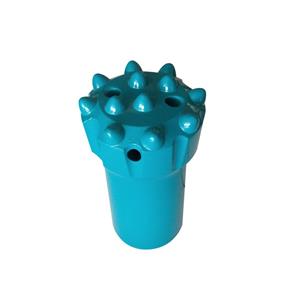
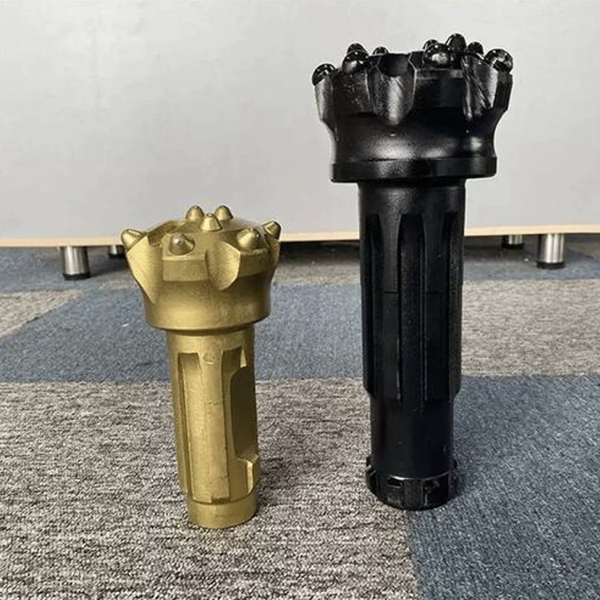
Button bits are widely used because their carbide inserts can be arranged to provide efficient rock breaking, good gauge protection, and flexible face designs. They are especially effective in many modern top-hammer and DTH applications.
But blade-style, cross, chisel, or composite designs still have value.
In extremely hard and tough rock, larger carbide blades or reinforced cutting elements may resist concentrated impact better than a design built around small buttons. In some cases, combining the impact strength of blade-style edge elements with the efficiency of central buttons can create a useful compromise.
The important point is not to treat one bit type as universally superior.
Good engineering starts by understanding where the load lands, how the rock fractures, how cuttings leave the hole, and how the bit is likely to wear.
Manufacturing quality is part of field performance
The factory and the mine are connected.
A weak forging, poorly controlled heat treatment, inaccurate thread, contaminated surface before quenching, or inconsistent carbide fixing process may not be obvious when a tool leaves the production line. But the consequences appear in the field.
This is why rock drilling tool quality control needs to cover the entire manufacturing chain:
Incoming steel and carbide inspection
Forging and body-shape control
Machining of threads, holes, and flushing passages
Heat-treatment consistency
Carbide fixation and retention checks
Hardness and metallographic verification
Straightness and thread inspection
Final marking, packaging, and traceability
The customer sees the finished tool. The manufacturer must control every step that created it.
Innovation is not only a new product
In rock drilling tools, innovation can be a new bit profile or a new carbide grade. It can also be a better process: improved heat treatment, more stable thread rolling, better carbide retention, enhanced corrosion protection, or a more useful inspection gauge.
It can be a service improvement too.
Providing application advice, wear analysis, regrinding guidance, and matched drill-string recommendations helps customers reduce drilling cost per meter. In many cases, that is more valuable than a small reduction in purchase price.
The drilling industry continues to demand faster, safer, and more accurate work. Tools must keep pace.
The future belongs to manufacturers that combine materials science with field understanding: tools that do not merely look correct, but transfer energy efficiently, resist wear, hold gauge, stay connected, and deliver reliable performance in the rock.