Three Ways to Spot a Failing Shank Adapter Before It Takes Down Your Drill String
Most shank adapter failures don't happen without warning. The problem is, the warning signs are easy to miss if you don't know what you're looking at — or listening to. By the time the adapter lets go completely, you're usually looking at collateral damage: a chewed-up driver, a damaged piston, or a rock drill rod that took a beating it didn't deserve.
Here are three ways to catch a shank adapter problem early, before it turns into a repair bill.
Look at the Surface
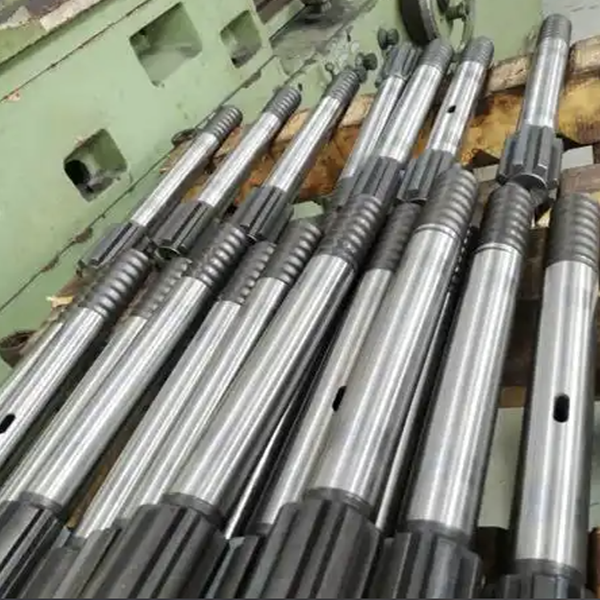
A healthy shank adapter should have a clean, uniform surface along its working length. No discoloration, no visible cracking, and the splines should show even, predictable wear — not gouging or steps.
If the shank adapter body has turned dark — blued or blackened — that's heat. And heat on a shank adapter almost always means one thing: insufficient lubrication. When the adapter runs dry against the guide bushing, friction spikes, temperatures climb, and the surface temper gets compromised. Once the surface hardness drops, wear accelerates fast. The fix is straightforward: check your lubrication system. Make sure you're using the right high-temperature grease and that it's actually reaching the contact surfaces. Don't assume — verify.
Cracks or chipping along the adapter body or splines are a hard stop. Pull the adapter immediately. A crack that's visible on the surface has already propagated deeper than you can see, and running it further risks a catastrophic break inside the hammer. While you're at it, check the guide bushing for excessive wear and verify that your impact pressure isn't set higher than the rock conditions justify. A shank adapter that's chipping out is often the victim of impact energy it was never meant to absorb.
Spline wear at the drive end is normal over time — but if it's concentrated at the front edge and the splines look stepped or mushroomed, dry-firing is the likely culprit. When the piston strikes without the bit seated against rock, the energy has to go somewhere, and the spline interface takes the brunt. Reduce your idle hammer time, check that your anti-dry-fire system is working, and confirm your feed pressure keeps the string engaged.
Listen to the Rig
A hydraulic rock drill in good condition produces a steady, continuous impact rhythm — tight, sharp, even. When something's wrong with the shank adapter, you'll hear it before you see it.
A clicking or rattling sound during operation often means the adapter is bouncing in the driver. That could be wear on the splines, wear in the guide bushing, or a combination of both. A dull, thudding impact — where the sharp crack of a normal blow turns into something heavier and more hollow — suggests energy isn't transferring cleanly through the adapter into the rock drill rod. And a high-pitched squeal or whine is usually metal-on-metal contact where lubrication has failed.
Any of these sounds means the same thing: stop the rig, pull the front head, and inspect the shank adapter. Don't try to finish the hole first. You'll just make it worse.
Measure What Matters
Visual inspection and sound will catch a lot. A caliper catches the rest.
Two measurements matter most. First, check the strike face — the end of the adapter that takes the piston impact. If that face has worn more than one millimeter from its original profile, the impact energy isn't transferring efficiently anymore, and you're beating up both the piston and the adapter. Replace it.
Second, measure the splines at both ends. If either end shows more than one millimeter of wear from the original profile, the adapter is done. Running a shank adapter past this point risks damaging the driver splines, and that's a much more expensive repair.
One more thing worth checking: the water seal area. If the diameter at the seal contact point has reduced and you're seeing water leaking past into the hammer body, replace the adapter immediately. Water infiltration into a hydraulic rock drill will emulsify the oil, and that damage cascades through the entire system in a matter of hours.
Routine dimensional checks — even just a quick once-over with calipers every few shifts — can extend shank adapter life by half or more. The adapter itself is a relatively cheap component. Everything it connects to is not.