The Four Reasons Your Shank Adapters Die Young — And One of Them Is Your Water
I've talked to enough drill crews to notice a pattern. Ask them why their shank adapters fail, and they'll usually say "bad steel" or "rough ground." But pull the records and track the failures over six months, and you'll find the same four culprits showing up again and again. Steel quality is rarely the problem. Everything else is.
Here are the four things that send shank adapters to the scrap bin before their time.
Too Much Hammer for the Job
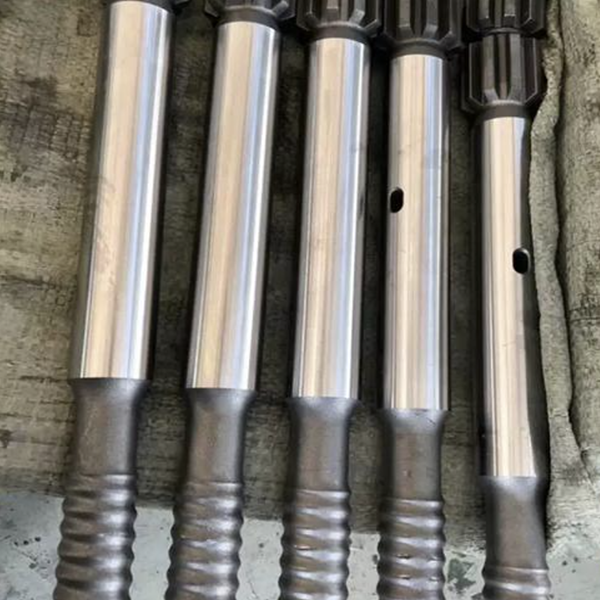
A shank adapter takes thousands of piston strikes every minute. Each impact sends a shockwave through the strike face, down the adapter body, and into the rock drill rod. Under normal loads, the adapter handles this — it's what it was built for. But when impact pressure is dialed past the design threshold, those shockwaves start doing something the alloy can't fully recover from.
Micro-cracks nucleate below the surface at the strike face. They're invisible at first — no discoloration, no obvious damage. But every over-powered blow feeds them, and over days or weeks they propagate deeper into the body. When they finally connect, the adapter fractures without warning. Not because it wore out. Because it was beaten past its fatigue limit.
The fix: match impact energy to the rock and the hole diameter. Harder rock and larger holes need more impact. Soft ground and small holes don't. If you're not sure where the line is, start low and work up — you can always add more, but you can't undo fatigue damage that's already accumulated.
Lubrication That Isn't Reaching Where It Counts
The surfaces that matter most on a shank adapter are the ones you can't see while it's running: the piston strike face, the spline contact zone inside the driver, and the shank body where it rides in the guide bushing. All three depend on a continuous air-oil mist to keep friction and heat under control.
When that mist thins out — blocked nozzle, empty reservoir, line crimped somewhere in the system — the adapter runs dry against hardened steel components at impact frequency. Friction spikes, surface temperature climbs, and the metal at the contact zone starts to anneal. Hardness drops. Wear rate multiplies. What should be a polished contact surface turns rough, then galled, then chewed.
Once the surface temper is gone, it doesn't come back. You can fix the lubrication, but the damage is already baked into the steel. The adapter is on borrowed time.
The Rig Is Worn and Nobody Checked
This one sneaks up on crews. The shank adapter doesn't work in isolation — it's surrounded by the rig's wear components: slide blocks, support bushings, guide bushings. When any of these wear past tolerance, the adapter loses its alignment. It's no longer sitting true in the driver. Every piston strike now has a tiny lateral component — a bending force that the adapter was never designed to handle.
Over time, that off-axis loading concentrates stress at the thread root or the transition between the shank body and the drive end. Fatigue cracks start. The adapter fails, and the crew blames the adapter — when the real problem is a worn guide bushing they haven't replaced in a year.
Check your rig's wear components when you check your adapters. If the guide bushing has play, the best adapter in the world won't last.
Dirty Water, Clean Problem
This one surprised me the first time I saw it. The flushing water that runs through the drill string to clear cuttings — if it's not filtered, it carries suspended particulates. Sand, silt, mineral fines. At the water seal on the shank adapter, those particles pack into the seal interface and turn it into a lapping compound. Instead of sealing, it grinds.
The water seal diameter wears down, water starts leaking past into the hammer body, and now you've got two problems: a worn adapter and hydraulic oil that's about to emulsify. Both are expensive. Both trace back to a water filter that costs pocket change.
Run your flush water through a filter. Check the seal area on the adapter during shift inspections. If the diameter is visibly reduced or you can feel a ridge with your fingernail, swap it before it leaks.