Shank Adapter Fractures: Five Things Your Rig Is Doing Wrong That Kill Shanks Before Their Time
A shank adapter that dies in under ten shifts is trying to tell you something.
I watched a crew in Vietnam go through four shanks in two weeks on a new development heading. They kept blaming the steel. "Bad batch," the shift boss said. But the metallurgy report came back clean — proper case depth, good bainite transition, no inclusions. The steel wasn't the problem.
The problem was the rig.
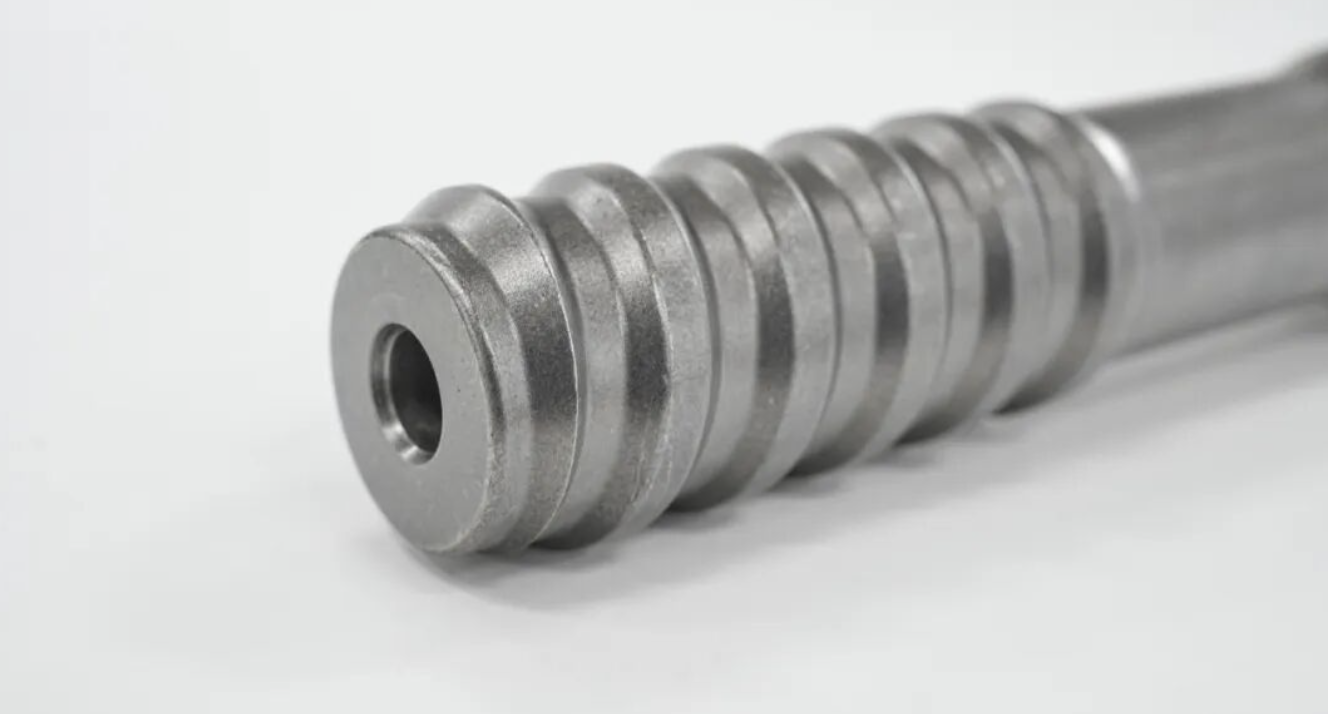
Shank adapters sit at the worst intersection of forces on any rock drill. The piston hammers one end. Rotation torque twists the middle. The drill string pulls from the other side. When everything's aligned and dialed in, a good shank handles it for hundreds of hours. When something's off, it snaps — usually at the thread root — and it snaps fast.
Here are the five rig-side problems that cause shank adapter fractures, and exactly what to check before you order another one.
1. Loose Mounting Bolts — The Wobble That Compounds
Every impact from the piston sends vibration through the entire drill body. Over time, the bolts holding the drill to the feed beam mounting plate work loose. Not dramatically — you probably won't notice it during a walk-by inspection. But even a millimeter of play at the mount translates to sideways movement at the shank.
Once the drill body starts swaying under load, the shank isn't loading straight into the string anymore. There's a radial component to every blow. Thread roots don't like radial loads. They're designed for axial impact, not bending. The fatigue life drops fast.
The fix is simple but boring: torque-check the mounting bolts on a schedule. Most manufacturers recommend every 40 impact hours. Nobody does it, and shanks keep breaking.
2. Worn Guide Bushing — The Gap That Grows
The shank guide bushing is supposed to keep the front end of the shank centered and stable. When it's new, the clearance between bushing ID and shank OD is tight — usually a few hundredths of a millimeter. That's enough to allow rotation and axial movement without letting the shank wobble.
As the bushing wears, that clearance opens up. Once it's beyond spec, the shank's front end starts orbiting inside the bushing instead of rotating cleanly on axis. Every orbit cycle puts a bending stress on the thread root. At 50 impacts per second, that's 50 bending cycles per second.
The industry rule of thumb is to replace the guide bushing every 800 impact hours. On a rig that's running two shifts a day, that's roughly every two months. Most sites stretch it to four or five. The shanks pay the price.
3. Starved Lubrication — Heat Death
Air-oil mist lubrication does two things: it cools the shank and it provides a film between the shank and everything it touches — the piston striking face, the bushing, the rotation chuck.
When lubrication drops below spec, the shank runs hot. Hot steel loses hardness. A shank that's supposed to be 58-60 HRC at the surface can drop below 50 HRC at operating temperature if there's no oil film carrying heat away. Softer steel wears faster and fatigues sooner. The thread root, already a stress concentrator, becomes a failure point even faster.
Check your lubricator before every shift. Watch for an even oil film on the shank after the first few blows. If the film isn't there, don't start drilling.
4. Mismatched Pressures — The Blank Fire Problem
This one's counterintuitive if you haven't seen it.
When feed pressure is too low relative to impact pressure, the drill body recoils away from the face instead of transmitting the blow into the rock. The piston hits the shank, but the shank isn't pressed firmly against the bottom of the hole. The energy that should go into breaking rock goes into ringing the shank like a bell instead.
That's blank firing — and it's brutal on shanks. The piston impacts the shank, the shank accelerates forward into nothing, then snaps back. The shock loads are higher than normal drilling because there's no rock to absorb them.
The fix: match feed pressure to rock hardness. Harder rock needs less feed pressure, not more — give the bit time to crush. Softer rock needs more feed pressure to keep the bit engaged. It's the opposite of what a new operator's gut says, and getting it wrong destroys shanks faster than almost anything else.
5. Feed Beam Misalignment — The Radial Load You Can't See
If the drill isn't mounted straight on the feed beam — if the shank centerline doesn't run true through the front and intermediate centralizers — the shank is under constant radial load from the moment drilling starts.
Imagine a straight rod being forced into a hole that's slightly off-axis. Every rotation cycle, the shank flexes. Every impact, the flexed section takes a bending stress spike. Thread roots don't just fatigue — they fatigue with a bending amplifier.
Alignment check is part of the 40-hour bolt inspection. Run a straight edge or use the centralizer bores as reference. If it's off, fix it before the next shift. A misaligned mount will kill shanks faster than bad steel ever will.
The Real Pattern
Here's what I've learned from watching shank failures across a lot of operations: when a shank breaks at the thread root in under 100 impact hours, the problem is almost never metallurgy. It's one of these five things. Usually more than one — they compound. A worn bushing plus low lubrication plus a slightly loose mount equals a shank that doesn't survive the week.
The shank is the messenger. Don't shoot it. Fix the rig.