Shank Adapter Selection Guide: T38, T45, T51, R32, R25, R38 — Which One Goes With Your Drill?
The shank adapter is the most overlooked component in a rock drilling system. It's the part that sits between the drill and the drill rod, taking the full force of every piston blow and transmitting it down the string. Pick the wrong one — wrong diameter, wrong length, wrong thread — and the drill won't just perform poorly. It will destroy itself. The piston will strike off-center. The drill rod will whip. The bit will drill an oval hole. And all of it traces back to a shank adapter that wasn't right for the application.
Here's a practical guide to the six most common shank adapter types, what they're designed for, and how to match one to your drill, your rock, and your hole.
T38: The Universal Standard
The T38 shank adapter — 38 millimeters in diameter, available in lengths from roughly 410 to 525 millimeters — is what you reach for when the application is "general mining and tunneling." It's the default shank on a huge range of hydraulic drifters worldwide, and for good reason: it balances impact energy transmission, durability, and compatibility across multiple drill models.
A T38 shank has enough cross-sectional area to handle the piston impact energy from mid-size drifters without deforming or fatiguing prematurely. The 38-millimeter diameter gives it a good ratio of stiffness to weight — stiff enough to transmit percussive energy efficiently, light enough that it doesn't add unnecessary inertia to the string.
The T38's threaded end — where the drill rod couples on — is typically an R38 or T38 rope thread, depending on the rod system, with a shouldered design that carries compressive load through the shoulder face rather than through the threads. This is the same design philosophy we covered in the drill rod connections article: let the shoulder take the impact, let the threads handle tension and torque.
If you're drilling standard production holes in medium to hard rock — 45 to 89 millimeters diameter, typical bench heights in quarrying and underground production — a T38 shank is almost certainly the right starting point unless your drill manual specifies otherwise.
T45: The Heavy-Duty Performer
When the rock gets harder and the holes get deeper, the T38's cross-section starts to become the limiting factor. The T45 — 45 millimeters in diameter, with lengths ranging from about 425 to 730 millimeters — steps up the load capacity proportionally.
The larger diameter means more steel cross-section for the same piston impact, which means lower stress in the shank body. Lower stress means longer fatigue life. In hard, abrasive formations where the drill is running at maximum impact power shift after shift, that extra fatigue margin translates directly into more meters between shank replacements.
The longer body lengths available for T45 shanks — up to 730 millimeters — also make them suitable for drills with deeper front heads or extended chuck assemblies where a standard T38 length would bottom out before full engagement.
T45 shanks typically drive T45 or R45 threaded drill rods, which have matching shoulder diameters for consistent load transfer. Mixing a T45 shank with undersized rods — say, R38 rods through an adapter — creates a stress concentration at the diameter step that will fatigue the shank at the shoulder.
T51: For the Biggest Drills in the Hardest Rock
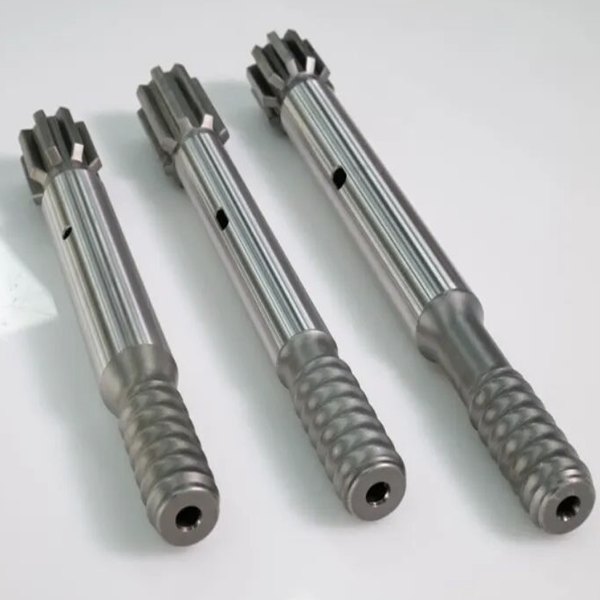
T51 is the heavy artillery. Fifty-one millimeters in diameter, 670 to 770 millimeters long, built for the largest hydraulic drifters on the largest tunneling jumbos and the hardest, most abrasive rock conditions.
The physics of why you need a T51 is straightforward: as piston impact energy increases — and modern high-power drifters can deliver well over 30 kilowatts of percussive power — the stress on the shank adapter increases proportionally. At some point, a T45 cross-section can't handle the cyclic loading without entering the low-cycle fatigue regime, where every blow is doing measurable fatigue damage. The T51's larger cross-section brings the stress back down into a range where the shank can survive thousands of meters of hard rock drilling.
The T51 is not a general-purpose shank. It's for specific applications: large-diameter holes — 89 to 127 millimeters and up — in hard, abrasive formations. Using a T51 where a T38 would suffice doesn't improve anything and adds unnecessary weight and cost. But where a T51 is required, nothing smaller will survive.
R32: The All-Rounder
If the T-series shanks are the specialists, the R32 is the generalist. Thirty-two millimeters in diameter, available in lengths from a stubby 202 millimeters out to 650 millimeters, the R32 shank covers everything from roof bolting to tunnel face drilling to small-scale production.
The R32's strength is its versatility. In a single shift, the same drill running an R32 shank might drill bolt holes in the morning and blast holes in the afternoon, switching between rod lengths and bit diameters without changing the shank. The smaller diameter makes it lighter, which is an advantage in hand-held and semi-mechanized drilling where every kilogram the operator has to manipulate counts.
The R32's threaded end typically uses R32 rope thread, and it drives the matching R32 drill rods that are the standard for bolting and light production drilling worldwide. The connection design is the same shouldered principle as the larger shanks, just scaled down for the smaller diameter.
R25: The Compact Specialist
The R25 shank adapter — 25 millimeters in diameter, available primarily in 202 and 205 millimeter lengths — is purpose-built for small hydraulic drifters like the S14BD and similar compact drills used in narrow-vein mining, small-section tunneling, and confined-space bolting.
The R25 uses a female thread — the rod screws into the shank rather than the shank screwing into the rod — which is unusual among rock drill shanks and worth noting because it changes the assembly sequence. The compact size means the shank has limited impact energy capacity, but in the small-diameter, short holes it's designed for, that's not a limitation — it's an appropriate match.
R38: The Bridge Between Worlds
The R38 shank adapter — 38 millimeters in diameter, 380 to 500 millimeters in length — sits between the R32 and T38 in terms of both physical size and application range. It offers more impact capacity than an R32 but in a package that's lighter and more compact than a T38.
The R38 is a good choice when the application calls for more durability than an R32 can provide but doesn't justify the weight and cost of stepping up to a T38. It's commonly found in medium-duty production drilling and in applications where the drill size or mounting configuration limits the shank diameter.
How to Choose: The Three Questions
When you're selecting a shank adapter — or replacing one that's worn out — three questions get you to the right answer faster than any catalog:
One: what does the drill manual specify? The manufacturer designed the drill around a specific shank diameter and length, and deviating from that spec changes the piston-to-shank impact dynamics in ways that are hard to predict and usually bad. If the manual says T38, use T38.
Two: what hole diameter and rock hardness are you drilling? Larger holes in harder rock need more impact energy, and more impact energy needs a larger shank cross-section. There's no formula that's universally agreed upon, but as a rough guide: holes under 64 millimeters in medium rock can be served by R32 or R38. Holes 64 to 89 millimeters in hard rock want T38 or T45. Holes above 89 millimeters in hard rock want T45 or T51.
Three: what rod system are you running? The shank's threaded end has to match the rod thread, not just in diameter but in thread profile and shoulder design. A T38 shank with an R-thread output won't connect to T-thread rods without an adapter, and adapters introduce another potential failure point in the string.