Shank Adapter Threads Worn Flat in a Week? The Problem Isn't the Steel
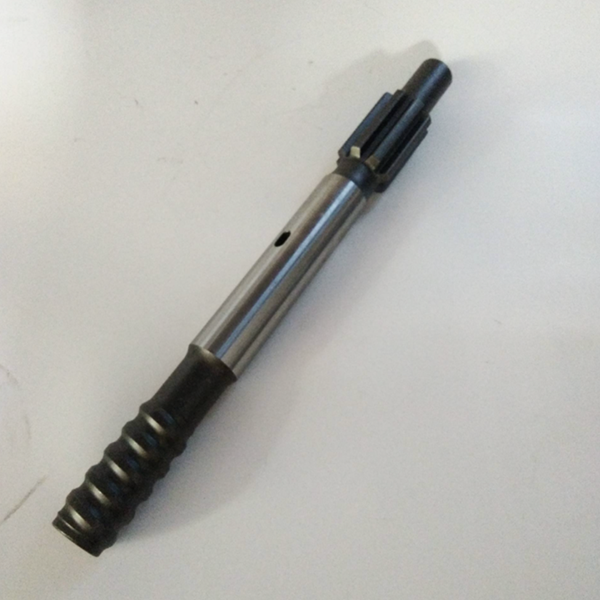
A contractor I know went through three shank adapters in a single month and was ready to blame the supplier. "The threads are garbage," he said. "Four or five days and they're gone."
So we looked at his rig settings. Impact pressure was maxed out, feed pressure was barely enough to keep the drill string in contact with the rock, and his operators had gotten into the habit of using the rig for scaling between blast cycles. The shank adapters weren't failing because the steel was bad. They were being fed into a meat grinder.
A shank adapter threads worn flat in under a week almost always points to one of two things — and neither of them is the metallurgy.
Mismatched Parameters: The Hidden Thread Killer
Every rock drill operates on a relationship between impact pressure and feed pressure. When those two are out of sync, the drill string bounces. The piston hammers forward, but instead of transferring energy through the shank adapter into the rock drill rod and down to the button bit, that energy ricochets back at the thread connection.
This is dry-firing — the tool isn't seated against the rock face, so the impact has nowhere to go except into the threads. Each blow acts like a micro-hammer on the thread flanks. Do that thousands of times per shift and a set of threads that should last months is gone in days.
The fix isn't complicated: dial your feed pressure up until the drill string stays engaged, then match your impact to the rock hardness. Harder rock can take more impact. Softer rock doesn't need it, and running impact too high in easy ground just beats up your connections for no gain. If you're not sure, start conservative and work up — threads are expensive tuition.
Bad Habits That Destroy Shank Adapters
Some jobsites use the drill rig for tasks it was never designed for. Scaling loose rock from the face. Pry-bar work. Starting holes at full impact before the bit has established a stable collar. Every one of these puts lateral and off-axis loads through the shank adapter threads that the thread profile was never engineered to handle.
A shank adapter is designed to transmit axial percussion — straight-line impact down the drill string. The moment you introduce bending, prying, or side-loading, you're concentrating stress at the root of the threads. That's where fatigue cracks nucleate, and once they start, the threads don't wear — they tear.
The rule is simple: the drill rig is for drilling. Use a scaler for scaling. And when you start a hole, ease in at low impact until the bit is collared and stable. Thirty seconds of patience at the start saves you from swapping a shank adapter mid-shift.
Why a Worn Shank Adapter Is Everyone's Problem
Here's what a lot of crews miss: a shank adapter with worn threads doesn't just fail on its own. It takes other components with it. The slop in the connection means impact energy isn't transmitting cleanly — some of it goes into the rock drill rod, some goes into the piston, some rattles around in the threads and turns into heat and vibration. That vibration walks upstream into the DTH hammer or drifter and downstream into the button bit, accelerating wear on everything in the string.
A twenty-dollar thread problem becomes a two-thousand-dollar repair bill if you let it ride.
What Actually Works
Check your shank adapter threads at the start of every shift. Look for flattening on the load flanks, galling, or pitting. If you can see visible wear on the thread profile, swap it out before it damages the mating components. Keep a spare on hand — they're small, they're cheap relative to the rest of the string, and having one ready means the difference between a five-minute change and a shift-killing delay.
And if a shank adapter fails in under a week, don't just replace it and move on. Look at your parameters. Watch how your operators are using the rig. Odds are the problem isn't sitting in the tool rack — it's sitting in the cab.