Shank Adapter vs. Hex Rod: Two Drill String Components That Sound the Same but Do Completely Different Jobs
In Chinese drilling terminology, 钎尾 (shank adapter) and 尾钎 (hexagonal intermediate rod) sound almost identical — just two characters swapped. On a job site, people use them interchangeably all the time. But in practice, they're different components sitting at different points in the drill string, doing different work, with different metallurgy and different failure modes. Confuse them when ordering spares and you'll get the wrong part every time.
The Hex Rod: An Intermediate Link, Not a Terminal One
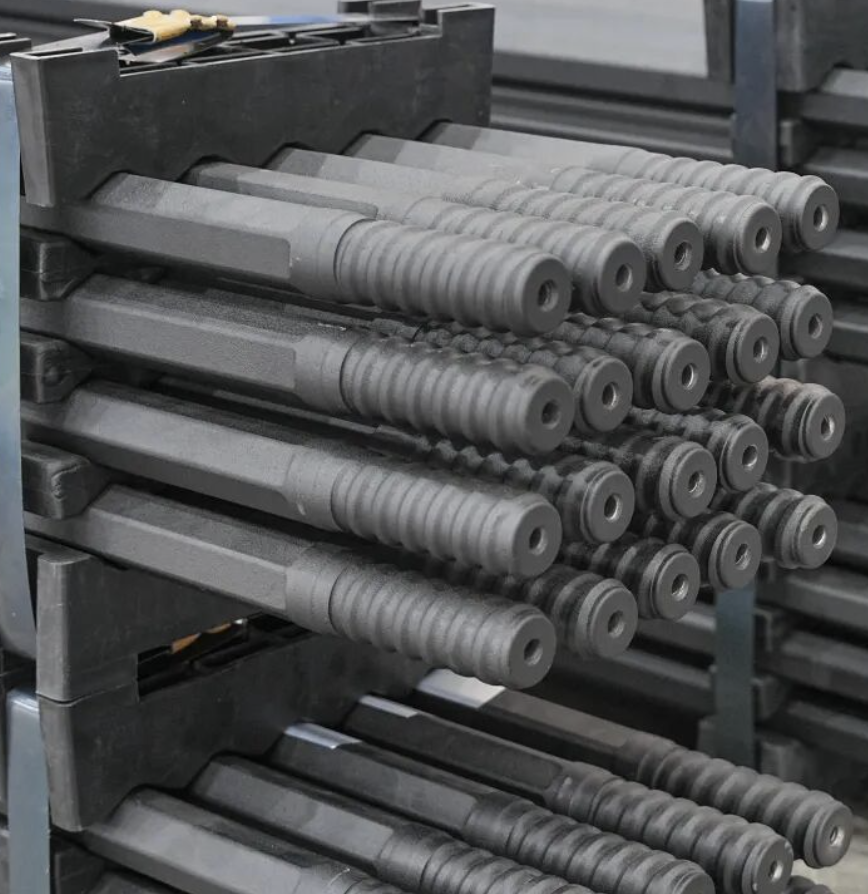
尾钎 — sometimes called a "tail rod" in rough translation — is a lightweight, hexagonal-section threaded drill rod designed for small-diameter drilling applications. It sits in the middle of the string, connecting the shank adapter at one end to the button bit assembly at the other. It's not the component that takes the piston impact directly. It's the component that passes that impact further down the line.
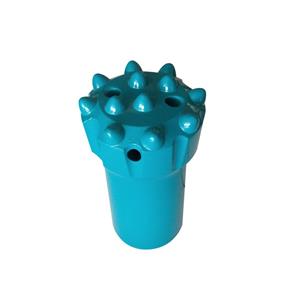
Hex rods see the most use in natural stone quarries, small-scale underground development, and tunneling where hole diameters are modest and the rig power class doesn't demand the heavier T-thread rod profiles. Compared to tapered rods or older-style quarry rods, a hex rod delivers better energy transfer and higher penetration efficiency — it's an evolution in rod design for the small-hole segment.
These rods are relatively simple in construction: a single piece of forged and heat-treated alloy steel with threads at both ends. They're consumables, not capital equipment.
The Shank Adapter: Where the Hammer Meets the Steel
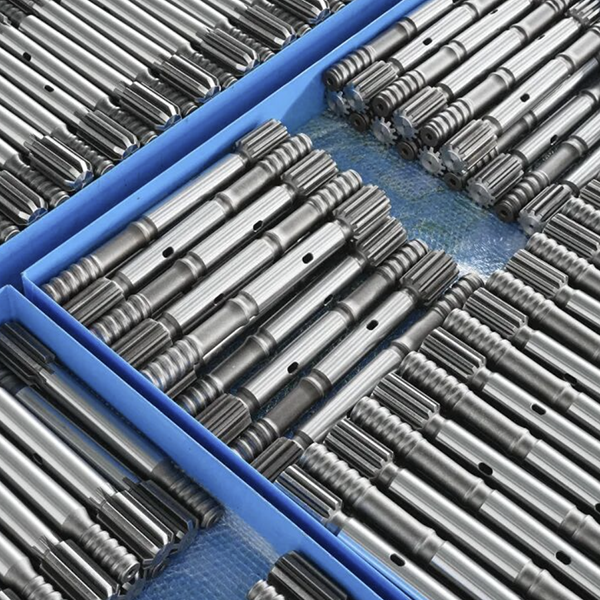
钎尾 — the shank adapter in English terminology — is an entirely different animal. This is the component that sits directly in the drill's front head, taking the full force of the piston impact with every blow and transmitting it into the first rod section. It's the most highly stressed single component in the entire drill string, and its metallurgy reflects that.
Shank adapters are made from premium-grade alloy steel, precision-machined for tight thread and spline tolerances, then subjected to full carburizing and quenching heat treatment — the entire body, not just the surface. After heat treatment, they're precision-straightened to ensure they run true in the guide bushing. A shank adapter that's even slightly bent will destroy itself and the bushing in short order.
The thread configuration matters for application. Male-thread shank adapters — where the threads are on the outside of the adapter nose — are the standard for light to heavy tunneling and development work where bending stress on the connection is a concern. The larger cross-section at the thread root handles off-axis loading better.
Female-thread shank adapters — where the threads are internal — make sense in tight-headroom situations, particularly underground roof bolting where the feed stroke is long and the workspace is cramped. The female configuration allows a shorter overall adapter length for the same thread engagement, buying you a few critical millimeters of clearance.
Why the Confusion Matters
Order "尾钎" when you need a shank adapter and you'll get a hex rod that won't fit in your front head. Order "钎尾" when you need a hex rod and you'll get a shank adapter that connects to nothing useful downstream. The parts look completely different, have different thread types, and sit in different positions in the string. The only thing they share is two Chinese characters in a different order.
For anyone sourcing drill string components — particularly across language barriers — a photo and a part number are worth more than a translated name. Know what you're looking at before you place the order.