Worn Shank Guide Bushing: How One Loose Component Destroys Everything Downstream
The shank guide bushing is one of those components nobody notices until it's already caused a chain reaction of failures. It's a simple steel ring pressed into the front head of a rock drill, with a precisely sized bore that supports and centers the shank adapter. Its entire job is to keep the adapter running true — aligned with the piston bore, square to the impact face, stable under load.
When it wears, everything downstream of it starts dying — not gradually, but in a cascade. Here's the damage chain, and why a bushing that costs a modest amount can protect tooling worth thousands.
The Bushing's Job: A Bearing That Takes a Beating
Think of the shank guide bushing as a linear bearing that's being hammered fifty times a second. The shank adapter reciprocates through it with every piston blow — forward on the power stroke, backward on the return — and the bushing bore is the only thing keeping that motion straight. The clearance between the bushing bore and the adapter shank is designed to be tight — typically a few hundredths of a millimeter — just enough for an oil film, not enough for the adapter to tilt.
Under normal conditions, the adapter runs true. The piston strikes the adapter's impact face square in the center. The impact energy travels in a straight line down the adapter, into the drill rod, into the drill bit, into the rock. All the forces are axial. All the components are loaded the way they were designed to be loaded.
When the bushing wears and the clearance opens up beyond its service limit, that clean axial loading disintegrates. The adapter can now tilt — fractions of a degree, but fractions are all it takes.
The Spline Sleeve Takes the First Hit
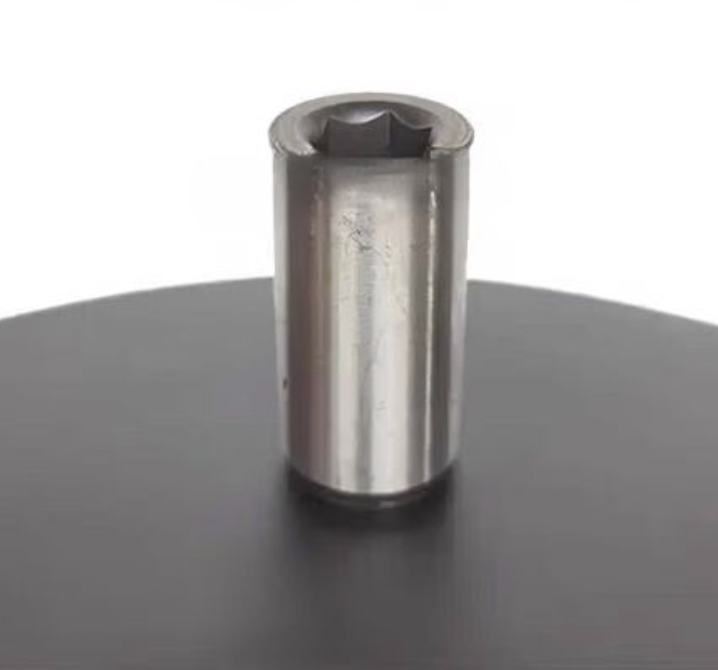
The component that suffers first is the triple-spline sleeve — the internally splined coupling that transmits rotation from the drill's drive to the shank adapter's external splines. The spline sleeve is designed to handle pure torque. That's it. It's not designed for side loads. It's not designed for bending. It's not designed for the adapter trying to push it sideways with every blow.
When the adapter tilts because the guide bushing clearance is too large, the adapter's splined section deflects off-axis. The spline teeth that should be meshing evenly across their full face width are now loaded on one edge only. The contact pressure goes from distributed to concentrated. The spline faces wear unevenly — one edge polished bright, the opposite edge untouched. The spline sleeve's internal teeth develop the same pattern in reverse.
Once the spline faces start wearing unevenly, the clearance in the spline connection opens up — in addition to the clearance in the guide bushing. The adapter can now tilt even more. The spline wear accelerates. It's a feedback loop that ends with spline teeth stripped or the spline sleeve cracked.
Then the Piston
A tilted shank adapter means the piston isn't striking a flat, square impact face — it's striking an angled one. The piston's impact energy is delivered off-center, creating a side force that pushes the adapter further off-axis. The piston's own guide surfaces take asymmetric loading, wearing unevenly. The impact face of the adapter develops a wear pattern that's deeper on one side than the other — a telltale sign of off-axis impact that can be seen with the naked eye once you know to look for it.
Then the Seals
The front head seals that keep oil in and contaminants out depend on the adapter running concentric with the seal bores. When the adapter tilts, the seal lip is pushed sideways with every stroke. One side of the seal carries excessive load and wears rapidly. The other side loses contact and allows leakage. Oil leaks out. Water and dust leak in. The internal components that depend on clean lubrication start wearing from contamination.
The Diagnosis and the Fix
The symptom pattern is consistent: the spline sleeve shows uneven wear on the tooth faces. The shank adapter's impact face is worn deeper on one side. The front head seals are failing prematurely. And the guide bushing itself, when measured, shows clearance beyond the manufacturer's service limit.
The fix is also consistent: replace the guide bushing. And while you're replacing it, inspect the shank adapter — if the sealing surface or splines show damage from the off-axis running, replace the adapter too. Inspect the spline sleeve — if the teeth are unevenly worn, replace it. Inspect the piston impact face for off-center wear.
The bushing is the root cause, but the damage propagates. Replacing only the bushing after the cascade has started just puts a new bushing into a system where the other components are already compromised. The new bushing will wear faster because it's guiding an adapter with already-damaged splines and an already-angled impact face.
The lesson is simple and expensive to ignore: when the shank guide bushing wears, fix it immediately. Don't wait until the spline sleeve is howling, the seals are leaking, and the piston is scoring the cylinder bore. A bushing replacement takes minutes and costs very little. The cascade it prevents costs orders of magnitude more.