The Secret to Efficient Drilling with Three-Wing PDC Drill Bits
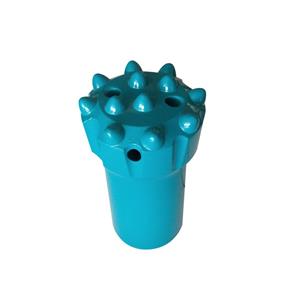
In geological exploration, coal mining, and many other underground engineering projects, the drill bit acts as the “Leader” that opens the way into the subsurface. Among the many types of drilling tools available, the three-wing PDC drill bit has become a preferred choice for drilling in soft to medium-hard formations thanks to its outstanding performance.
Its key advantages are clear: high drilling efficiency, long service life, stable operation, smooth cuttings removal, wide formation adaptability, and low overall cost. Though small in size, this drill bit embodies the engineering intelligence needed for efficient and reliable drilling.
High Performance Starts with Advanced Materials and Smart Design
The excellent performance of the three-wing PDC drill bit begins with its high-strength materials and scientifically optimized structure.
It uses polycrystalline diamond compact (PDC) cutters as its core cutting elements. PDC is a highly wear-resistant material with hardness second only to natural diamond. Its wear resistance is typically 20 to 40 times greater than that of conventional cemented carbide, and more than 10 times better than ordinary diamond drill bits in certain applications.
This outstanding material property allows the bit to maintain sharp cutting performance for a long time, even in relatively hard rock formations. It offers excellent abrasion resistance and impact resistance, which significantly reduces the need for frequent bit replacement and saves valuable drilling time.
Balanced Three-Wing Structure for Stable and Accurate Drilling
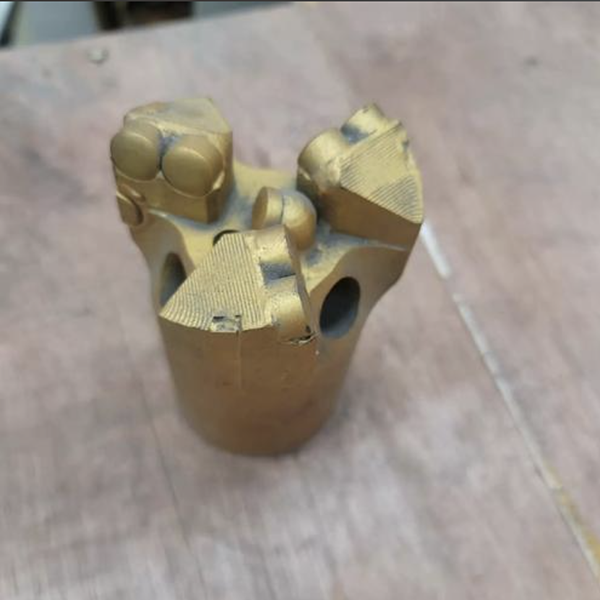
Another major advantage comes from the bit’s symmetrical three-wing design.
The three wings are evenly distributed at 120-degree intervals, which helps maintain radial force balance during rotation. This balanced structure greatly reduces vibration during drilling, minimizes hole deviation, and improves borehole straightness and verticality.
The stable design also enhances the bit's guiding performance, making it particularly suitable for directional drilling applications. When used together with a downhole motor, it provides a more stable tool face and helps the bit reach the target formation more accurately.
In addition, the bit features an integral one-piece structure with no moving parts, which greatly lowers the failure rate. Even in complex underground conditions, it can maintain reliable and stable performance.
Higher Drilling Efficiency in Real-World Applications
In actual drilling operations, the advantages of three-wing PDC drill bits become even more obvious.
The bit offers a larger cutting area, and the PDC cutters are fully exposed for efficient rock breaking. Compared with traditional drill bits, this design delivers much higher rock-breaking efficiency and can significantly improve the rate of penetration (ROP), helping shorten the overall project timeline.
Another important feature is the wide junk slots formed between the three wings. These channels allow rock cuttings to be discharged quickly and smoothly during drilling, effectively preventing cuttings accumulation, repeated crushing, and bit sticking. As a result, the drilling process becomes smoother, safer, and more efficient.
Better Borehole Quality with Less Rework
Borehole quality is another major strength of the three-wing PDC drill bit.
Because the cutting process is stable and produces less vibration, the drilled hole wall tends to be smoother and more complete. This reduces the need for additional operations such as reaming or hole repair, improving both construction quality and overall efficiency.
For contractors and drilling teams, this means less follow-up work, fewer complications, and lower extra costs during the project.
Lower Overall Drilling Cost
From a cost-performance perspective, the three-wing PDC drill bit offers excellent value.
The footage drilled by a single bit can be several times greater than that of a traditional carbide bit, which greatly reduces the number of bit trips and saves substantial labor time.
Even when the cutters become worn, the bit can often be repaired by re-welding or cutter restoration, and the restored performance can remain close to that of a new bit. This helps reduce consumable waste and further lowers the overall drilling cost.
Conclusion
With its core advantages of high penetration rate, long service life, stable guidance, efficient cuttings removal, wide application range, and low comprehensive cost, the three-wing PDC drill bit has become a reliable tool for efficient drilling in geological exploration, coal mining, hydrogeological drilling, and related fields.
Powered by advanced materials and practical engineering design, this drill bit helps make underground resource exploration and construction more efficient, more economical, and more dependable.