Why Your Threaded Drill Bits Die: A Failure Analysis That Reads the Damage
A drill bit that wears out gradually and gets retired at the end of its service life is doing its job. A bit that loses inserts in the first ten meters of hole, or snaps at the thread root on the third shift — that's not a bit problem. That's a signal.
Here's the number that should make you think: on a well-designed bit run under proper conditions, 16% to 67% of retirements are normal wear. The better the bit, the higher that percentage. If your normal-wear ratio is sitting at the low end, or if you're seeing insert failures and body fractures as routine rather than exceptions, something in the chain — selection, operation, or supplier quality — is off.
Let's work through the four ways threaded bits fail, and what each one actually means.
1. Broken and Chipped Inserts — The Sudden Ones
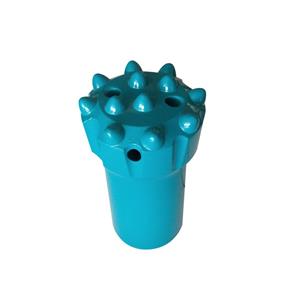
A carbide insert that shatters or chips didn't just "have a bad day." One of four things happened:
Wrong bit for the rock. The most common cause, and the most avoidable. Hard, abrasive formations need inserts with higher wear resistance — typically lower cobalt content, finer grain size. Fractured, blocky ground needs inserts with higher toughness — more cobalt, coarser grain. If you're chipping inserts in abrasive ground, the grade is probably too soft. If you're chipping inserts in fractured ground, the grade is probably too brittle. The rock tells you what grade to run. You just have to listen before you order.
Internal carbide quality issues. Not all tungsten carbide is created equal. Raw material purity, grain size distribution, and sintering quality all affect insert toughness. A batch of inserts from a supplier who cut corners on powder quality or sintering time will chip at impact energies that a properly made insert handles without complaint. This is hard to diagnose in the field, but if a batch of bits from the same supplier all fails the same way in conditions where other brands survive, the carbide is the variable.
Manufacturing damage during bit assembly. Pressing inserts into a bit body is a high-precision operation. Too much interference and the insert body is under residual tensile stress before it ever sees rock — a preload that adds to impact stress and reduces the margin to fracture. Damage to the insert during handling or pressing — micro-cracks from improper fixturing, for example — become macro-cracks after a few hundred blows.
Operator error at the face. Collaring a hole with too much feed pressure slams the bit into uneven rock before it's stabilized. Running a bit with dulled, flattened inserts multiplies the impact stress because the energy concentrates on a smaller contact area. Both are preventable with training and attention, but both happen constantly on sites where speed pressure overrides procedure.
2. Insert Fallout — The Press-Fit Problem
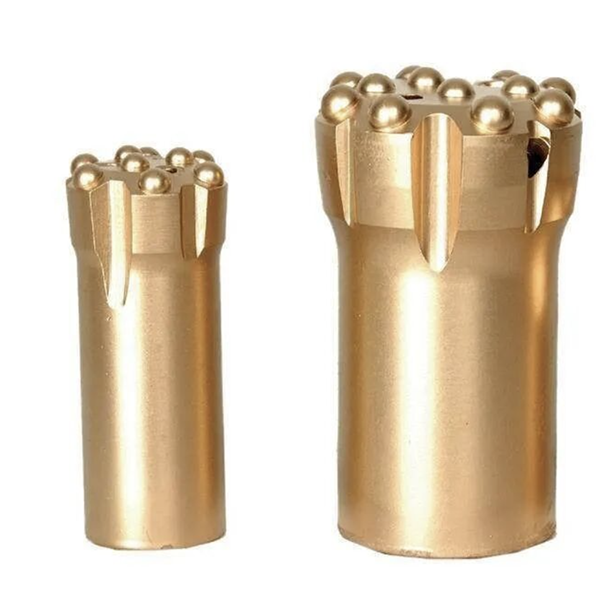
An insert that comes out of the bit body in the first few meters is almost certainly a manufacturing defect. The interference fit — how much larger the insert is than the hole it's pressed into — is wrong, or the hole geometry was off, or the pressing operation introduced damage.
An insert that falls out toward the end of the bit's life, especially a gauge-row insert, tells a different story. The outer edge of the gauge row takes the most wear and the highest bending loads. If the gauge-row geometry — the flank angle, the relief, the insert protrusion — isn't optimized for the formation, those outer inserts see higher loads than the face-row inserts. They wear faster, and once the wear reaches a point where the insert body is no longer fully supported by the bit steel, they work loose.
A face-row insert that fails while the gauge row is fine usually points to a face design issue — the insert placement pattern puts too much load on a single button, or the flushing groove layout causes uneven cooling and thermal stress.
The ideal: inserts and bit body wear at roughly the same rate. When the body steel erodes faster than the inserts, the inserts stand proud and take higher bending loads. When the inserts wear faster than the body, the body takes the rock contact and glazes over. Synchronized wear buys the longest bit life.
3. Bit Body Fracture — The Structural One
Bit body fractures are almost always fatigue failures. The body sees millions of impact cycles, and if the stress at any point exceeds the fatigue limit of the steel, a crack initiates and grows.
Seven things contribute:
Material selection. A bit body steel needs enough tensile strength to carry the impact loads and enough fatigue resistance to carry them millions of times. Cheap steels with low fatigue limits crack early.
Geometry. Sharp corners, abrupt section changes, and insufficient fillet radii concentrate stress. A well-designed bit body transitions smoothly between sections, with generous radii at every shoulder. If you're seeing fractures originate at the same geometric feature across multiple bits, the design has a stress concentration problem.
Heat treatment. The body needs a specific hardness profile: hard enough at the surface to resist abrasive wear from cuttings, tough enough in the core to resist fatigue crack propagation. Undertempered steel is brittle. Overtempered steel is soft. Both fail early, in different ways.
Surface finish. Deep machining marks, sharp tool grooves, and unblended transitions act as fatigue crack initiation sites. A bit body with a rough finish is pre-cracked, essentially.
Thread design. The thread that connects bit to rod is a natural stress concentration. Wall thickness behind the thread root, thread profile, and the transition from the threaded section to the body all affect fatigue life.
Rod-to-bit fit. If the rod thread and bit thread don't match — different manufacturers, different tolerance classes — the load distributes unevenly across the engaged threads. The first thread takes a disproportionate share and fatigues first.
Steel cleanliness. Inclusions in the steel — oxides, sulfides, non-metallic particles — act as internal stress concentrators. A clean steel with low inclusion content has a higher fatigue limit than a dirty steel with the same chemistry and hardness.
4. Normal Wear — The Good Kind
A bit that drills until the inserts are worn flat and won't penetrate anymore died the right death. The inserts wore gradually, the body steel eroded in step with the carbide, and nothing broke catastrophically.
A site where 60% or more of bits retire from normal wear is a well-run site. The bits match the rock. The operators know what they're doing. The supplier is delivering consistent quality.
If that number is below 30%, something else is dominating your failure mix — broken inserts, fallen inserts, or body fractures. Each of those has different root causes. Figure out which one is your biggest category, and work the diagnostic backward from there.
The bit doesn't care why it failed. But you should.