How a Tricone Bit Actually Breaks Rock: The Two Mechanisms Happening at the Bottom of Your Hole
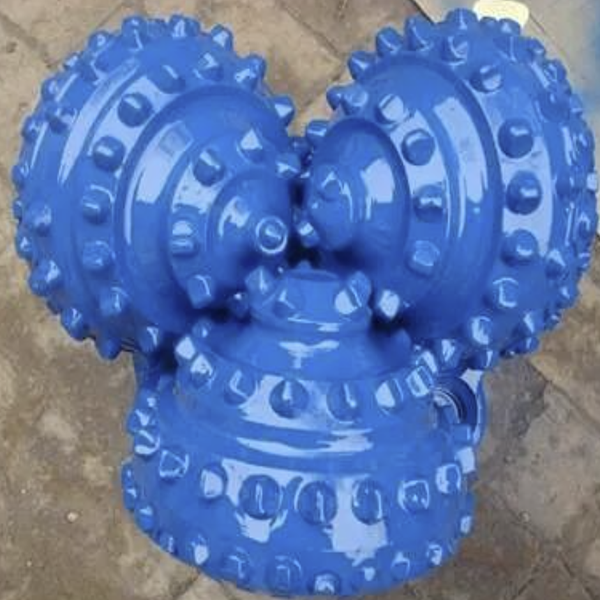
A tricone bit looks simple from the outside. Three cones, rows of teeth, a threaded connection at the top. Spin it, push down, rock breaks. End of story.
But what's happening at the bottom of the hole is more interesting — and understanding it explains why a tricone designed for soft shale will destroy itself in hard granite, and vice versa. The bit uses two distinct rock-breaking mechanisms at the same time, and the balance between them is what makes one bit design right for limestone and another right for chert.
The Setup: Revolution and Rotation
The bit body turns around the drill string axis — that's revolution, the obvious motion. But each of the three cones also spins independently on its own bearing axis. As the bit body rotates, the cones roll across the bottom of the hole like three little wheels.
This dual motion matters because it determines how the teeth contact the rock. A cone tooth doesn't just press into the formation. It rolls into contact, presses through the bottom, and rolls out. The contact pattern oscillates between single-tooth and double-tooth contact as the cone rolls, which creates a rhythmic loading cycle.
Mechanism One: Impact and Crushing
As the cones roll, the number of teeth in contact with the bottom alternates between one and two. When a single tooth carries the load, the cone center drops slightly. When two teeth share the load, the cone center rises. This constant up-and-down motion — at the frequency of tooth engagement, which can be hundreds of cycles per minute — creates a longitudinal vibration in the entire drill string.
Here's the elegant part: the drill string acts like a spring. The vibration compresses and extends the steel elastically, storing and releasing energy with each cycle. That oscillating elastic energy transmits through the teeth into the formation as a series of impact blows. The bit isn't just pressing on the rock — it's hammering it, using the drill string itself as the energy storage and release mechanism.
Impact and crushing is the primary rock-breaking mechanism in tricone bits. It's what does the heavy lifting in medium to hard formations. The teeth concentrate the weight on bit into very small contact areas — thousands of PSI at the tooth tip — and the rock fails in compression beneath each tooth.
Mechanism Two: Shearing and Scraping
If the cones only rolled purely, they'd just crush. But most tricone designs introduce controlled sliding as the cones roll, and that sliding scrapes rock off the bottom the way a drag bit does.
The sliding comes from three geometric tricks built into the cone and bearing design:
Cone offset means the cone apex doesn't point at the exact center of the bit. The cone axis is deliberately offset from the bit centerline. As the cone rolls, this offset forces the outer teeth to slide tangentially across the bottom — a scraping action in the direction of rotation.
Compound cone profile means the cone isn't a perfect cone. Different sections of the cone have different angles. The teeth at the transition between cone angles can't roll purely because the surface geometry doesn't match — they have to slide. This creates additional tangential scraping, particularly effective in the gauge area where hole wall quality matters most.
Journal offset angles the cone bearing axis so the cones don't point straight at the center. This introduces an axial sliding component — the teeth scrape sideways relative to the direction of rotation. Journal offset generates the shearing action that cuts through softer, more plastic formations.
How the Design Maps to the Formation
Here's the key design rule that determines whether a tricone bit works in a given formation:
Soft to medium-hard formations (shale, soft limestone, unconsolidated sandstone): maximum shearing action. The bit design includes cone offset, compound cone profiles, and journal offset. All three sliding mechanisms are engaged. The teeth scrape aggressively, removing rock through a combination of shearing and light crushing. Tooth spacing is wide to prevent balling in sticky formations.
Medium-hard to hard formations (dolomite, hard limestone, medium sandstone): moderate shearing. The bit includes cone offset and compound cone profiles, but no journal offset. Sliding is reduced. Crushing becomes the dominant mechanism, with shearing providing supplementary removal. Tooth spacing tightens.
Very hard, abrasive formations (granite, quartzite, chert): zero intentional sliding. The bit uses single-cone profiles with no offset and no journal offset. The cones roll as purely as possible. All rock removal is by crushing — high contact stress, low sliding, maximum tooth durability. Teeth are short, closely spaced, and made of the hardest carbide grades available.
If you put a soft-formation bit (lots of offset, lots of sliding) into hard granite, the teeth scrape instead of crushing. Carbide on granite at high sliding velocity wears the teeth to nubs in short order. Conversely, a hard-formation bit (no offset, pure rolling) in soft shale crushes without scraping and drills slowly because shale responds better to shearing than to compression.
What This Means When You're Buying
The tricone bit market is segmented by formation hardness for exactly this reason. An IADC code on a bit doesn't just tell you the bearing type and tooth material — it encodes the geometric design philosophy: how much offset, what cone profile, whether journal offset is present. Two bits with the same diameter and the same thread can be fundamentally different machines underneath, optimized for different rock.
When someone tells you a tricone bit "didn't work" in a particular formation, ask which IADC code they were running. Nine times out of ten, the bit wasn't bad — it was the wrong design for the rock.