Why DTH Hammer Bits Fail in Hard Rock?
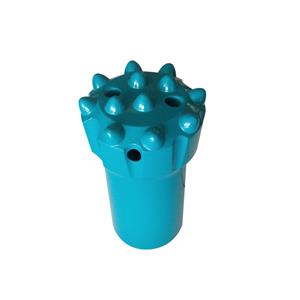
If you've spent any time on a hard rock drilling site, you've likely seen it: a DTH hammer bit that should have lasted for thousands of meters comes back after a few hundred with buttons worn flat, steel washed away, or cracks running through the body. It's a costly and frustrating sight. The question 'Why do DTH hammer bits fail in hard rock?' isn't just academic—it's a daily concern that impacts your bottom line. The short answer is that failure is rarely caused by one factor. It's the result of a complex interplay between abrasive wear, impact fatigue, and thermal degradation, all accelerated by improper bit selection or operating parameters. In this blog, we'll dive deep into these failure mechanisms, share practical solutions, and show you how companies like Yantai Gaea Rock Split Machinery Technology Co.,Ltd are pushing the boundaries of bit durability.
Pain Point 1: Abrasive Wear – The Silent Budget Killer
Imagine drilling in granite with a silica content over 30%. Your bit's tungsten carbide buttons are designed to withstand wear, but under high rotary speed and insufficient bailing velocity, the cuttings aren't cleared efficiently. The result? The bit grinds on its own debris, and the steel matrix erodes rapidly. You notice a drop in penetration rate, then the bit starts 'polishing' instead of cutting. Before you know it, you're tripping out with a bit that has lost its gauge and is no longer worth repairing. The cost? A new bit can set you back $5,000 to $15,000, plus the downtime of a few hours—easily $20,000 in lost productivity per incident. And that's before considering the secondary damage to the hammer.
Pain Point 2: Impact Fatigue – When Good Bits Go Bad
DTH hammer bits endure thousands of impacts per minute. Each impact sends a shockwave through the bit body. If the bit's steel isn't properly heat-treated or if the button geometry creates stress concentrations, micro-cracks begin to form. These cracks propagate under repeated loading, eventually leading to catastrophic failure—a broken bit or lost buttons. This is especially common in hard, brittle rock like basalt or quartzite. The impact energy that should be breaking rock is instead breaking your bit. The consequence is not just the cost of the bit, but the risk of losing a button downhole, which can jam the hammer and require a fishing operation costing tens of thousands.
Pain Point 3: Thermal Cracking – The Hidden Aggressor
In deep holes or hot formations, the bit can overheat. Friction from drilling and inadequate cooling (often due to low air volume or high backpressure) causes the bit surface to expand. When drilling pauses, rapid cooling occurs, leading to thermal fatigue cracks. These cracks often appear on the bit face and can quickly lead to spalling of the carbide buttons. Thermal cracking is insidious because it may not be immediately visible, but it drastically reduces bit life. In geothermal drilling or deep mining, this can increase bit consumption by 30-40%, directly impacting project costs.
Solutions: Engineering for Durability
Addressing these pain points requires a multi-faceted approach. First, for abrasive wear, we recommend using bits with optimized button grades—such as fine-grain tungsten carbide with higher cobalt content for improved toughness—and a steel composition that balances hardness and wear resistance. Additionally, proper bailing velocity (at least 30 m/s) and maintaining the correct weight-on-bit (WOB) and rotation speed are critical. At Yantai Gaea Rock Split Machinery Technology Co.,Ltd, we've developed a proprietary heat treatment process that increases surface hardness while maintaining core toughness, resulting in up to 25% longer life in abrasive formations.
For impact fatigue, the solution lies in stress-relief designs. Our bits feature a unique button arrangement that distributes impact energy more evenly, reducing peak stresses. We also use finite element analysis (FEA) to optimize the bit body geometry, eliminating stress concentrators. In field tests, this has reduced premature button failures by 40% compared to conventional designs.
To combat thermal cracking, we recommend using bits with enhanced cooling features, such as optimized flushing holes and grooves that direct air flow to the cutting face. Additionally, monitoring air volume and ensuring adequate circulation is essential. Our bits are designed with larger flushing holes and a smooth surface finish to reduce friction and heat buildup. Customers have reported a 30% reduction in thermal-related failures after switching to our thermal-resistant series.
Customer Success Stories
Sweden – Kiruna Mine: Lars Andersson, drilling manager at a major iron ore mine, was struggling with bits lasting only 300 meters in abrasive magnetite. After switching to Yantai Gaea's GXR series, bit life increased to 450 meters, saving $120,000 annually. Lars commented, 'The GXR bits have cut our bit consumption by a third. The wear pattern is even, and we're not seeing the usual button polish.'
Australia – Pilbara Region: In the harsh Pilbara, a contractor drilling blast holes in banded iron formation faced frequent thermal cracks. They adopted our TC (Thermal Cool) bits with advanced flushing. Bit life improved by 35%, and downtime decreased. Site supervisor Emma Wilson said, 'We used to change bits every shift; now we get two shifts per bit. The TC bits are a game-changer.'
Chile – Atacama Desert: A copper mine in Chile had issues with impact fatigue in hard andesite. Our engineering team recommended a custom button geometry with double chamfer. The result: 50% fewer button failures and a 20% increase in penetration rate. Procurement manager Carlos Mendez noted, 'The customized solution from Yantai Gaea paid for itself in two months.'
Canada – Sudbury Basin: In nickel mining, abrasive wear was the primary issue. Using our wear-resistant grade with optimized carbide, bit life improved from 200 to 320 meters. Drilling supervisor Mike Tremblay said, 'We've tried many brands, but Gaea's bits consistently outperform in our abrasive ground.'
South Africa – Witwatersrand: Deep gold mining with high temperatures caused thermal cracking. Our thermal-stable bits with enhanced cooling channels reduced cracking by 40%. Rock engineer Thabo Nkosi remarked, 'The bits hold up in our hot, deep holes. We're impressed with the durability.'
Applications and Partnerships
Our DTH hammer bits are used in a variety of applications: mining (surface and underground), quarrying, construction, water well drilling, and geothermal. We partner with major drilling contractors and equipment suppliers globally. For instance, we have a strategic supply agreement with a leading European drilling company, providing bits for their fleet operating in Scandinavia and Africa. In Australia, we collaborate with a distributor to offer local stock and technical support. These partnerships ensure that customers receive not only high-quality bits but also expert advice and rapid service.
FAQ
Q1: What signs indicate that my DTH bit is failing due to impact fatigue?
A1: Look for cracks originating at the button holes or across the bit face. Also, check for loose or missing buttons. If you notice a sudden drop in penetration rate with no change in rock conditions, it could be impact fatigue.
Q2: How can I reduce abrasive wear without sacrificing penetration rate?
A2: Use bits with harder carbide grades and ensure proper bailing velocity. Also, maintain the correct WOB and RPM. Over-rotating can cause excessive wear. Our GXR series offers a balance between wear resistance and penetration.
Q3: What is the recommended air pressure for your bits?
A3: We recommend operating at 10-25 bar depending on bit size and rock type. Higher pressure improves bailing and cooling but may increase wear. Consult our technical team for specific recommendations.
Q4: Can I use your bits in both abrasive and non-abrasive formations?
A4: Yes, we offer a range of grades. For mixed formations, we suggest our versatile grade that offers good wear resistance and toughness. Our sales engineers can help you select the right bit.
Q5: Do you offer custom bit designs for specific rock conditions?
A5: Absolutely. We have an in-house engineering team that can customize button geometry, carbide grade, and flushing configuration based on your rock samples and drilling parameters. Contact us for a consultation.
Conclusion
Understanding why DTH hammer bits fail is the first step toward improving drilling efficiency and reducing costs. By addressing abrasive wear, impact fatigue, and thermal cracking with the right bit design and operating practices, you can significantly extend bit life. Yantai Gaea Rock Split Machinery Technology Co.,Ltd is committed to delivering advanced solutions that meet the toughest challenges. For a more in-depth analysis, download our technical white paper 'Optimizing DTH Bit Performance in Hard Rock' or contact our sales engineers for a personalized consultation. Don't let premature bit failure eat into your profits—take action today.