Why Should Rock Drill Shanks Be Selected More Carefully?
Why Should Rock Drill Shanks Be Selected More Carefully?
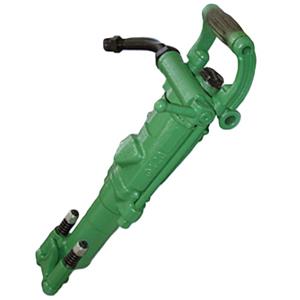
A rock drill shank is a core power-transmission component positioned between the rock drill piston and the drill rod. It transfers impact energy and rotational torque while operating under high loads, severe wear, and corrosive conditions.
During drilling, the shank adapter continuously receives high-frequency piston impacts. The impact frequency can reach 6,300 blows per minute. Repeated alternating compressive and tensile stresses can easily initiate fatigue cracks. Therefore, the shank must provide excellent fatigue resistance, continuously transmit impact energy and rotational torque, minimize energy loss, and prevent premature fracture.
Underground drilling conditions are even more demanding. Flushing water often contains minerals, sulfides, and other impurities, giving it strong corrosive potential. As the medium enters through the drilling-tool passage, it can cause electrochemical corrosion on the shank’s internal and external surfaces, splines, and threaded mating areas. Corrosion damages the material surface and creates pits that can become starting points for fatigue cracks.
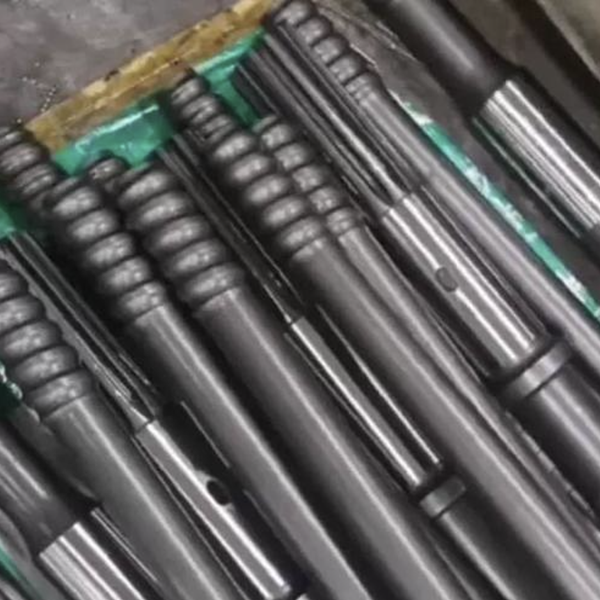
The shank also experiences continuous friction and wear between spline pairs. Impact, friction, and corrosion act together. If material quality is inadequate or surface protection fails, spline spalling, thread damage, and fracture may occur, resulting in equipment downtime.
For this reason, shank materials, heat treatment, and surface treatment must balance impact resistance, fatigue resistance, corrosion resistance, and wear resistance. Careful selection helps reduce spare-part consumption and improve the continuity of underground rock drilling operations.