How to Choose the Right DTH Bit: A Practical Guide to Face Design, Rock Type, and Air Pressure
Walk into the market for a DTH bit and the choices can become confusing quickly.
High-pressure bits. Low-pressure bits. Convex faces. Flat faces. Concave centers. Different button layouts, materials, diameters, and prices.
Manufacturers may all describe their products as durable or high-performance. But a bit that works well in one quarry can wear quickly or drill poorly in another. The right choice depends on the relationship between the bit, the hammer, the compressor, and the rock.
Start with the DTH Hammer and the Rock
DTH bits are commonly divided into high-pressure and low-pressure series.
The hammer’s operating pressure affects the bit’s impact conditions, air consumption, drilling speed, and flushing performance. A bit designed for a high-pressure DTH hammer should not automatically be installed on a low-pressure system, or the other way around.
Rock conditions matter just as much:
Hardness
Abrasiveness
Fracturing
Drill hole diameter
Required hole straightness
Cuttings removal conditions
The carbide button shape and button layout should be selected according to these factors. Choosing a DTH bit by price or appearance alone usually leads to an expensive lesson.
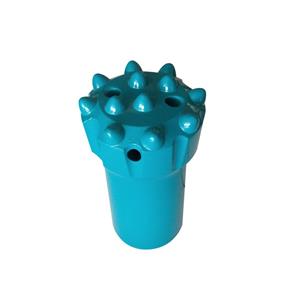
Four Common DTH Bit Face Designs
The face geometry controls how the bit contacts the rock, how it stays centered, and how efficiently it removes cuttings.
1. Convex Face DTH Bits
Convex-face bits may use a single raised section or a double raised section. The double-convex design is commonly used on larger-diameter DTH bits.
Their main advantage is drilling speed in medium-hard, hard, and abrasive rock. The raised face concentrates impact energy and can provide an aggressive cutting action.
The tradeoff is hole straightness.
Convex bits may allow the hole to deviate more easily, especially in fractured or uneven formations. They are therefore less suitable for projects where blast-hole alignment is critical.
They can be a good choice when penetration rate is the priority and the drilling project has a relatively generous tolerance for deviation.
2. Flat Face DTH Bits
Flat-face bits are known for their robust and durable structure.
They are suitable for hard and very hard rock. They can also be used in medium-hard and soft rock when the project does not require exceptionally straight holes.
A flat face can tolerate demanding contact conditions and is often selected for general-purpose drilling. Its stable structure makes it practical where reliability and service life matter more than maximum penetration speed.
However, the best result still depends on correct button selection and adequate flushing. A durable face design cannot compensate for an undersized compressor or poor drilling alignment.
3. Concave Face DTH Bits
Concave-face bits have a conical depression in the center of the bit face.
This shape creates a mild self-centering effect during drilling. The central geometry helps the bit remain aligned, which generally produces straighter holes than an aggressive convex design.
Concave bits also offer good cuttings removal and fast drilling in a wide range of applications. This balance between penetration, hole straightness, and flushing performance is one reason they are widely used in the market.
They are often a practical choice for production drilling where both drilling speed and hole quality are important.
4. Deep Concave Center Bits
Deep-concave-center bits evolved from related button bit designs.
The center of the bit face has a deeper recessed area. During drilling, this geometry supports a centering effect and helps maintain hole straightness, particularly in deeper holes.
The limitation is formation range. These bits are mainly suited to soft and medium-hard rock. In very hard or highly abrasive formations, the face design may not provide the durability or impact distribution required for long service life.
Carbide Button Layout Matters
Face shape is only one part of the selection.
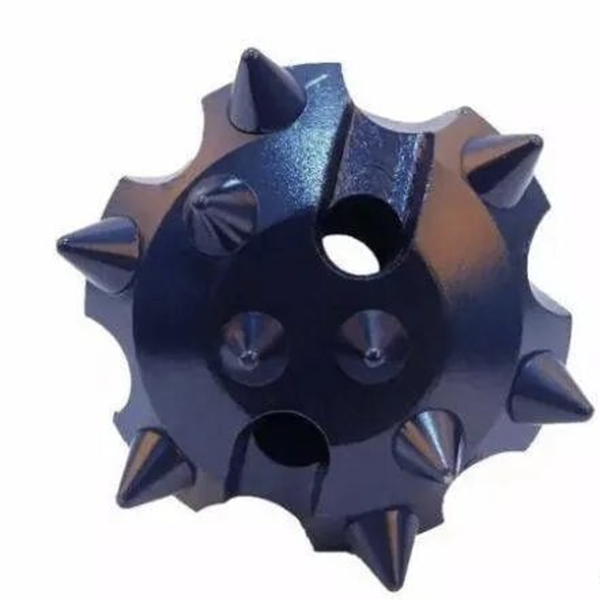
DTH bits may use spherical buttons, ballistic buttons, or a combination of button types. The layout determines how impact energy is transferred into the rock and how wear is distributed across the bit face.
Spherical buttons are commonly used when strength and resistance to impact damage are important. More aggressive button profiles may increase penetration in suitable formations but can be less tolerant of hard, abrasive contact.
A bit with the correct face shape can still perform poorly if the button profile does not match the rock.
Five Rules for Using a DTH Bit Correctly
1. Match the Bit to the Formation
Select the bit according to rock hardness, abrasiveness, hammer pressure, and drilling objective.
The same bit should not be expected to perform equally well in soft weathered ground and hard abrasive granite. Correct selection is the foundation of drilling speed and bit life.
2. Install the Bit Carefully
When installing the bit, place it smoothly into the chuck or bit retaining sleeve of the DTH hammer.
Do not strike the bit against the sleeve. Impact during installation can damage the bit shank, retaining components, or internal fitting surfaces before the bit even enters the hole.
3. Maintain Adequate Compressed Air
The DTH hammer needs enough compressed air to operate consistently and remove cuttings from the hole.
If the hammer starts working intermittently, or if cuttings are not clearing properly, inspect the compressor, air lines, connections, and flushing path.
Poor air supply reduces impact performance and allows rock debris to accumulate around the bit. That can slow drilling, increase wear, and create the risk of jamming.
4. Remove Metal Objects from the Hole
A piece of metal that falls into the hole can damage carbide buttons or become trapped between the bit and the rock.
Remove foreign metal objects as soon as they are discovered. A magnet or another suitable retrieval method may be used, depending on the hole condition and the object involved.
Do not continue drilling and hope the object will disappear.
5. Do Not Change to a New Bit Too Early
Monitor the finished hole diameter as the bit wears.
If the bit has become undersized but the hole has not reached its required depth, installing a new bit with a larger original diameter may create a step inside the hole. That increases the possibility of the bit sticking or becoming jammed.
Bit replacement should consider both button wear and actual hole size.
A Simple Selection Checklist
Before ordering a DTH bit, confirm:
Is it designed for a high-pressure or low-pressure hammer?
Is the rock soft, medium-hard, hard, or extremely hard?
How abrasive is the formation?
Is hole straightness a major requirement?
Is fast penetration more important than maximum durability?
Does the button profile suit the rock?
Is the bit shank compatible with the DTH hammer?
Can the compressor provide enough air for effective flushing?
The right DTH bit is not simply the most expensive bit or the one with the most aggressive face. It is the bit whose geometry, carbide buttons, shank, and operating pressure match the real drilling conditions.
Gaea Rock supplies DTH bits, DTH hammers, drill rods, and other rock drilling tools for mining, quarrying, water well drilling, construction, and earthwork projects. Contact our team for a DTH bit recommendation based on your hammer model, rock formation, hole diameter, and drilling requirements.