DTH Hammer Down Pressure: The Number on the Rig Gauge Is Lying to You
Three rods in, the hammer started sounding wrong. Not the sharp, rhythmic tak-tak-tak of a piston landing on a bit seated tight against rock — more of a muffled knock, the way a door sounds when the hinge is loose. The driller checked the feed gauge. Pressure was right where it should be, so he nudged it up a little. The sound got worse.
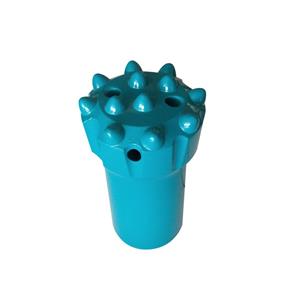
Two hours later they pulled the string. The bit had four carbide buttons popped clean out of the face, and the splines were blue from heat.
That crew had done everything by the book. The book was wrong.
I've spent enough years around DTH hammers to know this is the most common field mistake there is, and it eats bits, rods, and shift hours faster than almost anything else you can name. So here's what nobody told you about down pressure — and what I wish somebody had told me before I learned it on a contractor's budget.
What the gauge is actually telling you
Here's the thing most people get backwards. The pressure number on the rig does not tell you what the hammer feels at the bottom of the hole. It tells you what the rig is pushing at the top. Those are two different numbers, and the gap grows with every rod you add.
The hammer needs to stay pressed against the rock so the piston lands on a bit that isn't bouncing away. That pressure comes from two sources: what the rig feeds, plus the dead weight of the drill string hanging below it. By the time you're four or five rods deep, that string weight is doing a big share of the work. If you're setting feed pressure by the gauge and ignoring string weight, you're guessing — and the deeper you go, the worse your guess gets.
A rough way to keep it honest: start around 500 lbs per inch of bit diameter (about 9 kg per mm), and as you go deeper, subtract the rod weight from your opening pressure so the hammer's actual load stays roughly constant. It's a starting point, not a law. Ground conditions change, and so should your pressure.
Why hammer design matters before you ever drill a hole
Part of getting down pressure right is picking a hammer that behaves predictably, and that comes down to a few things you can check before the first collar:
Piston mass. A piston's weight should sit close to the bit's weight — a mass ratio in the 0.8 to 1.1 range is the sweet spot. Too heavy a piston relative to the bit and the hammer's overall output power drops. Too light and the piston rebounds off the bit, wasting energy and hammering efficiency right out of the bottom of the hole.
Simple construction. Under identical drilling conditions, a simpler hammer fails less often. Pistons are carburized and hardened steel, and every complex cut on their surface is a stress riser that cuts fatigue life. Fancy machining makes a good sales brochure; it does not make a longer-lasting piston.
Impact energy versus frequency. This is the trade you actually live with. A heavier piston with a longer stroke delivers more energy per blow — what you want in hard rock that needs real fracture energy to break. A lighter piston gives you a faster cycle, more blows per minute, but each one carries less punch. Since the hammer's power is roughly impact energy times frequency, there's no free lunch: you pick a hammer to match the ground, and the ground picks the tradeoff. As long as you're above the critical energy threshold for the rock, frequency is what wins you footage.
The two ways you can still get it wrong
Say you've got the hammer matched to the rock and a sensible starting pressure. You can still blow it in either direction, and both directions are expensive.
Too much pressure. Here's the one that surprises people: piling on more feed pressure does not increase penetration rate. The rock doesn't care how hard the rig shoves. It only cares how much energy the piston delivers. Extra weight past the useful point just hammers the bit harder into the rock and scrubs the carbide — shorter bit life, faster button wear, more cost per meter. Nobody who's paid for a set of buttons twice in one season needs this explained twice.
Too little pressure. The less obvious failure, and in some ways the nastier one. When the hammer isn't held firmly against the rock it starts to bounce and slide:
The bit slips during the blow cycle, and holes come out anything but vertical.
A sliding bit lets carbide buttons pop out of the face — the classic job-killer that leaves the piston striking air or stalling the whole hammer.
Straight-shank bits start to wander, the drill string drifts sideways, and the chuck splines and bit shank run hot. Once that heat damage sets in, failure isn't a question of if — it's a question of when.
Residual stress builds up in the hammer components, and you get vibration you can feel through the deck but can't tune out with any amount of feed.
Either way, the string comes out of the hole damaged and the meterage goes backwards.
What to actually do about it
None of this is glamorous, but it holds up:
Know your string weight. Don't set down pressure from the gauge alone.
Start at 500 lbs per inch of bit diameter and adjust from there — down as you go deeper, up only if the bit is visibly not engaging.
Match the hammer to the ground: fracture energy for hard rock, frequency for softer formations.
Trust the sound and the rate, not the dial. A hammer seated against rock sounds different from a hammer bouncing off it, and your ears on a steady formation are more reliable than most gauges.
This is one of those truths that applies no matter whose hammer you run — a Xuanhua-style 360, a valved import, or our own DTH line at Gaea Rock. The physics doesn't change with the nameplate.
If you're setting up a DTH rig and want to talk through matching a hammer and bit to your hole size and rock type, that's what we do every day at Gaea Rock. Tell us your diameter, your formation, and how deep you're going — we'll help you pick the combination that doesn't spend the season in the repair bay.